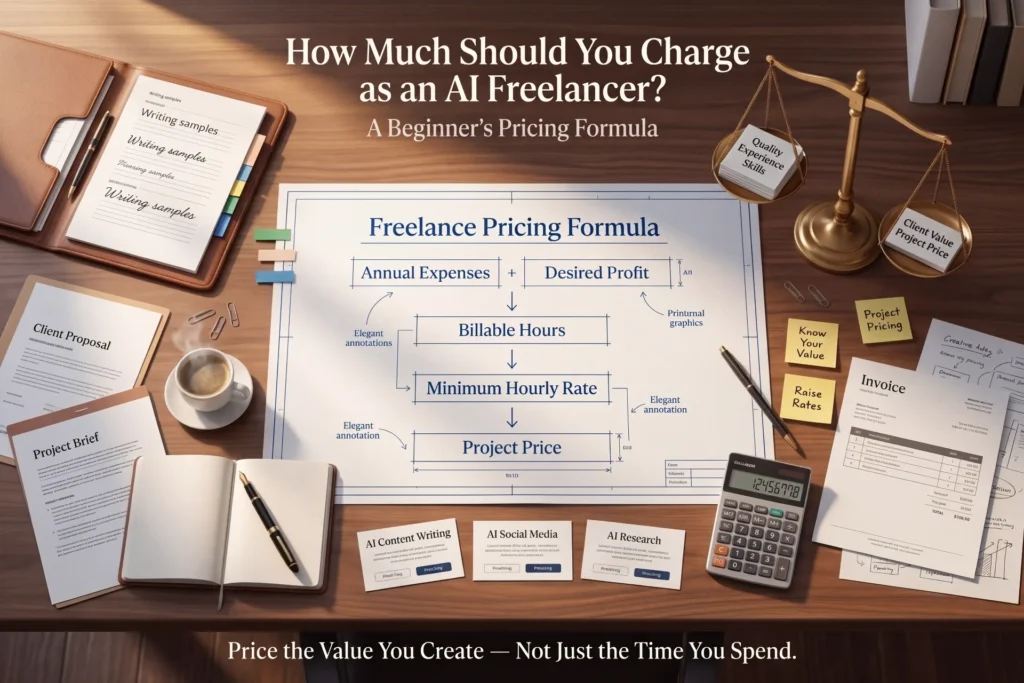
“This guide answers exactly how much to charge as an AI freelancer — the formula to calculate your minimum rate, real pricing tables for content writing, social media, and research, and why charging by the hour quietly punishes the speed advantage AI gives you.”
If you have already read our guide on AI Freelancing for Beginners, you know Stage 7 of the Arthify Freelancing Roadmap touches on pricing briefly — start at 50 to 70 percent of market rate, raise it after every five reviews, charge per project rather than per hour. This guide is the complete version of that idea, with the actual formula, real numbers, and the reasoning behind it, so you are not just picking a number that feels safe.
Most pricing advice online falls into one of two traps. It either throws out a random number with no explanation of where it came from, or it is written for technical AI developers charging $150 to $300 an hour, which has nothing to do with pricing a blog post or a social media content calendar. This guide is neither — it is built around the three services from our How to Build an AI Freelancing Portfolio With No Experience guide, with numbers that actually apply to your first ten projects.
Why Pricing Feels Scarier Than It Actually Is

Figuring out how much to charge as an AI freelancer feels different from every decision you have made so far in this journey, and here is exactly why.. Choosing a service had a clear right answer. Building a portfolio had a clear right answer. Pricing feels like it doesn’t — and that uncertainty is what actually causes the fear, not the number itself.
Underneath the fear are usually the same handful of questions:
- Am I about to price myself out of getting hired at all
- Am I about to undervalue work that is genuinely good
- Will a client laugh at my price, or worse, just go silent
- Should I just copy whatever the cheapest gig on Fiverr is charging
Every one of those is a confidence question dressed up as a math question. The good news is that once you have an actual formula behind your number, most of that fear disappears — not because the fear was irrational, but because a calculated number is much easier to stand behind than a guessed one.
The Formula Behind Every Freelance Rate
Every serious pricing resource, regardless of industry, ultimately points back to some version of the same formula:
(Annual expenses + desired profit) ÷ realistic billable hours = your minimum hourly rate
⚡ Rate Calculator
Calculate your real minimum
This is your floor, not your target — the number below which a project genuinely does not make sense for you financially, no matter how much you want the client.
- Add up your annual expenses — living costs if freelancing is your main income, tools and subscriptions, and taxes. If freelancing is part-time alongside another income, this number can be smaller, but do not skip it
- Decide your desired profit — what you actually want to take home beyond covering expenses
- Estimate realistic billable hours per year — not 40 hours a week for 52 weeks. Once you account for proposals, portfolio updates, and slower weeks, many freelancers estimate somewhere around 800 to 1,200 billable hours a year
- Divide (expenses + profit) by billable hours — this is your minimum hourly rate
A worked example: you want to earn $24,000 this year, and you realistically expect to bill 1,000 hours once proposals and slower weeks are accounted for. Your minimum hourly rate is $24,000 ÷ 1,000 = $24 per hour. A typical AI-assisted blog post takes you two hours, so your baseline project price is $48. Add a 25 percent buffer for revisions, and you land on roughly $60 per article as your calculated starting rate.
You will not announce your hourly number to clients. It is the private floor you check every project against, so you never accidentally take on work that costs you money once your real time and expenses are honestly accounted for.
Why Charging Per Hour Quietly Punishes Your AI Speed Advantage

This is one of the most important ideas in this entire guide, and very few beginner pricing guides explain it clearly — it is specific to freelancers using AI tools.
Imagine a blog post that used to take four hours manually now takes ninety minutes with AI-assisted drafting, using the exact workflow from AI Freelancing for Beginners. If you charge $20 an hour and bill actual time, that ninety-minute post now earns $30 instead of the $80 it earned at the old pace. You got faster. You got better with your tools. Your reward was a pay cut.
Here is the same idea as two side-by-side scenarios, using the identical article:
At month one, both models pay the same. In this example, by month six hourly billing cuts your earnings by more than 60 percent for identical output — while project pricing lets your growing speed become extra time for more clients, not a pay cut on this one.
The fix is straightforward once you see it clearly: price the deliverable, not the hours it personally takes you. A blog post is worth what it's worth to the client, regardless of whether it takes you ninety minutes or four hours. This is exactly why the pillar guide recommends project pricing from Stage 7 onward.
Turning Your Hourly Number Into a Project Price
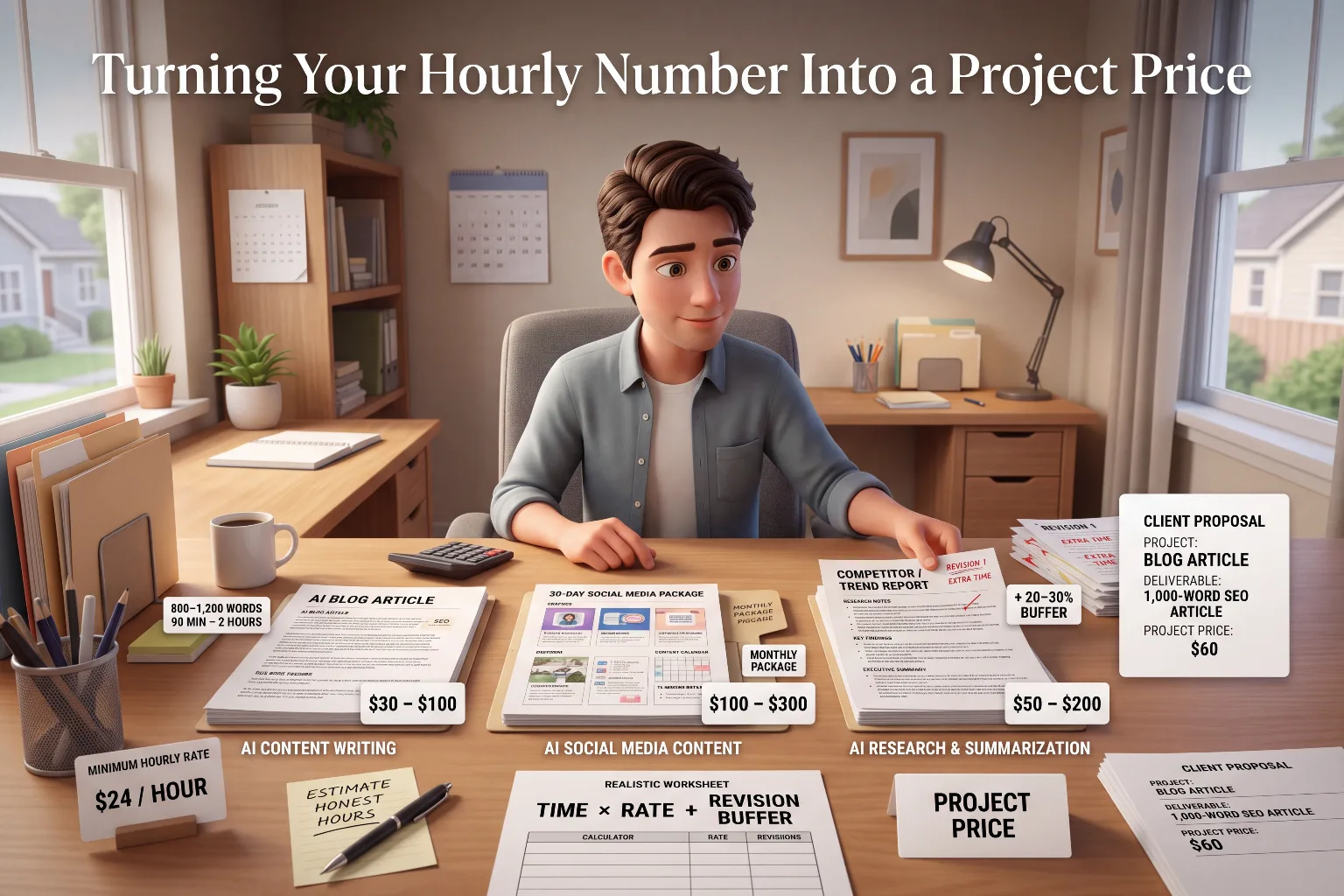
Once you know your minimum hourly rate from the formula above, converting it into a project price for each service is straightforward — estimate honest hours, multiply by your rate, add a buffer for revisions, then present it as one clear project price.
Pricing AI Content Writing
For most beginners using AI-assisted drafting, an 800 to 1,200 word blog post takes roughly 90 minutes to two hours once you have a workflow. Multiply that time by your hourly rate, add a 20 to 30 percent buffer for revisions, and a standard beginner blog post typically lands in the $30 to $100 range, with longer or more research-heavy pieces running higher — matching common beginner pricing patterns observed on freelance marketplaces such as Fiverr and Upwork.
Pricing AI Social Media Content
A full thirty-day content calendar with graphics, captions, and planning takes considerably longer than a single post, so price it as one complete monthly package rather than per post. Estimate total hours for the full deliverable, apply your rate plus buffer, and present a single monthly price — typically $100 to $300 for a beginner, scaling upward as you add strategy and more platforms.
Pricing AI Research and Summarization
Research reports vary in depth, so estimate hours honestly based on how many sources you review and how polished the final document needs to be. A focused competitor analysis or trend summary typically lands in the $50 to $200 range for a beginner, with more comprehensive reports commanding more.
If a project ends up taking noticeably longer than you estimated, that is useful data, not a failure. Define what is included before the project begins — a set number of revisions, a clear word count or deliverable — so scope is explicit from the start. Estimate slightly conservatively while you are still new, and your estimates will get sharper with every project you complete.
Beginner Pricing at a Glance
Use this table as a quick reference once you have calculated your own rate using the formula above.
These ranges are illustrative starting points based on common marketplace pricing patterns, not fixed industry standards — use the formula above to calculate the number that's actually right for you.
Beginner Pricing at a Glance
Tap a tier to expand
Why Fiverr's $5 Gigs Should Not Set Your Prices

Almost every beginner has the same panic moment — scrolling Fiverr and seeing "I will write 1000 words for $5," then wondering if that is actually the going rate they need to match.
It is not, and here is exactly why those listings exist and why copying them is a mistake.
- Many of the lowest-priced gigs belong to sellers still building their first few reviews, using an aggressively low price as a temporary strategy, exactly like the intro-pricing approach covered below — not their long-term rate
- Some are simply unsustainable, run by sellers who have not done the formula above and will burn out or quietly disappear once they realize the math does not work
- A small number are low-quality output at scale, relying on volume and refunds rather than genuinely satisfied repeat clients
- Racing to match the lowest price on the platform puts you in competition with sellers who have different costs, different countries, and different financial situations than you — a competition you cannot win by going lower, only by being clearly better
Your price should come from the formula in this guide, not from the lowest number you can find in a search results page. A client who only responds to $5 pricing was never going to become a sustainable long-term client regardless of what you charged.
Should You Charge Less for Your First Client

Yes — deliberately, and temporarily, not as your permanent rate.
Pricing at 50 to 70 percent of your calculated project rate for your first two to three clients is a reasonable, common strategy specifically to earn your first reviews, exactly as AI Freelancing for Beginners Stage 7 recommends. The distinction that matters is treating this as a conscious, temporary launch price — not quietly settling into it as your rate forever because raising it later feels uncomfortable.
Frame it internally as an introductory rate with a clear endpoint: after your first three to five reviews, move to your full calculated rate. Every client you take on afterward should know your current rate, not the one you started at.
What to Say When a Client Pushes Back on Your Price

Price pushback happens to every freelancer, and how you respond in the first month sets a pattern that either protects your rates or slowly erodes them.
- Do not immediately discount — a client who only responds to your lowest possible price is rarely a client worth keeping once you have other options
- Offer to adjust scope instead of price — "For that budget, the project would include the article and one round of revisions. To include additional research and a second revision round, the original price reflects that added work" reframes the conversation around value rather than making your number feel inflated
- If you do lower your rate for early clients specifically to build reviews, treat it as the deliberate, temporary launch pricing described above — not a permanent decision made under pressure
Discounting because a client asked signals your original price was not real. Adjusting scope for a smaller budget signals your price reflects genuine value — a small but important difference in how each is perceived.
When and How to Raise Your Rates

Raising rates feels risky for a beginner, but staying at your starting rate indefinitely is a far bigger risk to your long-term income than a client occasionally saying no to a higher price.
A simple, sustainable pattern: raise your rate by 15 to 20 percent after every five positive reviews. This creates steady, predictable growth without one large, anxiety-inducing jump. Apply new rates to new clients first — you do not need to immediately raise prices on existing clients you want to keep, though doing so gradually as the relationship grows is reasonable.
If you are never losing a potential project because your price felt slightly too high to someone, that is itself a signal you may be pricing below where the market would support you.
Once pricing is agreed, the next step is starting the project professionally. Our guide on What to Do After Your First AI Freelancing Client Says Yes walks through exactly what to send and collect before you begin.
Pricing Mistakes That Quietly Cap Your Income
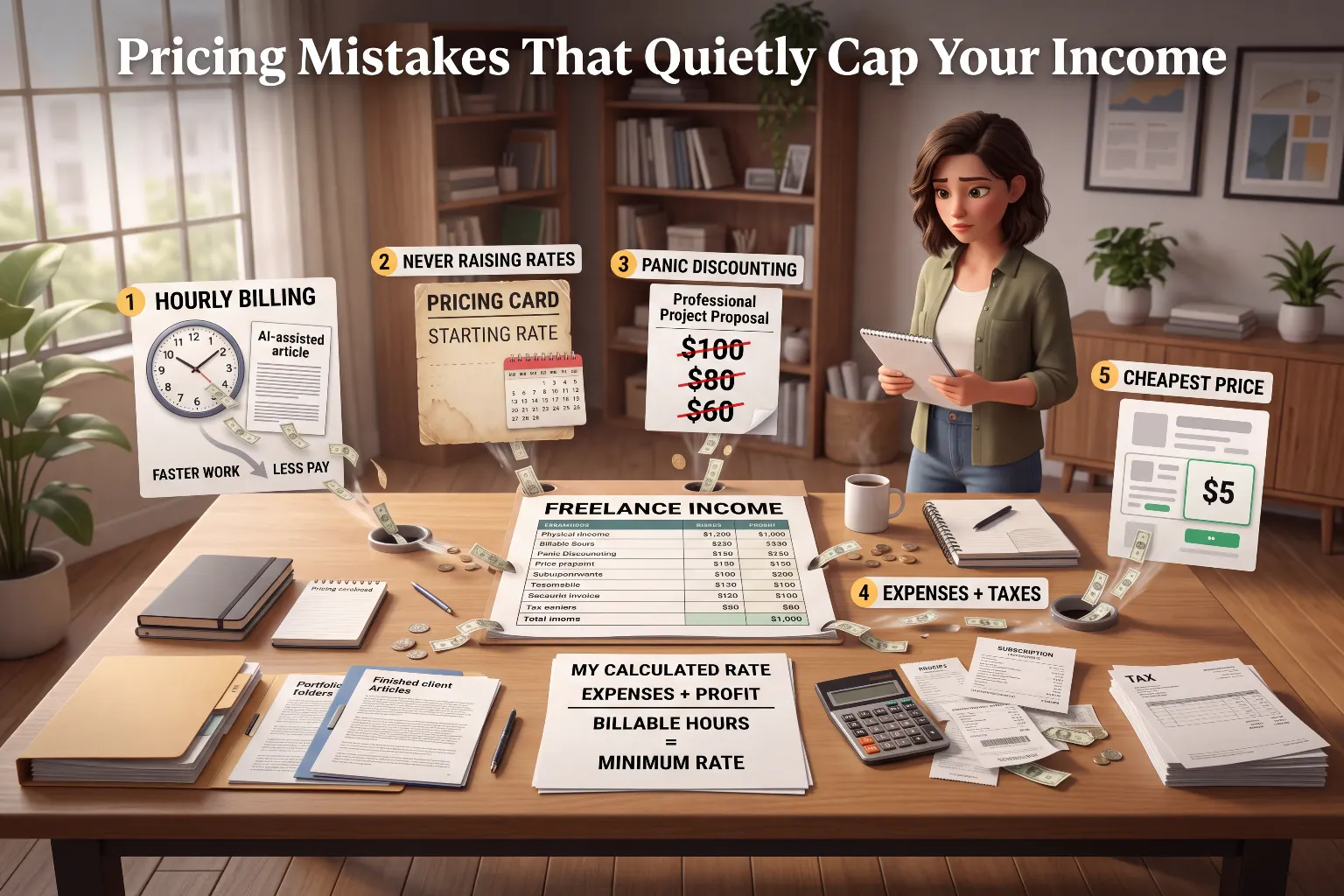
- Charging by the hour indefinitely as an AI-assisted freelancer — this directly punishes every improvement in your speed and skill, exactly as explained above
- Never revisiting your rate after your first few clients — a rate that felt reasonable at zero reviews is almost always too low once you have five or ten
- Discounting immediately at the first sign of price pushback — trains clients and yourself into treating your stated price as a negotiating opener rather than a real number
- Pricing without accounting for your actual expenses and taxes — a rate that looks fine on paper can quietly leave you with far less than expected once real costs are subtracted
- Comparing your rate only to the cheapest gigs on Fiverr — those sellers have not necessarily done the formula either. Anchor to your own calculation, not to the lowest listing you can find
Final Thoughts
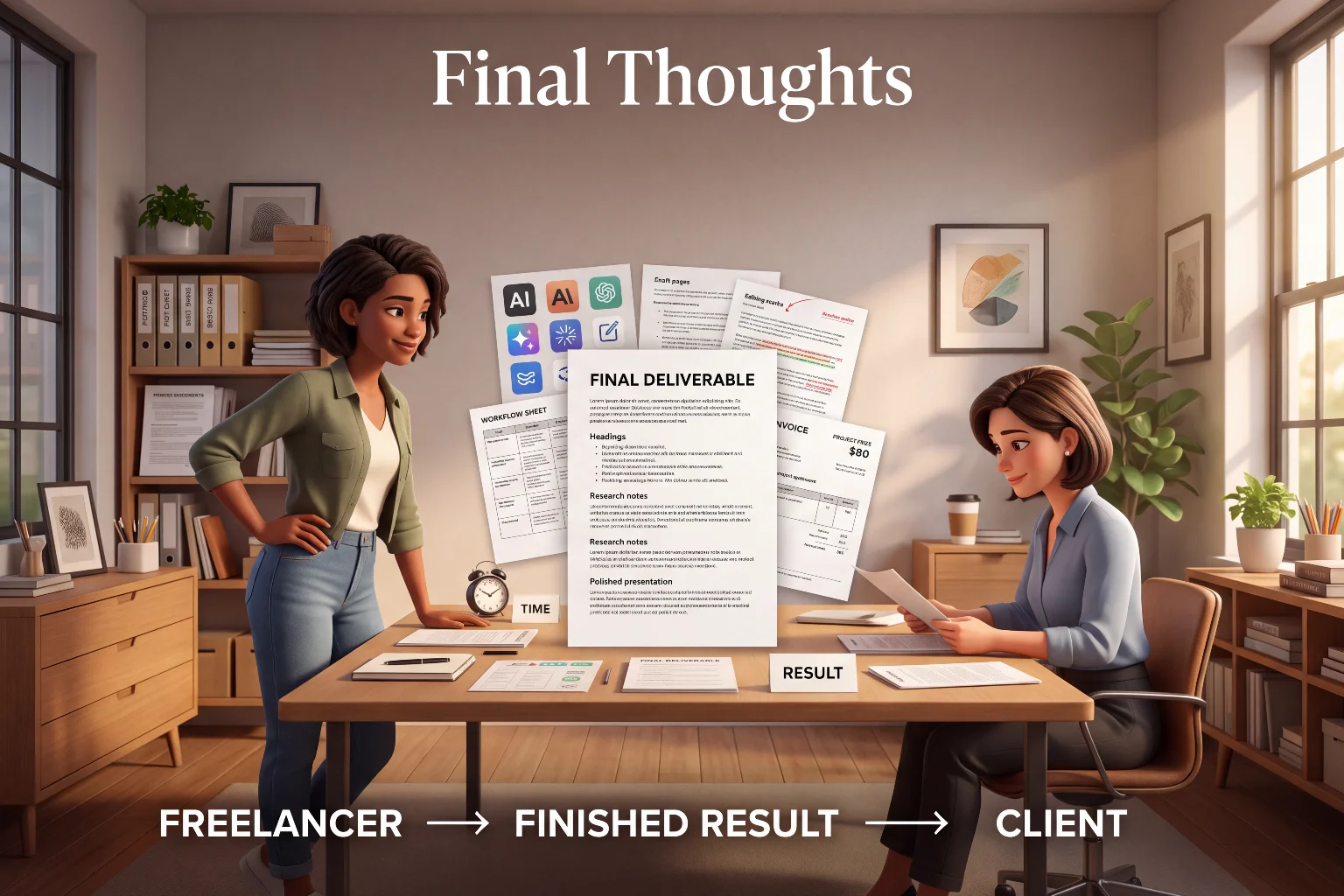
Clients do not pay you for the hours you spend. They pay you for the result you deliver. They are not paying you because you used ChatGPT or Claude. They are paying for an accurate, polished result delivered faster than they could get it elsewhere. AI helps you deliver that result faster — your pricing should reflect the value of the outcome, not the specific tools behind it.
Pricing does not need to feel like guesswork. It is a calculation — your expenses and desired profit divided by realistic billable hours — converted into a clear project price, with a deliberate plan to review and raise it as your reviews build.
If you have not yet built your portfolio or landed your first client, our guides on How to Build an AI Freelancing Portfolio With No Experience and How to Get Your First AI Freelancing Client cover those stages in full detail. And for the complete seven-stage roadmap this guide expands on, our pillar article AI Freelancing for Beginners ties the entire journey together.
Frequently Asked Questions
How much should a beginner charge as an AI freelancer?
Beginner AI content writers typically charge $30 to $100 per article, $100 to $300 for a monthly social media package, and $50 to $200 for a research report, based on common beginner pricing patterns observed on freelance marketplaces such as Fiverr and Upwork. Calculate your own specific number using the formula in this guide — (annual expenses + desired profit) divided by realistic billable hours — rather than relying only on a general range.
Should I charge per hour or per project as an AI freelancer?
Project-based pricing is generally better once you have completed a few projects and understand your real timing, because hourly billing directly punishes you as AI tools help you work faster. Hourly is reasonable only for your very first project or two while you are still learning how long tasks genuinely take you.
Why shouldn't I just match the cheapest gigs on Fiverr?
The lowest-priced Fiverr gigs are often temporary launch pricing from other beginners, unsustainable rates that will not last, or low-quality volume-based sellers. Racing to match them puts you in a competition you cannot win by going lower. Price using the formula in this guide instead of copying the cheapest listing you can find.
Should I charge less for my first few clients?
Yes, deliberately and temporarily. Pricing at 50 to 70 percent of your calculated rate for your first two to three clients is a common, reasonable strategy to earn initial reviews. Treat it as a conscious launch price with a clear endpoint — move to your full calculated rate after your first three to five reviews, not indefinitely.
When should I raise my freelancing rates?
A sustainable pattern is raising your rate by 15 to 20 percent after every five positive reviews. Apply new rates to new clients first. Staying at your starting rate indefinitely is a bigger long-term risk than occasionally losing a project to a higher price.
What should I do if a client says my price is too high?
Avoid immediately discounting, since that signals your original price was not genuine. Instead, offer to adjust the scope of the project to fit their budget, which keeps your rate intact while giving the client a clear, honest choice.
How do I calculate my minimum freelance rate?
Add your annual expenses and desired profit, then divide by your realistic billable hours per year — many freelancers estimate somewhere around 800 to 1,200 billable hours once proposals, portfolio work, and slower weeks are accounted for honestly. This gives your minimum hourly rate, which you then convert into project pricing using the examples in this guide.
Is value-based pricing realistic for a beginner AI freelancer?
Not usually for your first several clients, since it requires enough experience to credibly discuss a client's business outcomes. It is worth understanding as the direction pricing moves as you gain experience, but project-based pricing from the formula in this guide is the more realistic starting point.

Hi, I’m Harshil Patel, founder of Arthify.
I share simple, practical guides on AI tools, blogging, and online earning to help beginners work smarter and grow online.
My goal is to simplify AI tools so anyone can build skills and create opportunities in the digital world.