“This guide shows you how to build a convincing AI freelancing portfolio with no experience — what to create for each service, how many samples you actually need, where to host them, and how to present them so clients take you seriously from the very first click.“
If you have already read our guide on AI Freelancing for Beginners, you know Stage 2 of the Arthify Freelancing Roadmap is called “Breaking the Beginner Catch-22.” That section explains the core idea — clients judge the quality of what they see, not whether someone paid for it. This guide is the full, practical execution of that idea. What to actually create, service by service, sample by sample, with every question about formatting, hosting, and presentation answered so nothing is left to guesswork.
By the end you will know exactly what to build this weekend, how many pieces are genuinely enough, where to put them so a client can open them in one click, and how to talk about self-made work with complete confidence.
Why “No Experience” Is Not the Problem You Think It Is
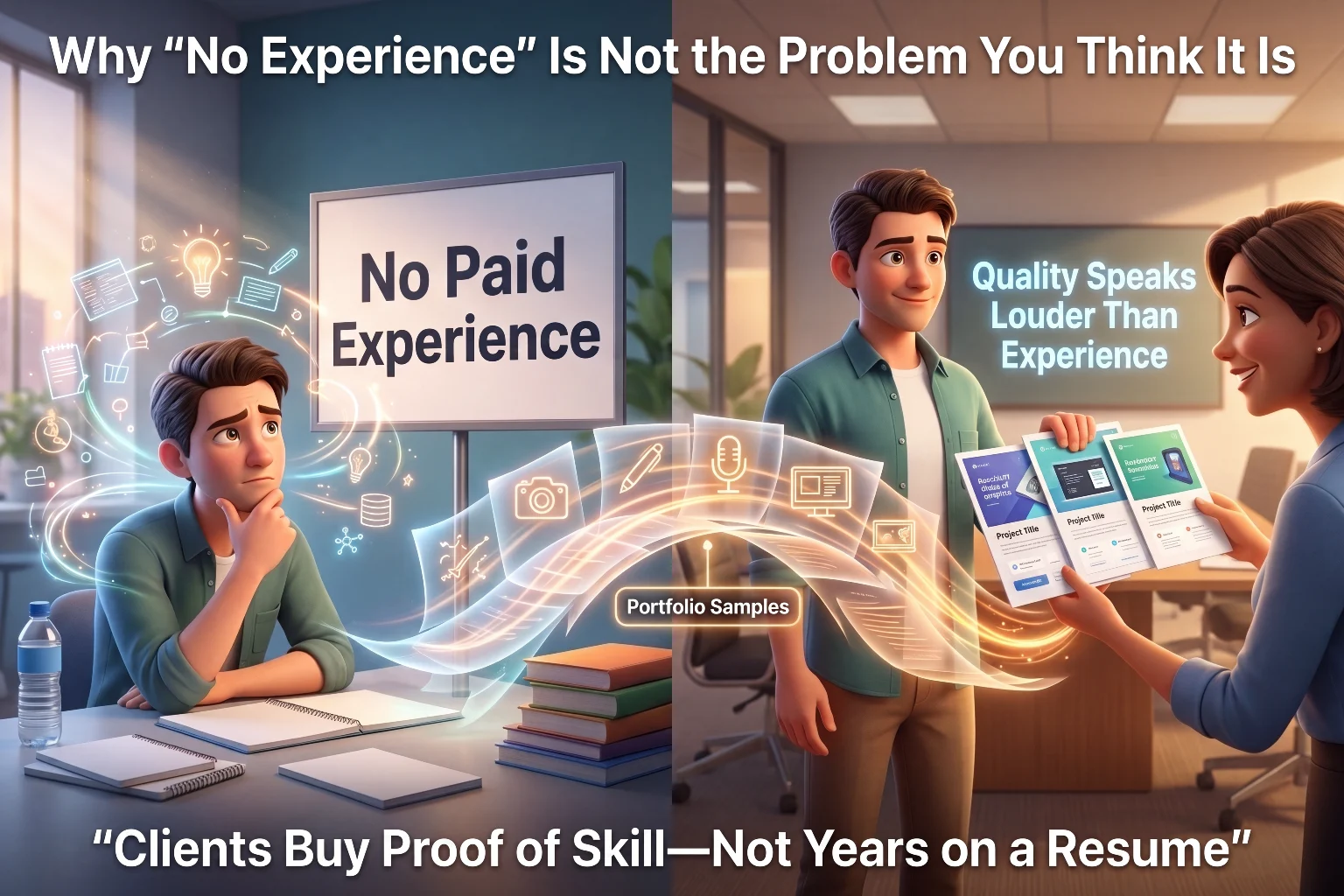
Here is the sentence that stops most beginners before they start: “I cannot apply for freelance work because I have no experience.”
That sentence is not true. What is true is that you have no paid experience. Those are two completely different things, and the gap between them is much smaller than most guides ever explain.
A client hiring a freelancer is not asking to see your employment history. They are asking one question: can this person produce the specific result I need? A blog post you wrote for a fictional client this weekend demonstrates exactly the same writing ability as a blog post you wrote for a paying client last year. The words on the page do not know the difference. Neither does the person reading them.
This is genuinely good news. It means the thing standing between you and your first client is not years of experience you do not have. It is a few hours of focused, quality work you can do starting today.
The one thing that does matter is quality. A rushed, unedited sample is worse than no sample at all, because it proves the opposite of what you are trying to demonstrate. Everything in this guide is built around creating a small number of genuinely strong samples rather than a large number of mediocre ones.
What Clients Are Actually Judging When They Look at Your Portfolio
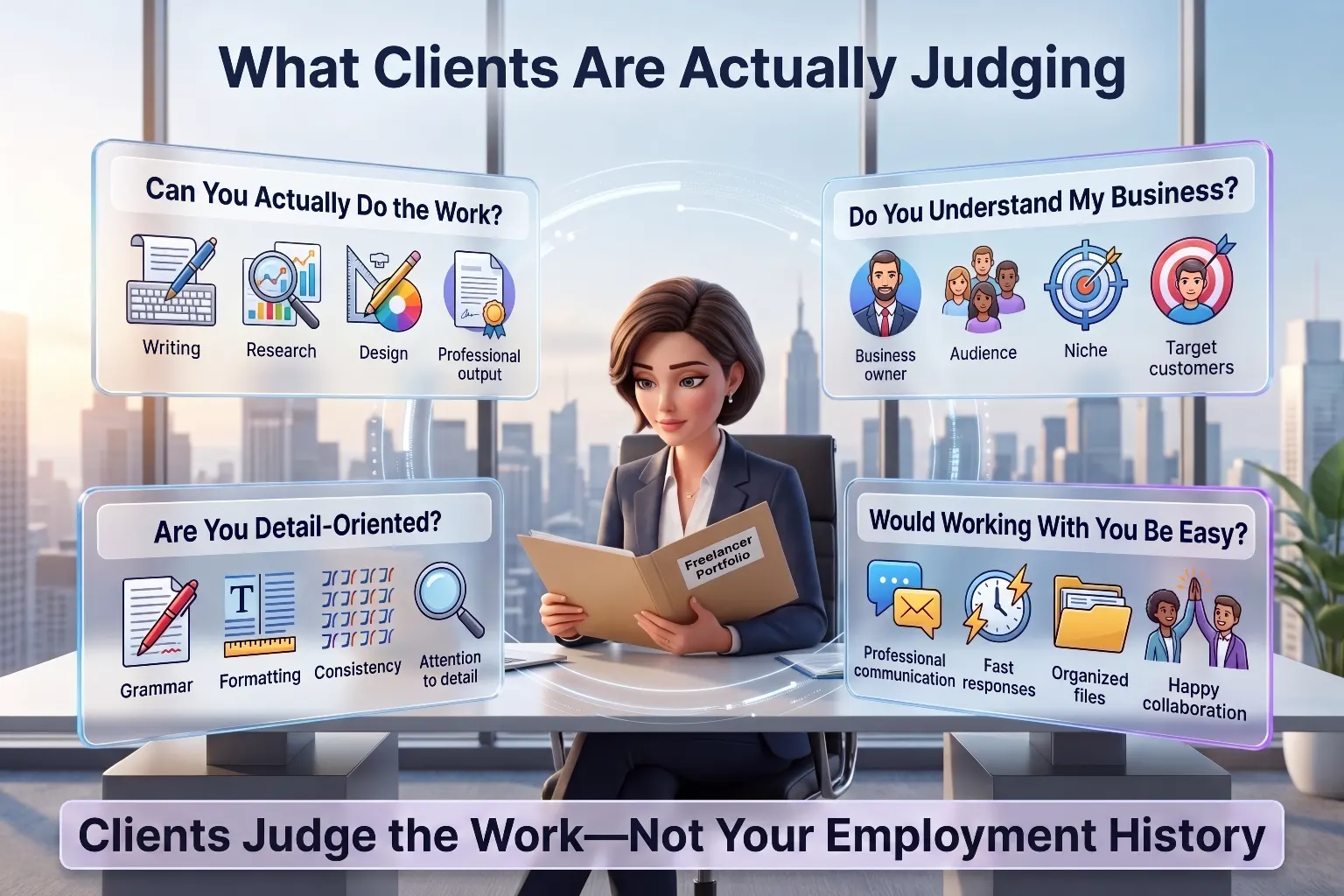
Before you create anything, it helps to understand exactly what a client evaluates when they click your portfolio link. It is not what most beginners assume.
Clients are judging four specific things:
- Can you actually do the work — is the writing clear, is the design clean, is the research organized and accurate
- Do you understand their type of business — does the sample feel generic, or does it show you thought about a specific audience with a specific goal
- Are you detail-oriented — are there typos, awkward formatting, or inconsistencies that suggest carelessness
- Would working with you be easy — does the sample look ready to use, or does it feel like a rough draft they would need to fix themselves
Notice that none of these require a paying client. Every one of them can be proven through a self-created sample of genuinely high quality. You are not faking anything. You are simply demonstrating your ability before someone pays you to use it.
How Many Samples You Actually Need
Beginners make one of two mistakes here. They either create one rushed sample and start applying immediately, or they spend three weeks building fifteen samples before they feel “ready” — which usually means they never actually start.
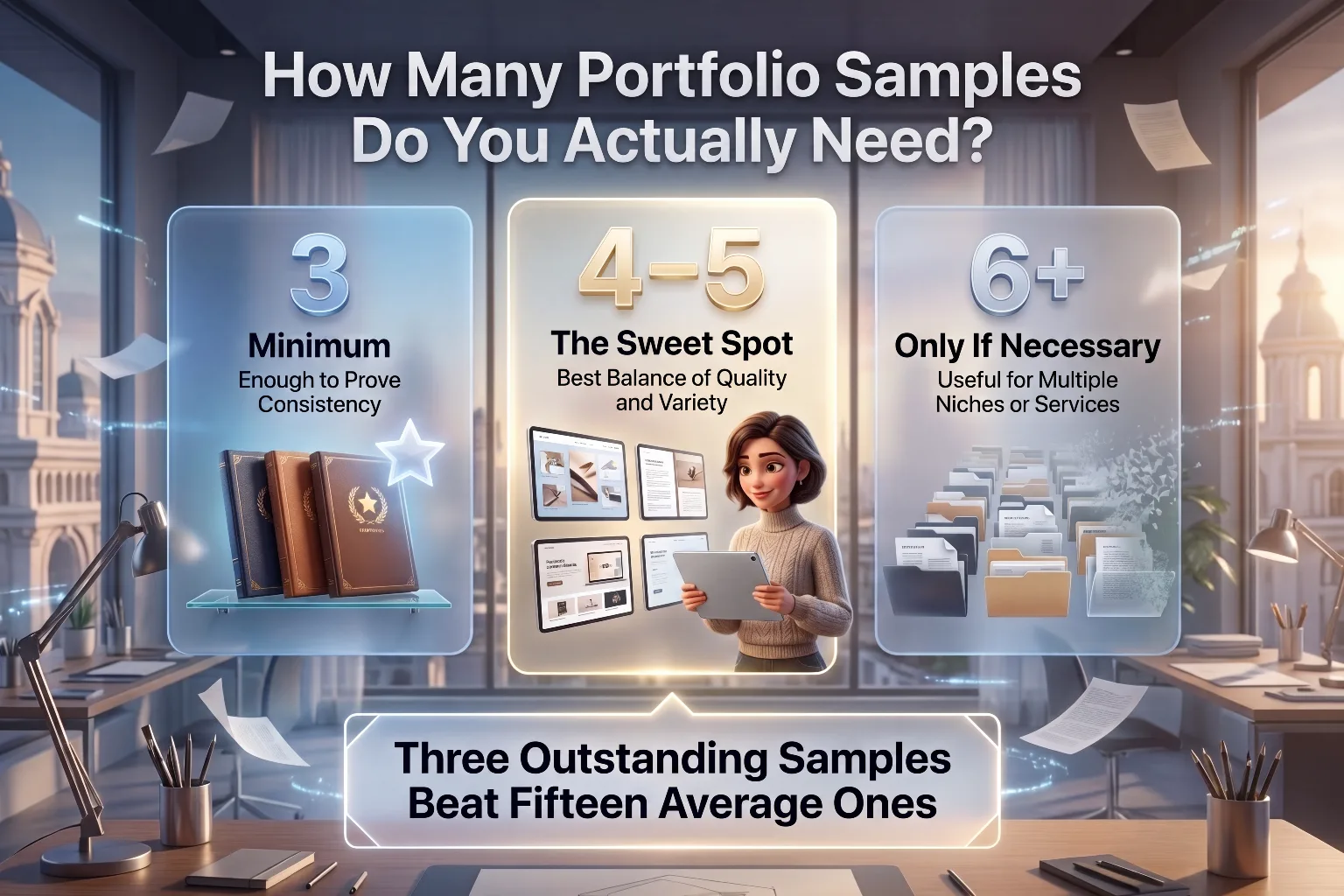
The right number is three to five samples. Here is exactly why:
- Three samples — the minimum for a convincing portfolio. Proves consistency, not a one-off lucky piece. Only go this low if all three are exceptional.
- Four to five samples — the sweet spot for most beginners. Enough to show range without overwhelming someone who is skimming.
- More than five — only worth adding if you are targeting two different niches or service types and need to show range across them. Otherwise, more samples just increase the odds a client lands on your weakest one.
The goal this weekend is not to build an impressive body of work. It is to create three to five pieces you would be comfortable with if your ideal client read every word right now. That is a completely achievable target in two focused days.
The Three Types of Portfolio Samples You Can Create
Most guides tell you to “build samples” without explaining what kinds of samples actually convince clients. There are three genuinely distinct types, and knowing which one to use makes the difference between a portfolio that gets you hired and one that gets ignored.
Type 1 — Practice Projects
A practice project is a complete, finished piece of work you create entirely on your own for a topic or scenario you choose. Nobody requested it. Nobody paid for it. But you complete it exactly as though a real client did, at the same quality level you would deliver professionally.
This is the most straightforward starting point. Write the blog post, design the content calendar, or produce the research report as if a client brief landed in your inbox this morning. The output should be indistinguishable from paid work in terms of quality, formatting, and polish.
Type 2 — Fictional Client Projects
A fictional client project goes one level deeper. Instead of picking a random topic, you invent a specific client — a real type of business with a realistic name, a clear problem to solve, and an actual audience to write for. You then complete the project exactly as you would for a real client, including a short brief you write yourself before starting.
For example: you invent a fictional sustainable clothing brand called “Greenline Studio” that needs three blog posts to attract eco-conscious shoppers aged 25 to 40. You write the brief, then complete the posts exactly as if Greenline Studio was a paying client. When a real sustainable fashion client later sees these samples, they immediately recognize their own world in your work. Specificity creates that connection.
Type 3 — Improvement Projects
An improvement project is the most underused tactic in beginner portfolios, and one of the most convincing. Instead of creating something from scratch, you take a piece of real content that already exists — a poorly written blog post from a small business website, a weak product description on an ecommerce page, or a dull social media caption — and you rewrite it significantly better. Then you present both versions, the original and your improved version, side by side.
This approach does two things no other sample type can. It shows a client exactly what working with you looks like in concrete before-and-after terms. And it demonstrates editing judgment, which is a skill that is just as valuable to clients as drafting ability, because most clients need a freelancer who can improve what they already have, not only write from scratch.
Building Your Samples by Service
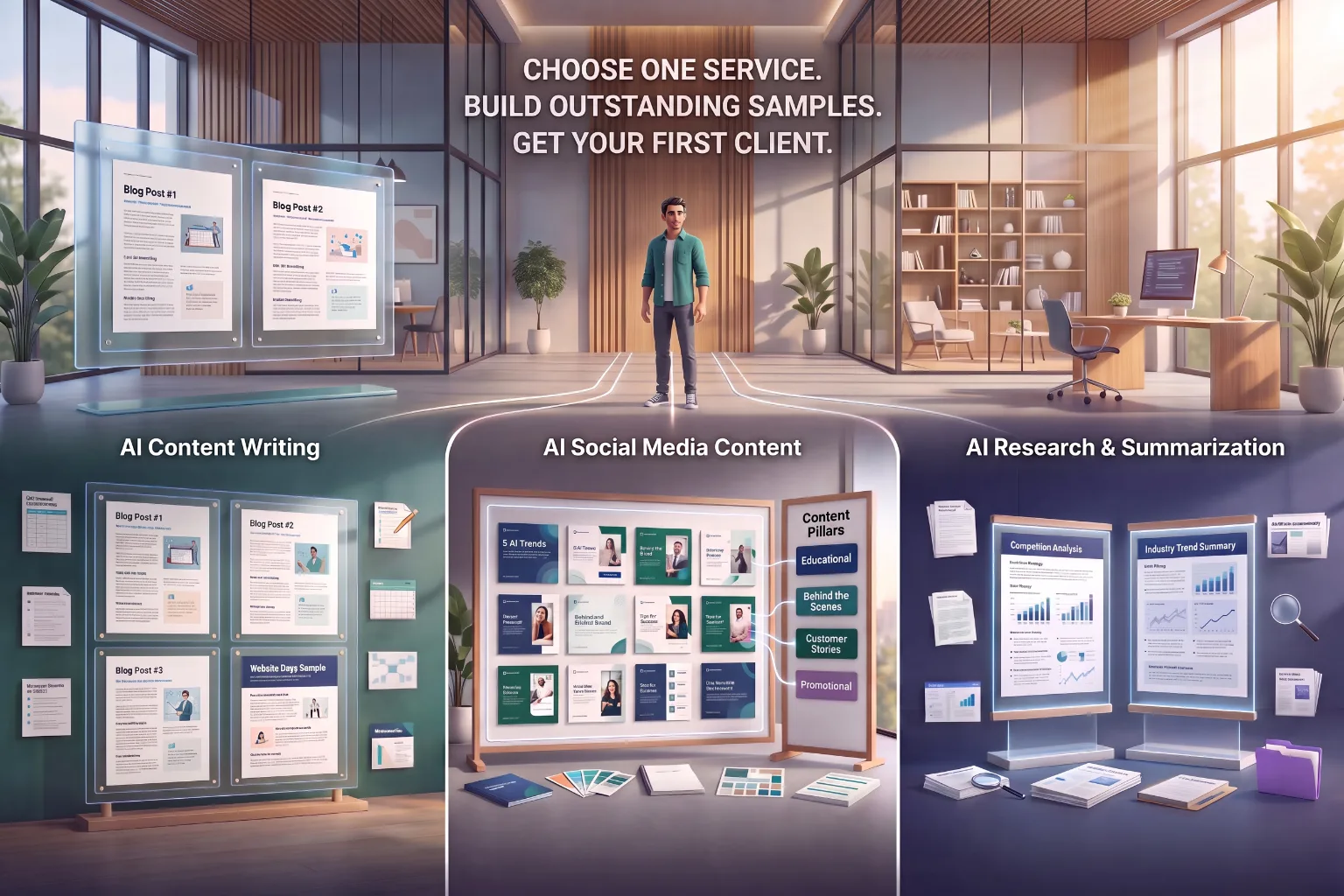
The exact samples you create depend on which of the three services you chose in Stage 1 of the Arthify Freelancing Roadmap. Our guide on How to Write Better Prompts for AI can help you generate stronger first drafts for any of the service types below. Here is precisely what to build for each one.
Portfolio Samples for AI Content Writing
Create three complete blog posts, each 800 to 1,200 words, on different topics within one specific niche rather than three unrelated topics. Three blog posts about fitness, travel, and cryptocurrency prove you can write in general. Three blog posts all focused on AI tools for small business owners prove you understand one specific audience, which is far more convincing to a client in that space.
Draft each piece with ChatGPT or Claude, then read every sentence critically. Rewrite anything that sounds generic. Add at least one specific example, statistic, or insight per section that comes from genuine research rather than from the AI draft. Format every piece exactly as it would appear on a client’s website — clear title, proper H2 and H3 headings, short paragraphs, natural conclusion.
Add one additional sample — a piece of website copy such as an “About Us” page or a set of product descriptions for a fictional brand. This shows range beyond long-form writing and appeals to clients who need website content, not just articles. If you want to understand how on-page SEO factors into content writing deliverables, our guide on On-Page SEO for Blog Posts covers everything a client would expect from a properly optimized piece.
Portfolio Samples for AI Social Media Content
Create one complete thirty-day content calendar for a fictional brand in a specific niche. Give the brand an actual name, a defined voice, and a consistent visual style using Canva. Your sample should include at minimum ten designed graphics, captions written for each post, and a content calendar document showing posting days and platforms.
One complete calendar is more convincing than twenty disconnected posts because it shows planning and consistency — the actual skills clients pay for. Add one bonus deliverable: a one-page “content pillars” document explaining the three or four themes the fictional brand rotates through each month. This is exactly the strategic thinking that separates a freelancer clients keep long-term from one they use for a single project.
Portfolio Samples for AI Research and Summarization
Create two research reports on different topics — one competitor analysis for a specific type of local business, and one industry trend summary for a specific market. Use Perplexity AI to gather current information and verify every source before including it.
Present each report as a clean, well-organized document — a short executive summary at the top, clearly labeled sections, key findings as bullet points, and a brief conclusion stating what the client should do with this information. A business owner should be able to skim your report in ninety seconds and understand the main takeaways without reading every word. That usability is the skill you are demonstrating.
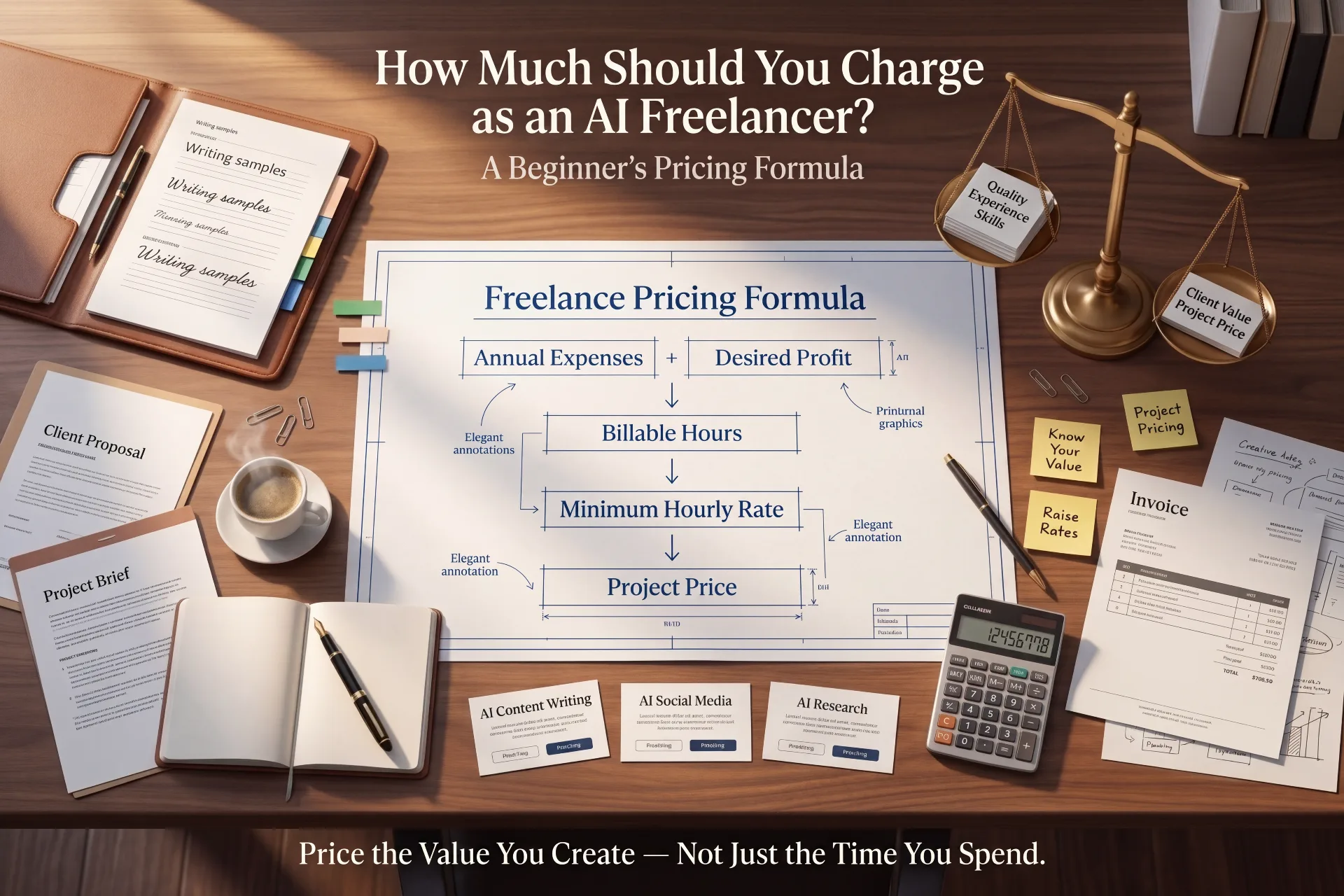
Once your samples are ready, our guide on How Much to Charge as an AI Freelancer shows you exactly how to turn your portfolio into a project price for each service.
Google Drive vs Notion — Where to Host Your Portfolio
Google Drive
It is the fastest option. Create one folder named clearly — for example “AI Content Writing Portfolio — Harshil Patel” — add your samples as Google Docs or exported PDFs, and set sharing to “anyone with the link can view.” This takes under ten minutes and works reliably on every platform. The only downside is that it looks slightly less polished than a dedicated portfolio page.
Notion
It is better option once you want something more organized and visually clean. Create one page with a short intro about who you help and what you deliver, then add each portfolio sample below it with a short description. Notion pages look professional, load fast, and give you a single shareable link that covers your entire portfolio. For most Arthify readers this is the right long-term option.
The practical approach for most beginners: set up Google Drive today to send your first proposals this week, then build a Notion page in parallel over the next few days once you have momentum. Do not delay your first proposal by a single day waiting to build the “perfect” Notion page — that is exactly the kind of preparation that quietly turns into procrastination.
How to Write a Short Case Study for Every Sample
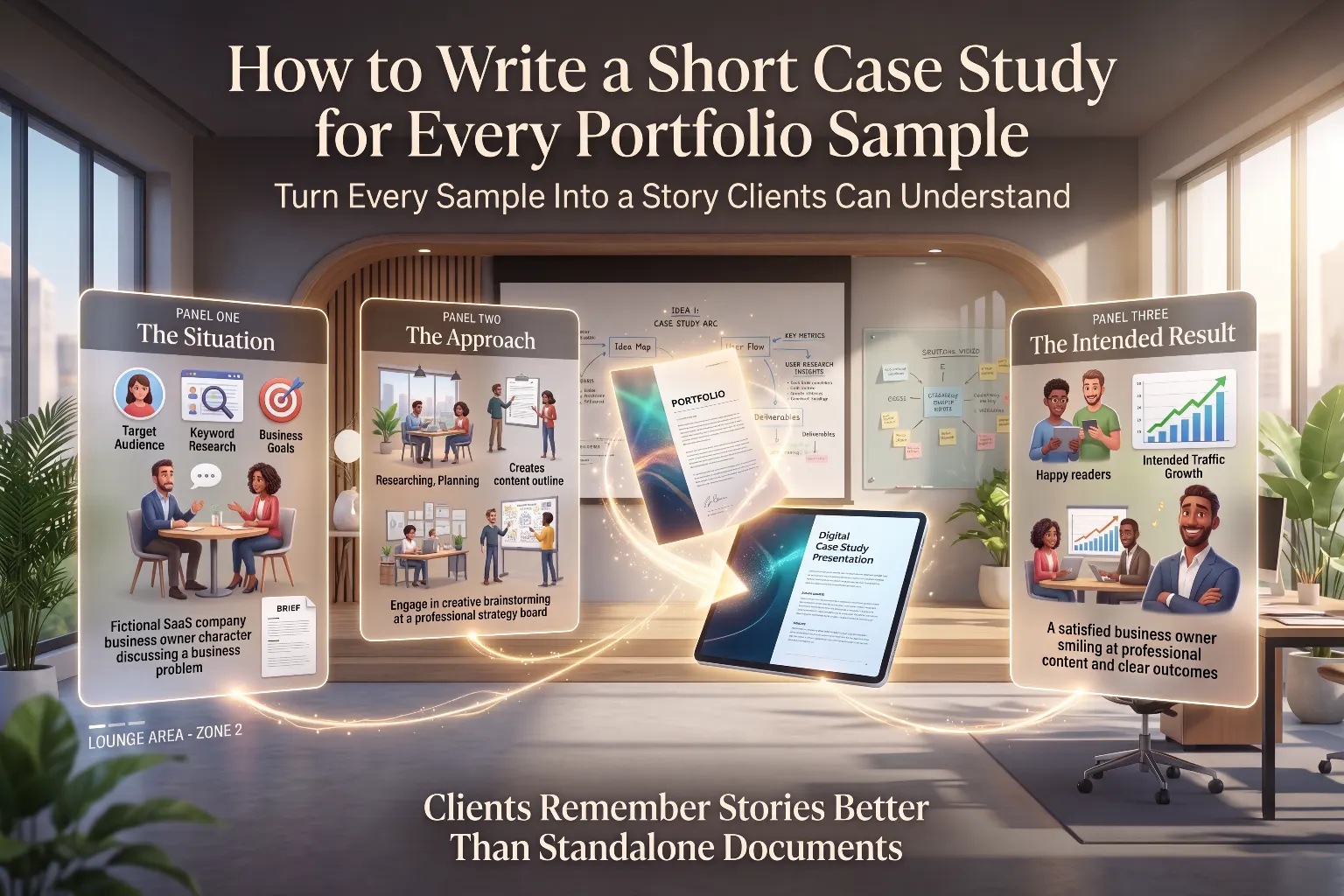
A portfolio sample without any context is just a document. A portfolio sample with a short case study attached becomes a story a client can actually relate to — and this is the single most underused tactic in beginner portfolios.
For every sample, write three to four sentences covering three specific things:
- The situation — one or two sentences describing the fictional brand or scenario and what they needed. “A fictional SaaS startup needed a blog post that could rank for a beginner-friendly AI keyword while explaining a complex concept in plain language.”
- The approach — one or two sentences on how you approached it. “I researched the top-ranking articles for the keyword, identified a gap in practical examples, and structured the piece around filling that specific gap.”
- The intended result — frame this around what the piece was designed to achieve, not a fabricated outcome. “The final article balances SEO structure with genuinely useful explanations a non-technical reader can act on immediately.”
This case study format takes five minutes to write per sample and adds a layer of professionalism that most beginner portfolios skip entirely. It shows a client how you think about a project, not just what you can produce. For a deeper look at how to use AI tools to research and structure this kind of analytical thinking, our guide on How to Use Claude AI for Beginners covers the process in practical detail.
Should You Tell Clients Your Samples Were Self-Made
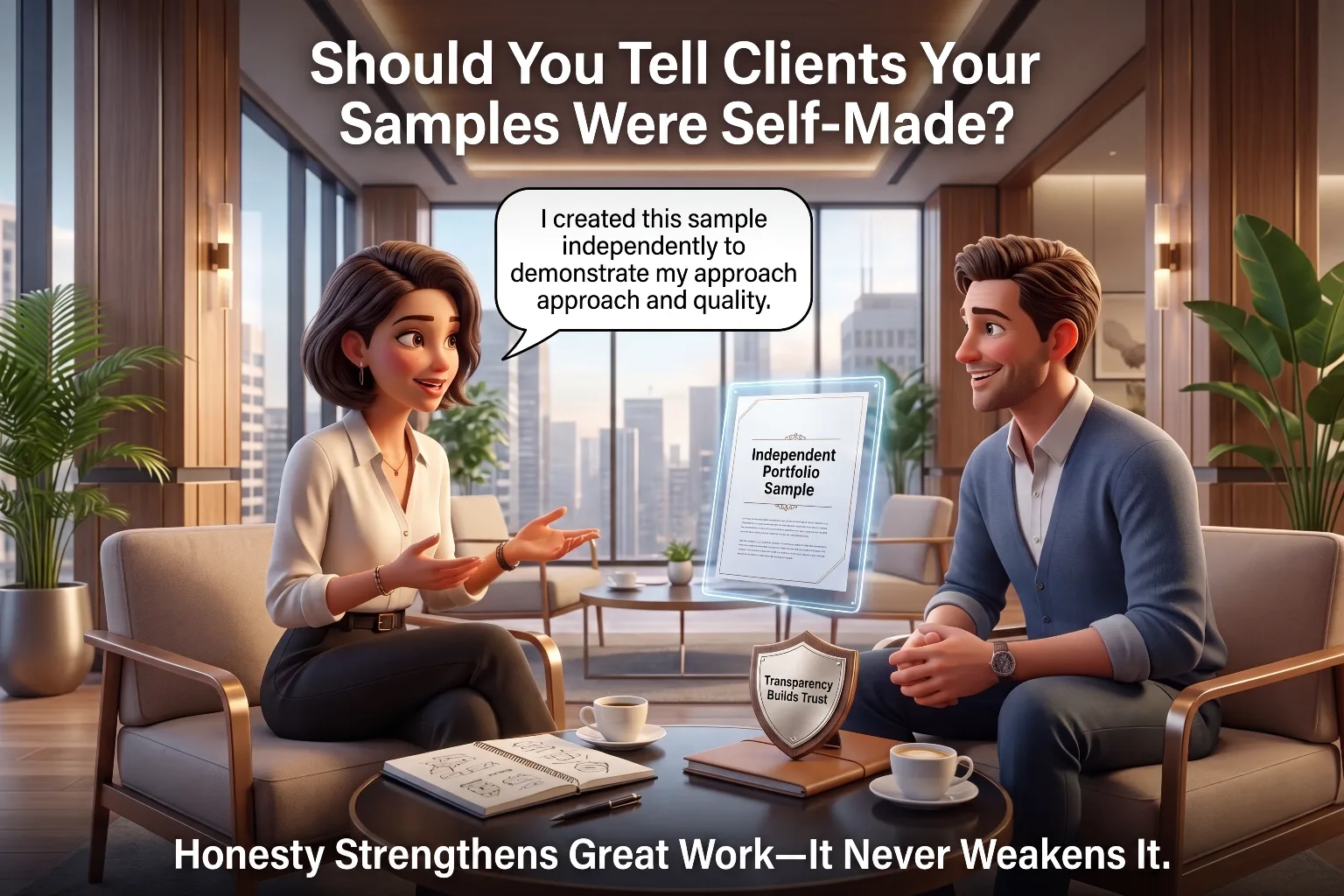
Yes, if asked directly. No, you do not need to volunteer it unprompted.
There is nothing dishonest about self-created samples. You are not claiming a specific business paid you. You are presenting a demonstration of your ability, which is exactly what a portfolio is for. Most experienced freelancers built their first portfolio exactly this way, and most clients understand this completely.
The cleanest approach is to add a one-line note at the top of your portfolio that says something like “Portfolio pieces include both client work and independently created samples demonstrating my workflow and approach.” This is completely transparent and does not weaken the portfolio’s impact.
If a client asks directly, answer honestly: “This was a sample project I created to demonstrate my approach to this type of content, since I’m building my portfolio in this specific niche.” Confident, honest, and does not undermine the quality of the work itself.
What damages trust is not the fact that a sample was self-made — it is being evasive when asked directly about it.
The Portfolio Checklist — How to Know When You Are Ready to Apply
Perfectionism is the most common reason beginners delay their first proposal for weeks longer than necessary. Use this checklist to know exactly when to stop building and start applying.
Portfolio Readiness
Check before you apply
- Every sample is completely finished — no placeholder text, no unfinished sections, no placeholder images
- Every sample has been read aloud at least once to catch awkward phrasing your eyes missed while reading silently
- Every sample is free of spelling and grammar errors — run each one through Grammarly before considering it finished
- All samples share a consistent niche or theme rather than feeling like five unrelated topics
- Each sample has a short case study paragraph above or below it
- Your portfolio link opens correctly from a different device, confirming sharing permissions are set to public view
- The portfolio is organized strongest sample first
- File names and document titles are clean — not “Draft 3 final FINAL” or “Untitled document”
- You would be genuinely comfortable if the client you most want to impress read every single sample right now
Once every item on this list is true, you are ready. Waiting longer than this does not meaningfully improve your chances — it only delays your first proposal, which is the actual bottleneck standing between you and your first income.
Portfolio Mistakes That Quietly Cost You Clients
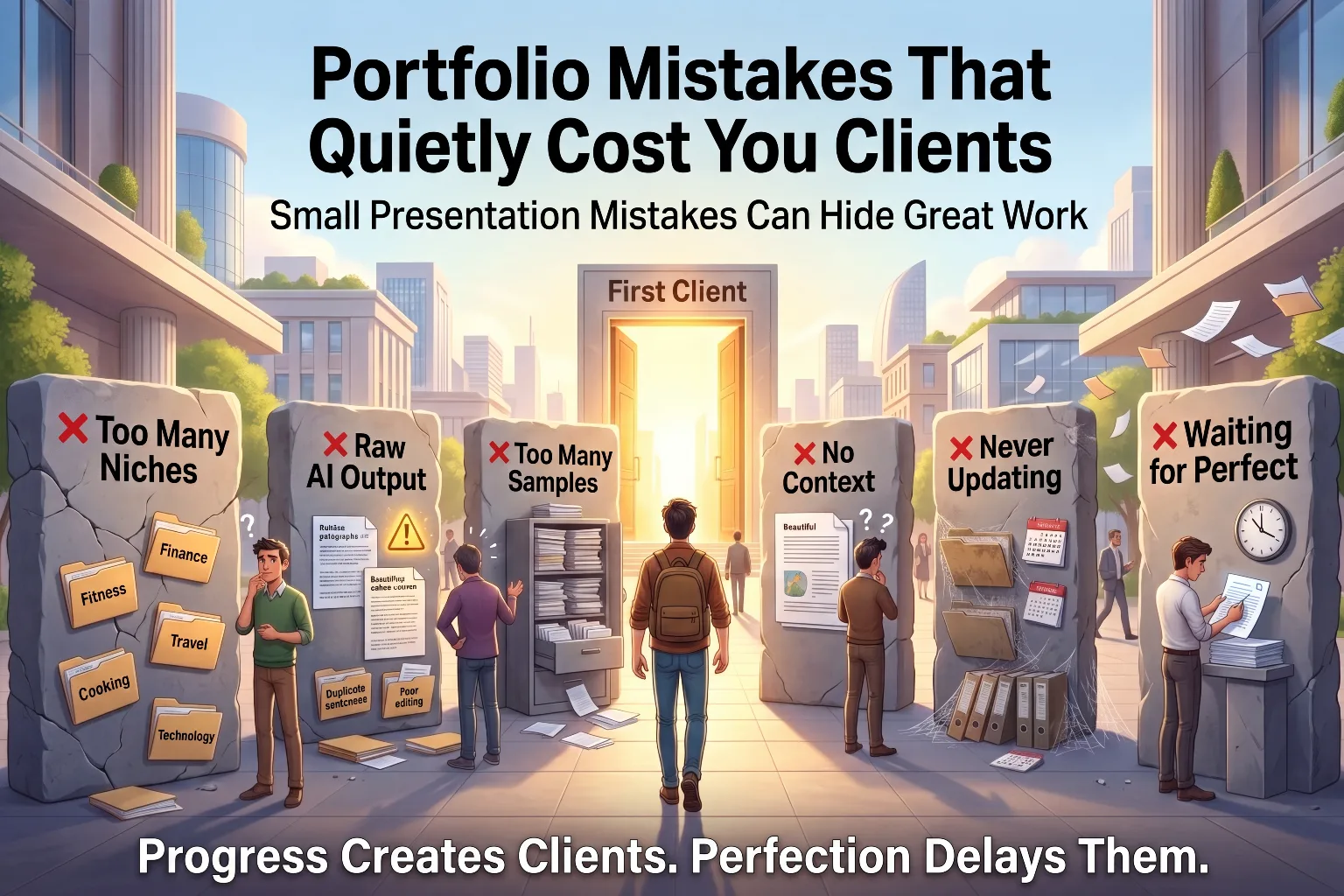
These are not generic warnings — these are the specific presentation mistakes that cause strong, capable beginners to get ignored before a client even reads a word of their work.
- Showing samples across five completely different niches — this signals uncertainty rather than versatility. A client in the fitness niche looking for a content writer sees three fitness samples and thinks “this person understands my world.” They see samples in fitness, travel, finance, AI, and cooking and think “this person does not specialize in anything.” Pick one niche for your portfolio and stay there until you have real client work to show range.
- Submitting raw, unedited AI output as portfolio samples — this is the single fastest way to lose a client’s trust before a conversation begins. AI-generated content without significant human editing has a particular flatness — uniform vocabulary, generic examples, transitions that are too smooth. Portfolio samples deserve more editing time than actual paid work, not less.
- Including too many samples — beyond five pieces, clients skim rather than read, and the odds increase that they land on your weakest piece rather than your strongest. Quality density matters more than total count.
- No context or explanation for any sample — a folder of documents with no titles, no case studies, and no organization forces the client to do the work of figuring out what they are looking at. Make it completely effortless for them.
- Never updating the portfolio — the same three samples from month one should not still be the only samples in month six. Replace self-made samples with real client work as soon as you have permission to share it. Your portfolio should always show your current best, not your starting point.
- Waiting for the “perfect” portfolio — three genuinely good samples sent to real clients this week are worth more than an endlessly revised portfolio that nobody ever sees. Perfectionism at this stage delays income, it does not increase it.
From Portfolio to First Client
Your portfolio’s job is not to impress everyone. It is to survive the thirty-second glance a real client gives it before deciding whether to keep reading your proposal. Once your samples pass that test, the portfolio has done its job — the next stage is entirely about what you do with it.
That means setting up your profile so it points clients directly toward your strongest samples, and writing proposals that reference specific pieces of your portfolio rather than making the client dig for relevance themselves. Our pillar guide on AI Freelancing for Beginners walks through both of those stages — profile setup in Stage 3 and proposal writing in Stage 4 — in complete detail.
Your portfolio gets you noticed. Your proposal gets you hired. Both matter, and neither works without the other.
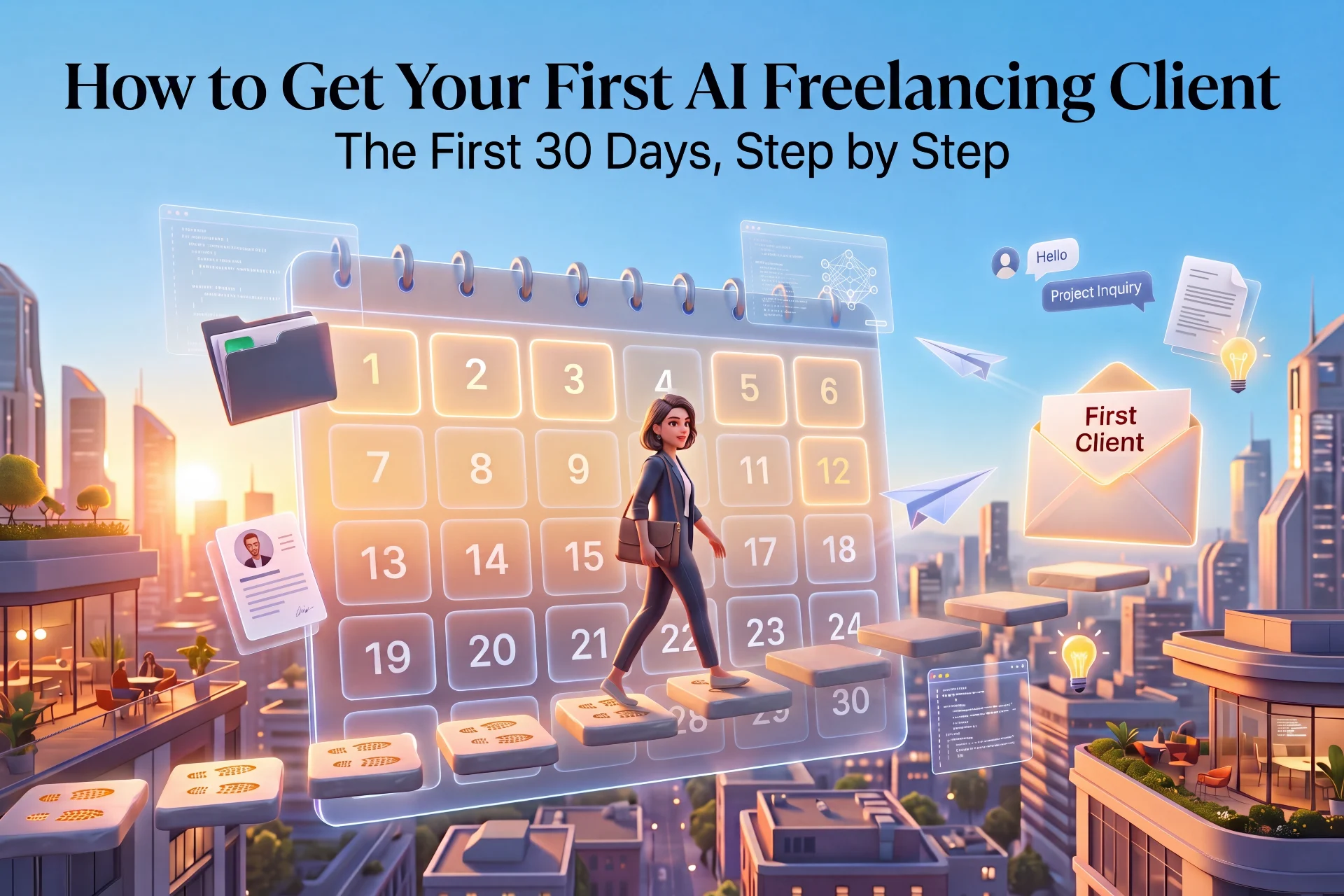
For the exact day-by-day process of what happens after your portfolio is ready — setting up a profile that gets clicked, how many proposals to send, and what to do in the silent first two weeks — our guide on How to Get Your First AI Freelancing Client covers the complete first 30 days.
Final Thoughts

The portfolio catch-22 feels like a genuine wall the first time you encounter it. It is not. It is one of the most solvable problems in freelancing — it just requires doing the work before anyone asks you to, instead of waiting for permission that never comes.
Three to five genuinely strong, self-created samples, organized clearly, presented with a short case study, and hosted on Google Drive or Notion, is a complete and convincing portfolio. It is not a lesser version of a “real” portfolio. It is exactly what a real portfolio is — proof of ability, presented professionally.
Once your portfolio is ready, the next challenge is setting up your profile and sending your first proposal — the stages that come right after in the Arthify Freelancing Roadmap. Our pillar guide on AI Freelancing for Beginners covers both of those in full detail, along with every stage from choosing your service all the way to building your first retainer client relationships.
Build three samples this weekend. That is the entire starting point.
Frequently Asked Questions
How do I build an AI freelancing portfolio with no clients or experience?
Create your own samples for a fictional brand or a topic you choose yourself, at the same quality level as real client work. Three types work well — practice projects you complete independently, fictional client projects built around a specific invented brand with a real brief, and improvement projects where you rewrite existing weak content and show both versions side by side. Clients evaluate the quality of what they see in front of them, not whether a real business paid for it.
How many portfolio samples do I actually need?
Three to five is the right range. Three is the minimum needed to show consistency rather than a single lucky piece. Five is generally the ceiling — beyond that, clients skim rather than read, and each additional sample increases the odds they land on a weaker piece. Focus on making each sample genuinely strong rather than maximizing the total count.
What is the best type of portfolio sample for a beginner?
It depends on what you want to demonstrate. Practice projects are the fastest to create and build confidence. Fictional client projects are more specific and convincing because they mirror real client scenarios. Improvement projects are the most persuasive because they show before-and-after editing judgment, not just drafting ability. A portfolio with one or two of each type shows the most range.
Is it honest to use self-made samples in a freelancing portfolio?
Yes. A portfolio demonstrates ability, not employment history. There is nothing dishonest about a self-created sample as long as you are honest if a client asks directly. Add a one-line note to your portfolio explaining that samples include independently created demonstration pieces alongside any client work. Most clients care far more about the quality in front of them than about whether an invoice existed.
Where should I host my portfolio if I have no website?
Google Drive is the fastest option — create a shared folder with view access and use that single link in your proposals and profiles. Notion is more polished and worth setting up in parallel once you have momentum. Start with Google Drive this week so your first proposals go out on time. Build Notion alongside it rather than before it.
Should I use AI tools to create my portfolio samples?
Yes, but never submit the raw AI draft as your final sample. Use ChatGPT or Claude to speed up research, outlining, and first drafts. Then edit every sentence critically, add specific examples and insights from your own research, verify every fact, and make sure the final piece genuinely reflects the quality you would deliver to a real client. The editing phase is where your professional value as an AI freelancer actually lives.
How do I know when my portfolio is good enough to start applying?
Use this test — read each sample as if you are the client. Would you trust the person who created this to work on your business? If at least three samples pass that test and every item on the portfolio checklist in this guide is confirmed, your portfolio is ready. Most beginners could have started applying two weeks before they actually did. The portfolio’s job is to start a conversation, not to win an award.
Can I use the same portfolio samples on Fiverr and Upwork?
Yes. The same three to five samples work across both platforms and any other platform you use. There is no need to create separate portfolios. Focus your energy on making one strong, well-organized set of samples rather than duplicating effort across platforms. Once you have real client work to add, update the same portfolio rather than creating new ones from scratch.

Hi, I’m Harshil Patel, founder of Arthify.
I share simple, practical guides on AI tools, blogging, and online earning to help beginners work smarter and grow online.
My goal is to simplify AI tools so anyone can build skills and create opportunities in the digital world.