“This beginner’s guide to AI freelancing for beginners gives you the honest, step-by-step path to your first paying client in 2026 — from picking your first service and building a no-experience portfolio to writing proposals that actually get replies and building a freelance income that grows over time.”
Here is something most AI freelancing guides will not tell you upfront.
The tools are the easy part.
Getting a free ChatGPT account takes thirty seconds. Learning enough to produce a usable first draft takes a few days. That part is genuinely accessible to anyone. But knowing which service to offer, how to build a portfolio before you have any clients, what to write in a proposal that actually gets a reply, and how to turn a first project into ongoing income — that is where most beginners get stuck, and that is exactly what this guide focuses on.
If you have already read our guide on How to Make Money with AI in 2026, you know that AI freelancing is the fastest path to your first online income.
This guide goes several layers deeper — into the positioning, the portfolio, the proposals, the workflow, and the professional habits that turn a beginner with zero clients into someone with a real freelancing career.
No inflated income promises. No shortcuts that do not work. Just the complete, honest roadmap that most beginner guides skip.
What AI Freelancing Actually Is and Why Clients Pay for It
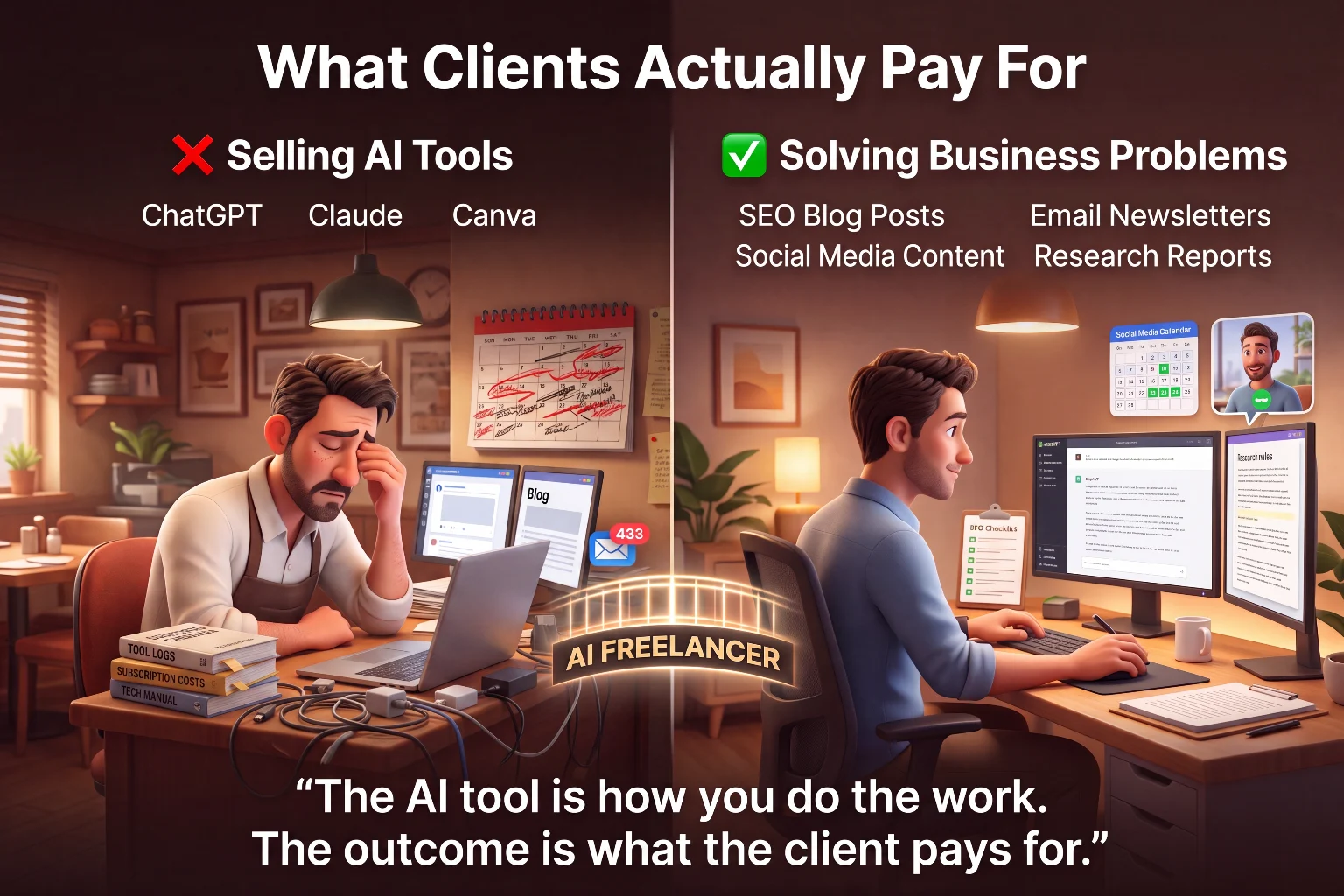
AI freelancing is not about selling access to AI tools. Clients already have ChatGPT, Canva, and Claude. They do not need you for that.
What they need is someone who can use those tools to solve a specific business problem — reliably, consistently, and at a professional standard they cannot achieve themselves.
Think about it from the client’s side. A small business owner running a restaurant knows they should be posting on social media. They know they should have a blog. They know they should be sending email newsletters. But they have twelve other priorities and no time to figure out how to use AI tools effectively for any of it. They need someone to just handle it.
That is what you sell as an AI freelancer. Not the tool. The outcome.
This distinction changes everything about how you think about your service, your portfolio, and your proposals. You are not marketing yourself as “someone who knows ChatGPT.” You are marketing yourself as “someone who writes SEO blog posts that help small businesses get found on Google” or “someone who creates a full month of social media content that keeps a brand’s audience engaged.”
The AI tool is how you do the work. The outcome is what the client pays for.
This is also why AI freelancing rewards people who combine AI speed with genuine judgment. Clients can tell the difference between a freelancer who reviewed, edited, and polished the AI output and one who copy-pasted whatever the tool produced and hit send. The freelancers who build long-term careers treat AI as a starting point, not a finishing point.
Understanding this distinction is the foundation everything else in this guide builds on — including whether now is actually a good time to act on it.
Why 2026 Is the Right Time to Start AI Freelancing
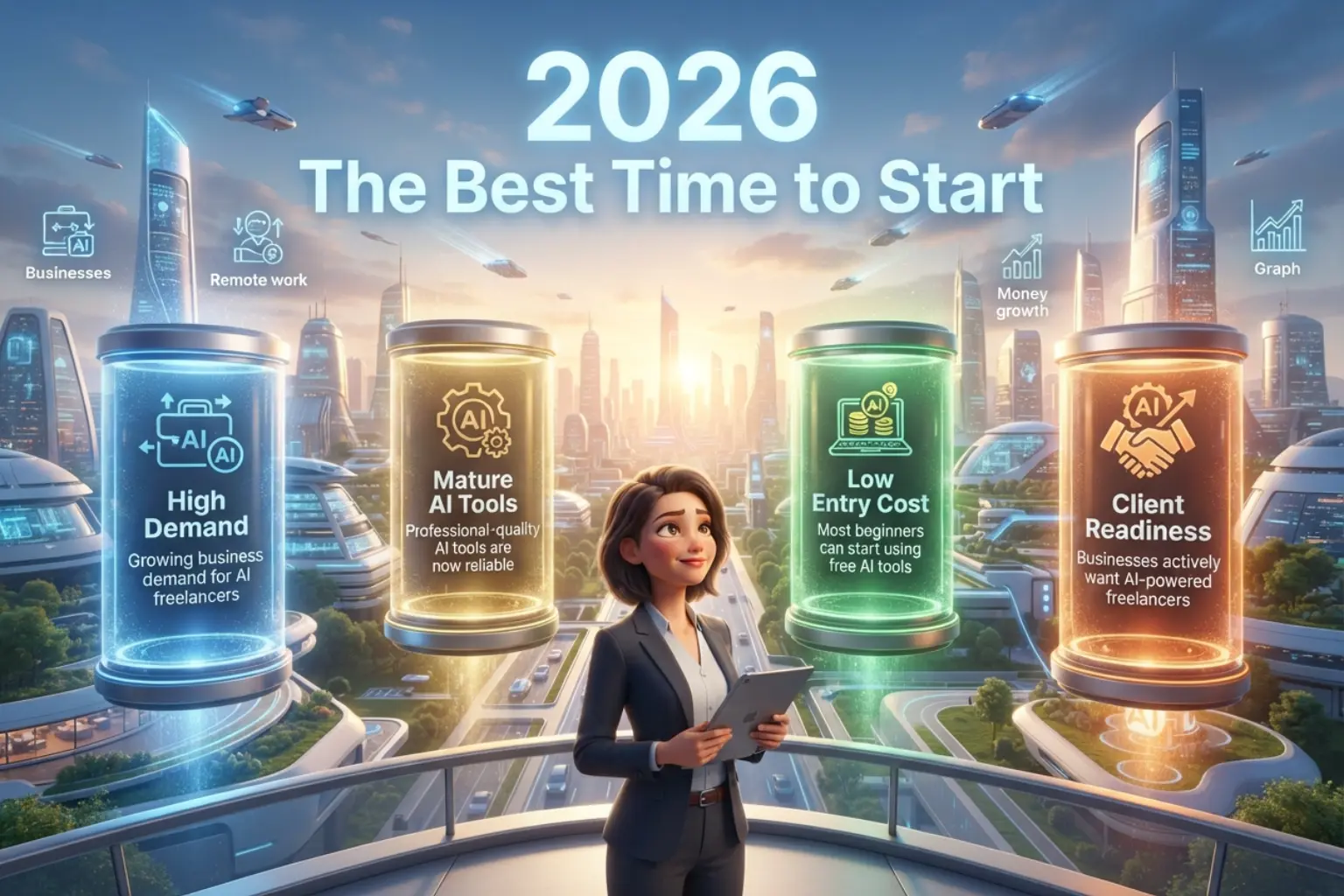
The timing matters. Here is the honest picture of where the market is right now.
Demand for AI-skilled freelancers has grown significantly across every major platform. Businesses of every size are trying to create more content, automate more tasks, and serve customers faster — but most business owners do not have the time or knowledge to use AI tools effectively themselves. This creates a genuine and growing gap that AI freelancers fill.
The tools have matured. In 2022 and 2023 AI tools were experimental and inconsistent. In 2026 tools like ChatGPT, Claude, Canva, and Runway are stable, reliable, and capable of producing professional-quality output when used correctly. The learning curve is lower than it has ever been.
The barrier to entry has also dropped to almost zero. Most major AI tools have free tiers that are sufficient for a beginner to complete real client work and build a genuine portfolio. You do not need expensive subscriptions before your first client.
Most importantly — clients are ready. Two years ago many small business owners were skeptical about AI. In 2026 most of them understand the benefits and actively want to work with freelancers who use AI tools because it means faster delivery and better value for their budget.
This combination of high demand, mature tools, low entry costs, and client readiness makes 2026 a genuinely good window to start. Starting now while the market is still growing is a real strategic advantage over waiting until the space becomes more crowded.
Knowing the timing is right is one thing. Knowing what you actually need to act on it is another — and the answer is shorter than most beginners expect.
What You Actually Need to Start AI Freelancing
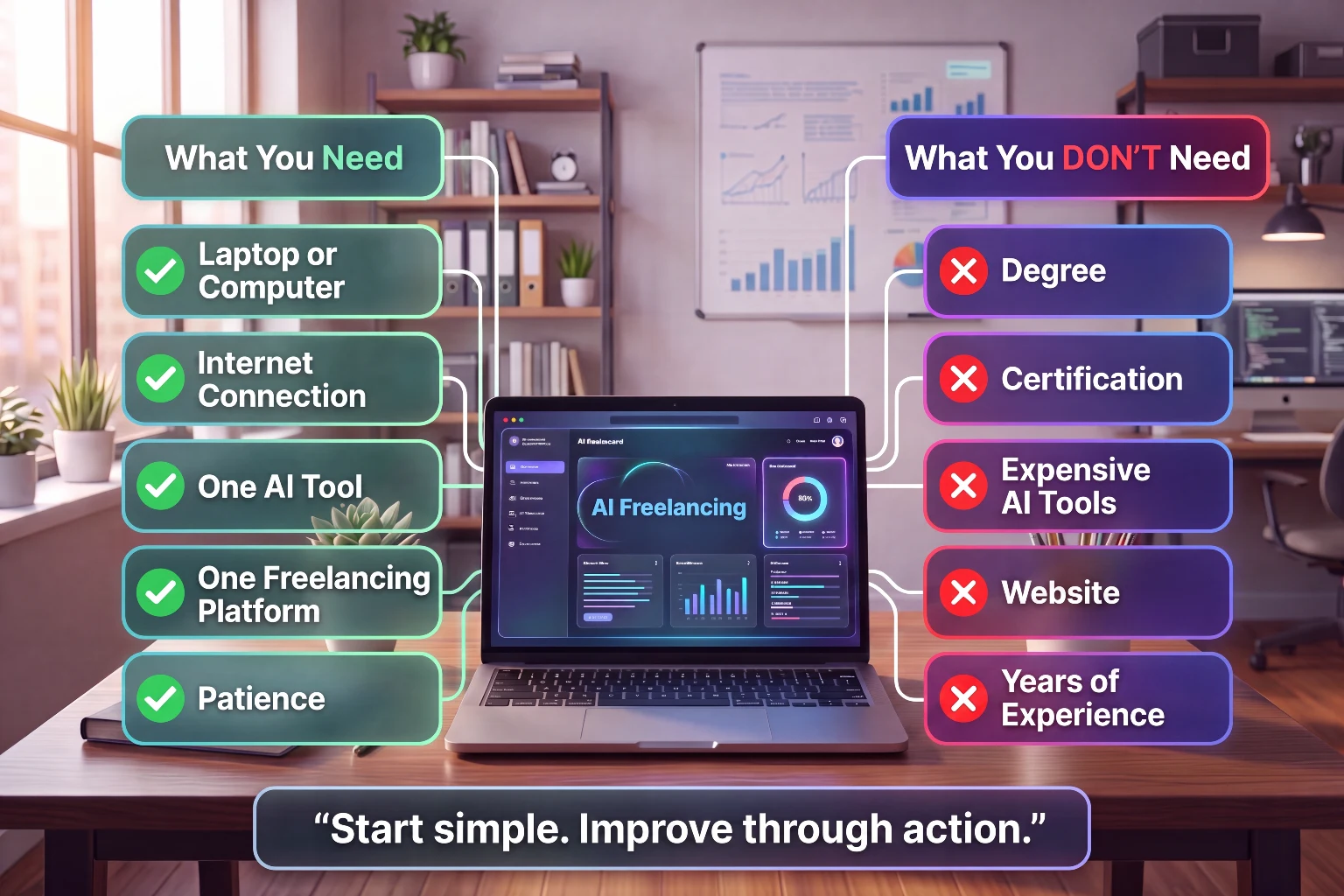
Before going through the steps, here is what you actually need — and what you do not need — to get started.
What you need:
- A laptop or computer with a reliable internet connection
- A free account on one AI tool — ChatGPT is the best starting point for most beginners
- One clear service to offer — just one, not five
- A free account on one freelancing platform — either Fiverr or Upwork
- The patience to work through a slow first month without giving up
What you do not need:
- A degree, certification, or formal qualification of any kind
- Expensive paid AI tool subscriptions before your first client
- A professional website or personal portfolio site before starting
- Years of previous freelancing or writing experience
- Permission from anyone to begin
The single biggest mistake beginners make before they even start is overcomplicating the setup. They spend weeks building websites, comparing every AI tool, designing logos, and preparing for a launch that never comes. The setup takes one afternoon. The results come from showing up consistently after that.
With the basics covered, here is the complete path from zero to your first paying client — broken into seven stages you can follow in order.
The Arthify Freelancing Roadmap
Every section of this guide maps to one stage of this roadmap. By the time you finish reading, you will have a clear picture of exactly where to start, what to do next, and how each stage builds on the one before it.
The Arthify Freelancing Roadmap
7 stages · Start earning online with AI
Stage 1 — Choose Your AI Freelancing Service
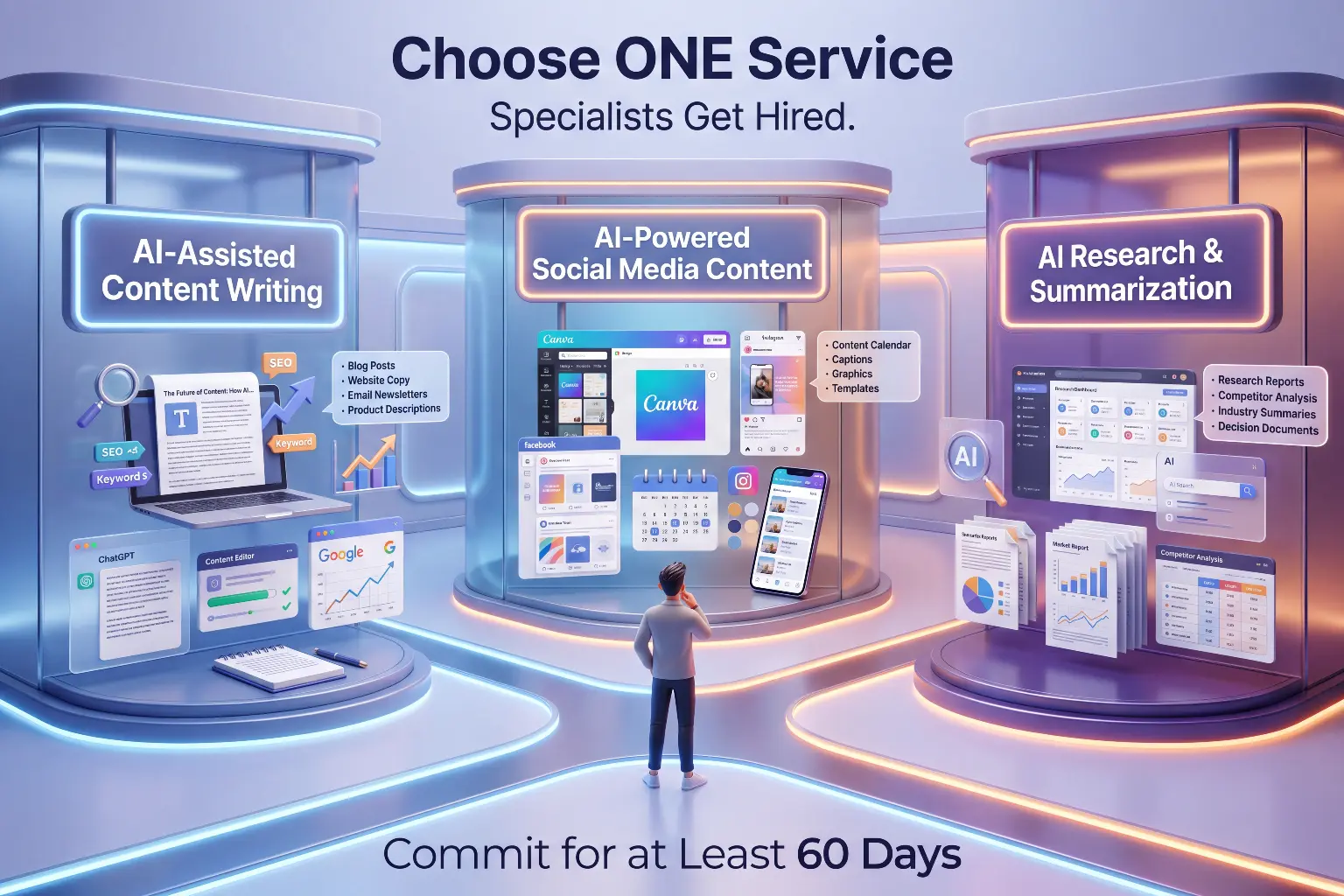
The single most common mistake beginners make is trying to offer every service they can think of before proving they can deliver even one.
A profile that lists writing, design, video editing, chatbot building, research, and social media tells every potential client the same thing — this person does not specialise in anything. And clients hire specialists. Always.
Think about it from the client’s perspective. If you need surgery, do you want a doctor who also does dentistry, dermatology, and pediatrics? Or a surgeon? The specialist wins, even if the other doctor is technically capable of all four. The same logic applies to freelancing.
The three most beginner-friendly AI freelancing services in 2026:
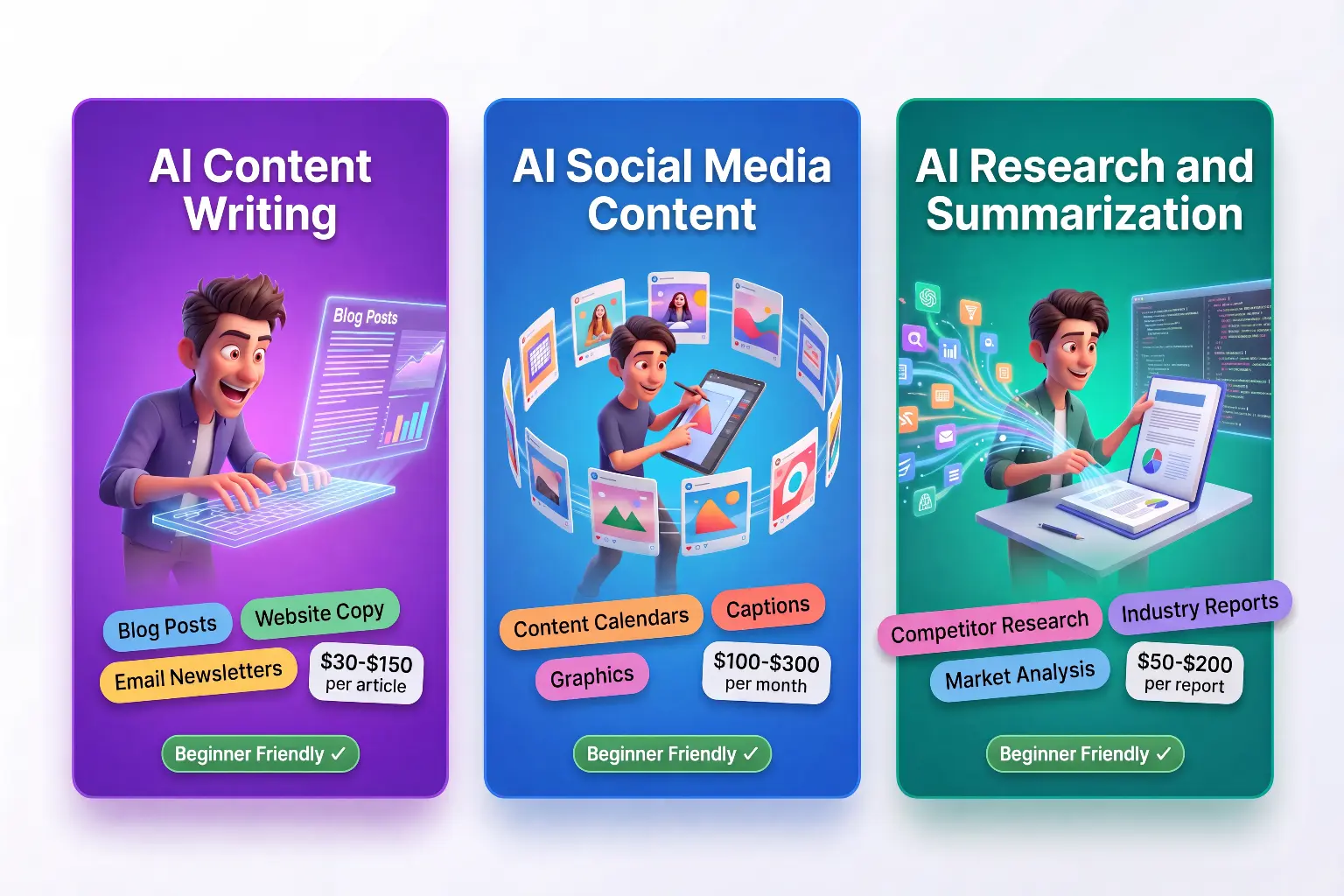
AI-Assisted Content Writing:
- What you deliver — blog posts, website copy, email newsletters, product descriptions
- Who typically hires for this — small businesses, agencies, SaaS companies, and bloggers who need consistent content but lack the time to write it themselves — If you want to understand how blogging works from the content side, our guide on How to Start Blogging with AI covers the full process.
- Why it works — writing is where AI tools are most effective and where free tiers are most capable
- What clients pay — $30 to $150 per article for beginners, $300 to $1,500 per month for content retainers as reviews build
AI-Powered Social Media Content:
- What you deliver — monthly content calendars, captions, post templates, designed graphics
- Who typically hires for this — local businesses, ecommerce brands, and solo entrepreneurs who know they need a presence but cannot keep up with daily posting
- Why it works — every business with a social presence needs this and most lack the time to create it
- What clients pay — $100 to $300 for a monthly content package for beginners
AI Research and Summarization:
- What you deliver — competitor research reports, industry summaries, organized information in clear actionable formats
- Who typically hires for this — founders, marketers, and consultants who need to make decisions quickly but do not have hours to manually research
- Why it works — one of the least competitive beginner services available right now, since most beginners go straight for writing or design
- What clients pay — $50 to $200 per research report depending on depth and complexity
All three services share the same growth path. You start with single, one-off projects to build reviews, move into monthly retainers once a client trusts your work, and eventually combine adjacent skills — a content writer who also handles light social media, or a researcher who also writes the report they researched — to increase your value per client without needing to learn a completely new service.
For a deeper look at how each of these services works and what you can realistically earn from each one, our guide on How to Make Money with AI in 2026 covers all three in complete detail. Choose one from that guide, then come back here for the process of building your freelancing career around it.
How to choose the right service for you:
- Which of these genuinely interests you? Interest sustains consistency better than any other factor.
- Which one connects to something you already know something about? Background knowledge produces better output and faster improvement.
- Which one can you practice and improve at within the next five days? Choose the service where you can sit down today and create a sample piece.
Pick one. Commit to it for at least 60 days before considering expanding.
Once you know what you are offering, the next challenge is proving you can deliver it — without a single client to show for it yet.
Stage 2 — Build a Portfolio With No Clients (Breaking the Beginner Catch-22)
Every beginner hits the same wall almost immediately.
Clients want to see experience. To get experience you need clients. But to get clients you need experience.
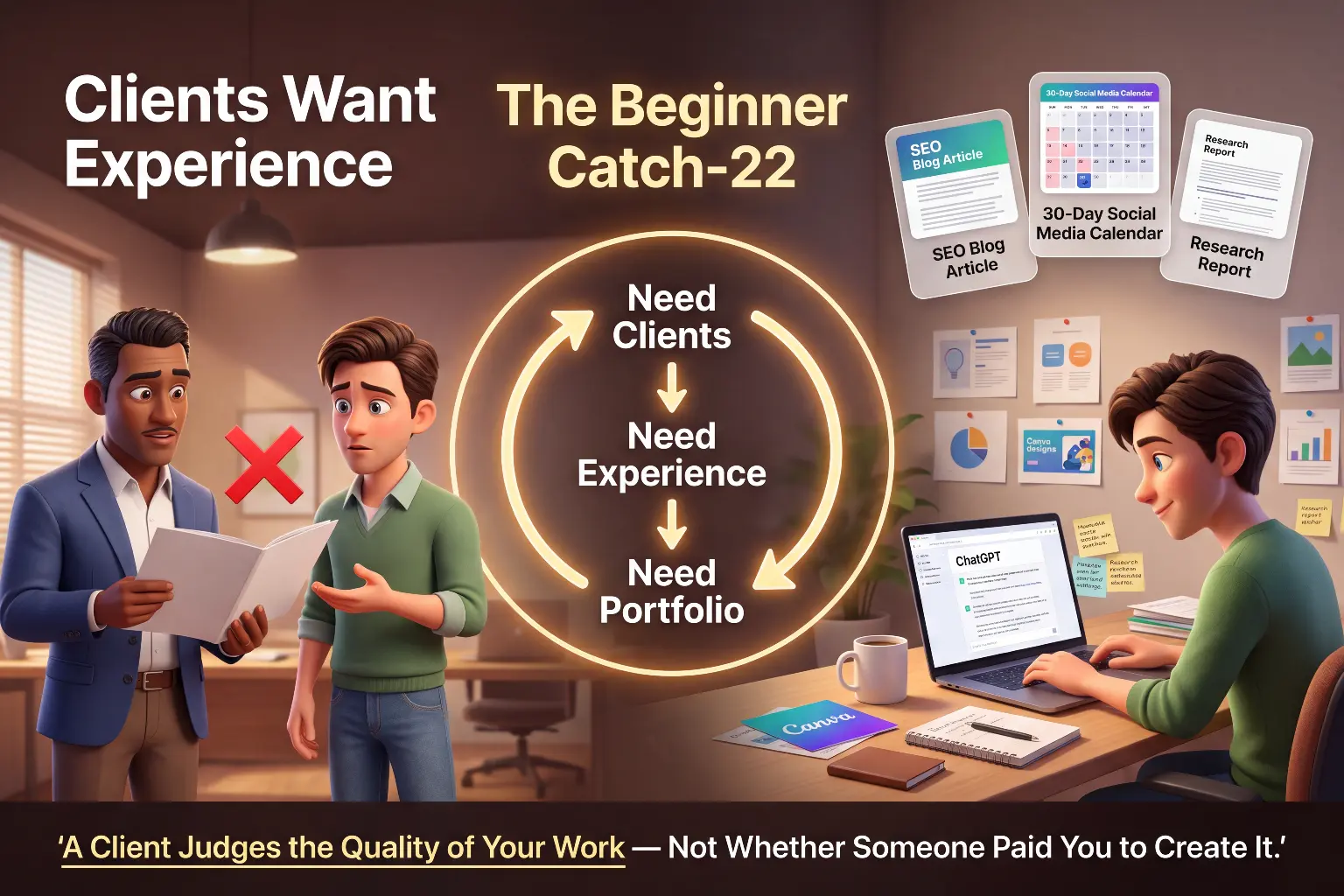
This feels like an impossible loop. It is not — but breaking it requires understanding what clients actually mean when they ask for experience. They are not asking for a specific number of completed projects. They are asking one question: can I trust this person to deliver something I would actually use?
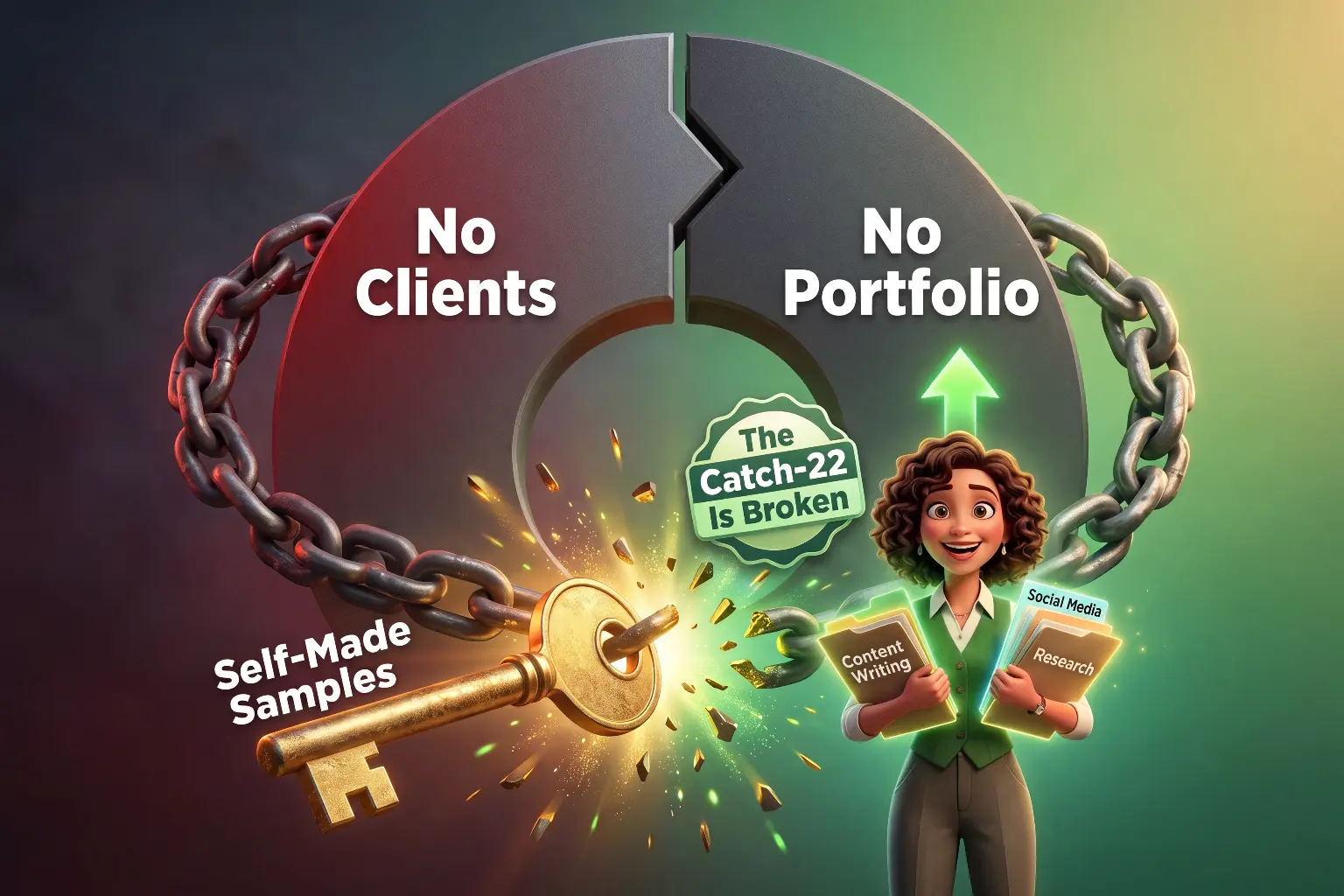
That question can be answered with a strong portfolio sample even if no client ever paid for it.
Here is the insight that most beginner guides never say directly: a client evaluating your work has no way of knowing whether a portfolio piece was paid for or created as a practice exercise. They judge the quality of the output, not its employment history. A perfectly written blog post you created as a practice piece is indistinguishable from a blog post you wrote for a paying client — as long as the quality is genuinely there.
Build three to five strong portfolio samples this weekend before sending a single proposal.
What to create based on your chosen service:
For content writing — write three complete blog posts on topics you know or find genuinely interesting. Each should be at least 800 to 1,000 words, well structured with headings, and edited to a professional standard. Do not submit raw AI output. Draft with AI, then read every sentence critically, rewrite anything generic or inaccurate, add real examples and specific insights, and make it something you would genuinely be proud to put your name on. Clients hiring content writers increasingly expect basic SEO knowledge. Our guide on On-Page SEO for Blog Posts is the fastest way to build that foundation.
For social media content — create a complete thirty-day content calendar for a fictional brand in a niche you understand. Include captions, post ideas, and at least ten designed graphics using Canva. Give the brand a real name, a consistent voice, and a recognizable aesthetic across all posts. Make it feel like a real client project.
For research and summarization — choose a topic that small businesses commonly need to understand — competitor analysis for a specific industry, a summary of recent trends in a particular market, or a comparison of tools for a specific business task. Research using Perplexity AI, organize the findings clearly, and present them in a professional document format that a business owner could use to make an actual decision.
What makes a portfolio sample convincing:
- Specificity — a blog post about “five AI tools that help real estate agents save ten hours a week” is far more compelling than a blog post about “AI tools in general.” Specific samples show potential clients that you understand their world.
- Polish — every sample should be completely finished. No placeholder sections, no notes to yourself about what to add, no spelling errors. Treat every portfolio piece as if the client you most want to impress is reading it in the next hour.
- Relevance — make your samples match the type of clients you want to attract. If you want to write for technology brands, write technology samples. Niche relevance converts better than general competence.
A strong portfolio breaks the catch-22 by giving clients proof before they ever ask for it. The next step is making sure that proof actually gets seen — which starts with your profile.
For the complete walkthrough of exactly what to build for each service, which type of samples are most convincing, where to host your portfolio, and how to write a case study for a self-made piece, our dedicated guide on How to Build an AI Freelancing Portfolio With No Experience covers every detail.
Stage 3 — Set Up Your Freelancing Profile
Your profile is your first impression. For most clients on Fiverr and Upwork, it is the only impression before they decide whether to contact you or keep scrolling.
How to write a profile that clients actually read:
The most common mistake is writing about yourself instead of writing about what you deliver for clients.
This does not work: “I am a passionate writer with years of experience and a love of storytelling.”
This works: “I help small businesses publish consistent, well-researched blog content using AI tools — delivered faster and at a higher quality than traditional writing services.”
Write your profile as if you are answering one unasked question from the client: why should I hire this person specifically?
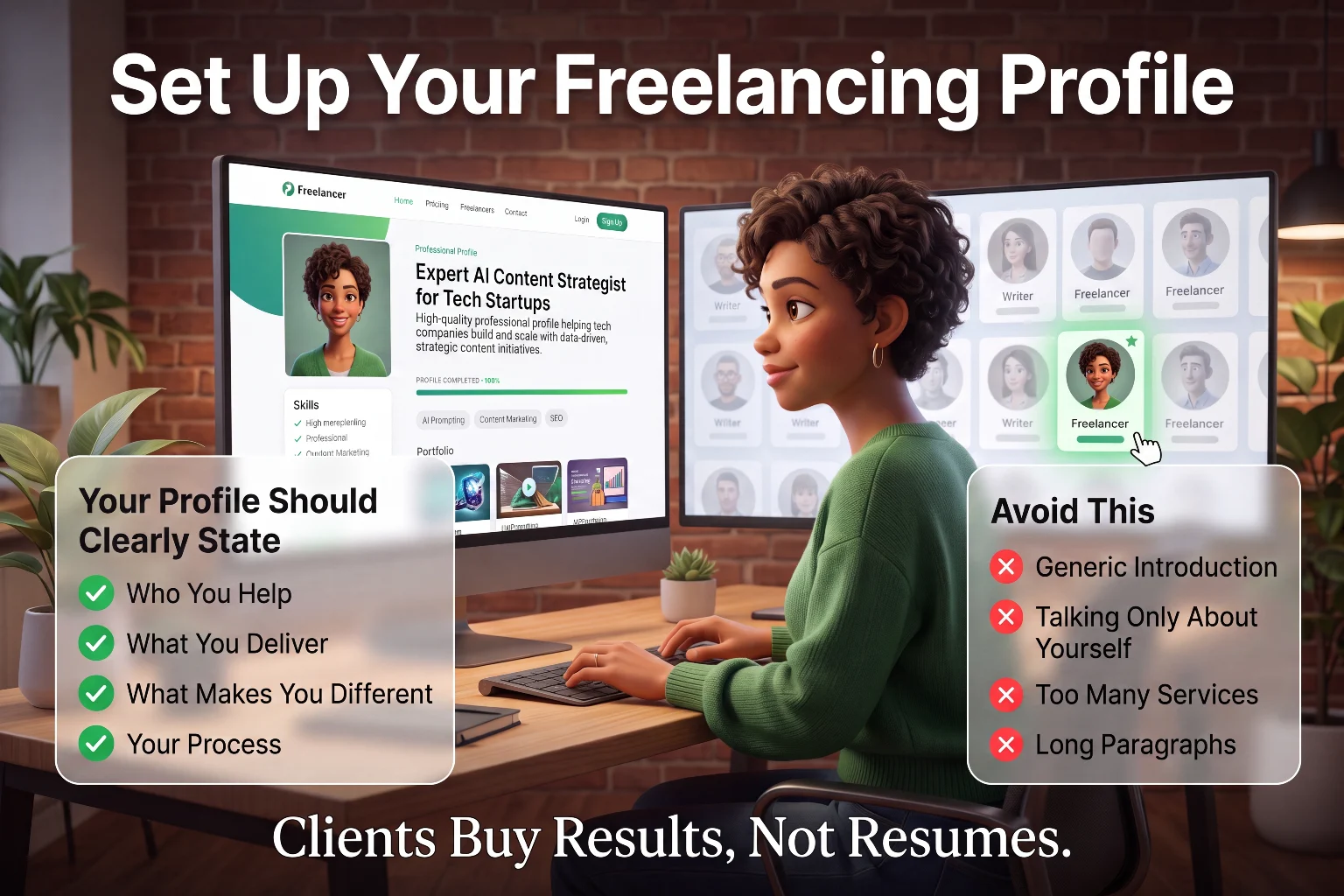
Your profile should clearly state:
- Who you help — be specific about the types of clients and industries you serve
- What you deliver — the specific output or result, not just the general category
- What makes working with you different — faster turnaround, AI-powered research, professional editing before delivery
- How your process works — one sentence about what working with you feels like so clients know what to expect
Keep it short enough to read in ninety seconds. Clients skim for clarity and confidence, not length.
Fiverr vs Upwork — the honest comparison:
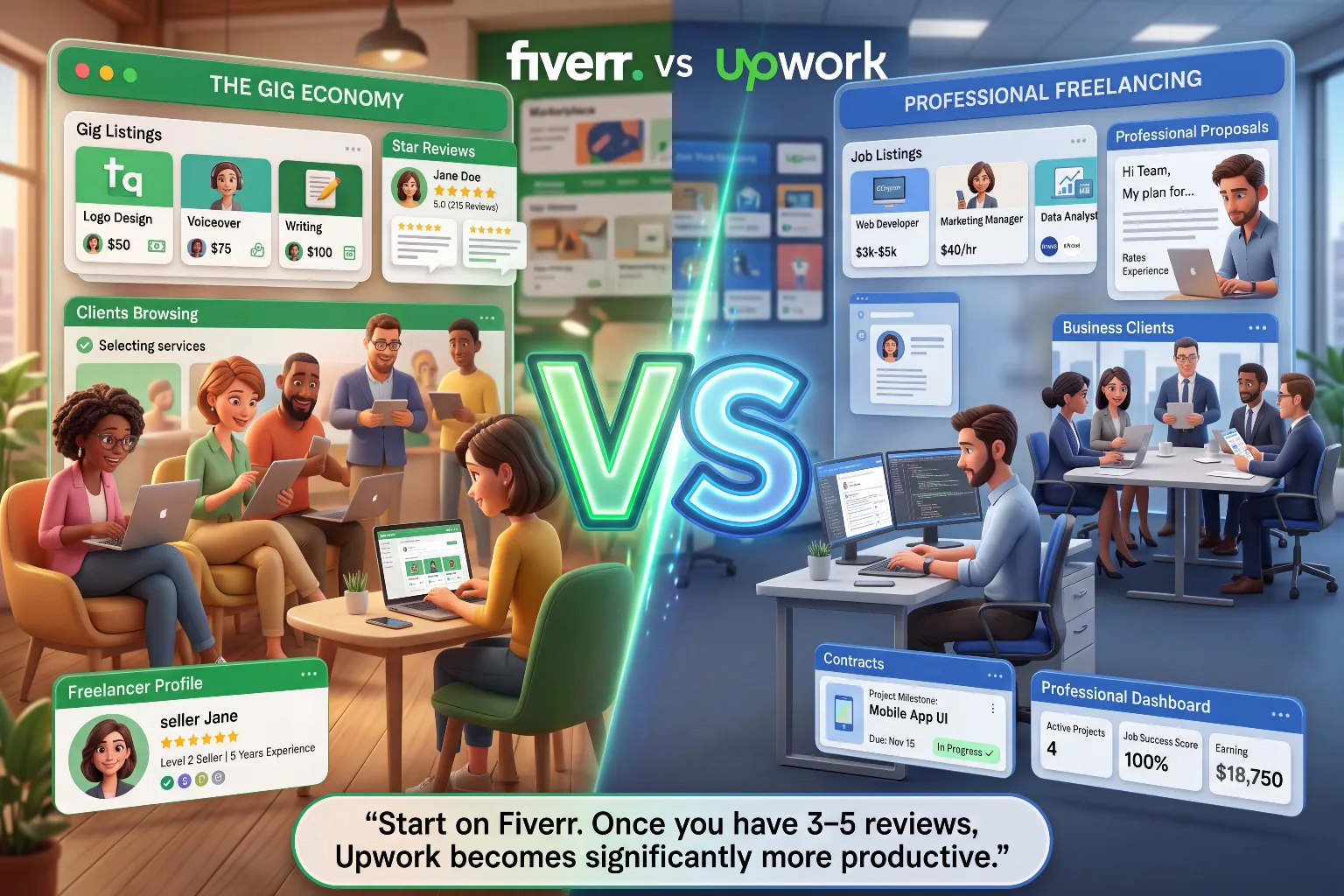
For most complete beginners, start on Fiverr. Once you have your first three to five reviews, Upwork becomes significantly more productive because you have something to show in your proposals.
A strong profile gets you noticed. What gets you hired is what you say next — and that depends entirely on how you write your proposals.
Stage 4 — Write Proposals That Get Replies
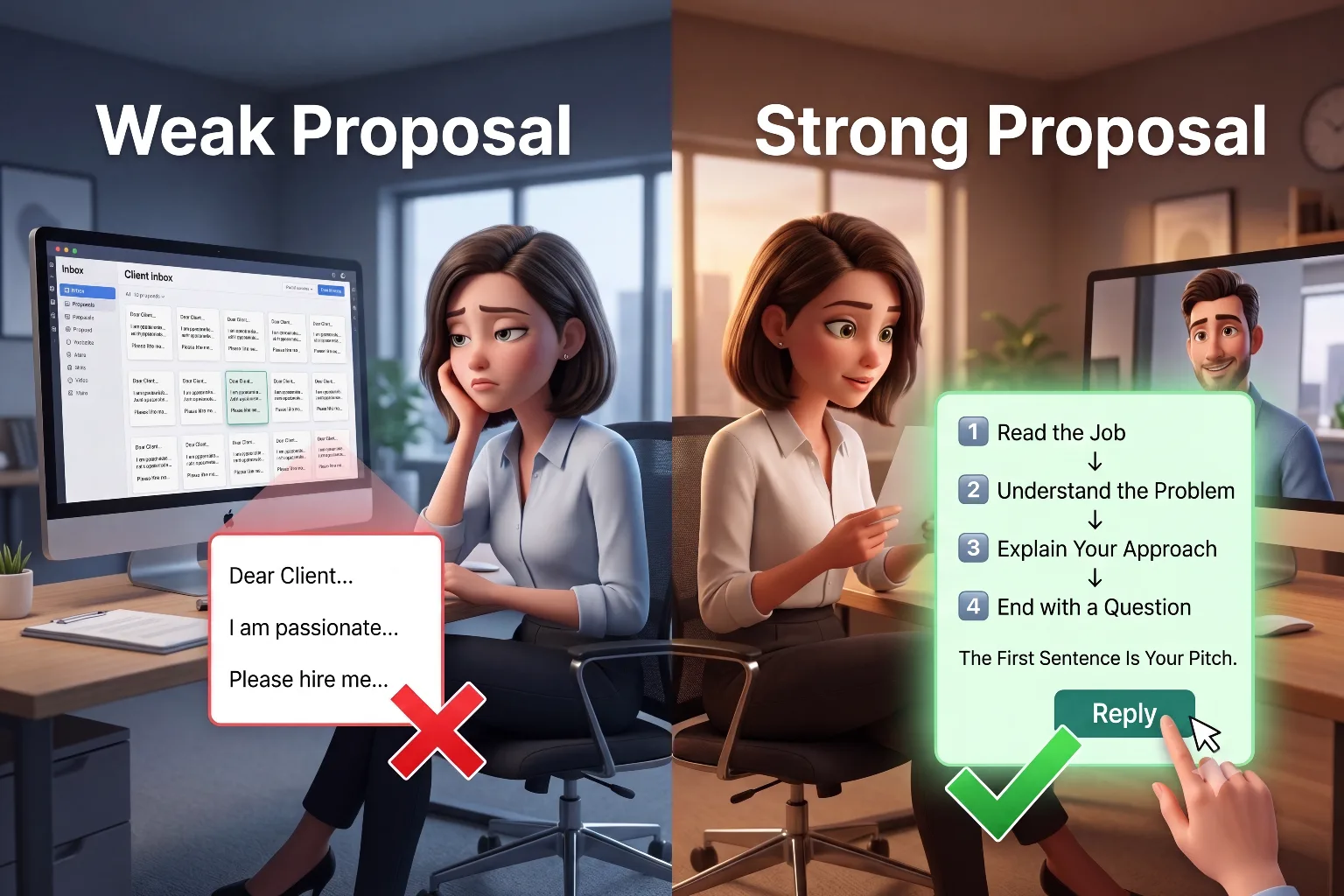
Most proposals get ignored. Not because the freelancer is unqualified — but because the proposal sounds exactly like every other proposal the client received that day.
The average client on Upwork sees between 20 and 50 proposals per job posting. They skim looking for one thing: a sign that this person actually read the job description and understands what I need. Most proposals fail this test in the first sentence.
The first sentence of your proposal is the only sentence most clients actually read before deciding whether to continue. Everything else is context for the people who were already interested. This means your first sentence is not an introduction — it is your entire pitch compressed into one line.
The four parts of a proposal that works:
- Part 1 — Prove you read the job post. Reference one specific detail from the description in your opening. Not the general topic — something specific that shows you actually read it.
- Part 2 — Show you understand the underlying problem. In one sentence, describe the real challenge behind the request. A client posting for blog content is trying to get found on Google or build audience trust — not just fill a page with words.
- Part 3 — Say specifically how you would approach their project. Not your skills in general — how you would approach this exact project. Two sentences maximum.
- Part 4 — End with a low-pressure question or offer. Not “please hire me” — something like “Would it help if I shared a sample outline for your first post?” This invites conversation rather than demanding a decision.
Weak proposal vs strong proposal — the same job, two completely different results:
Client post: Looking for a writer for weekly blog posts about sustainable fashion.
Weak version:
“Dear client, I am a professional content writer with extensive experience in writing SEO-optimized blog posts across multiple industries. I am hardworking, reliable, and passionate about delivering high-quality content. Please check my portfolio and let me know if you would like to work together.”
Strong version:
“You mentioned your sustainable fashion brand needs content that connects with eco-conscious consumers — that is a specific audience with specific values and generic content will not reach them. I write research-backed blog posts using AI for drafting and personal editing to match your brand voice and your readers’ values. I can have a sample intro section for your first post ready within 24 hours. What topic would be most useful to start with?”
The strong version is two sentences longer and infinitely more likely to get a reply. It proves the freelancer read the post, understands the challenge, offers specific value, and ends with a natural question. Write every proposal this way.
A great proposal gets you the project. What you do with that first project determines whether you ever have to write a cold proposal again.
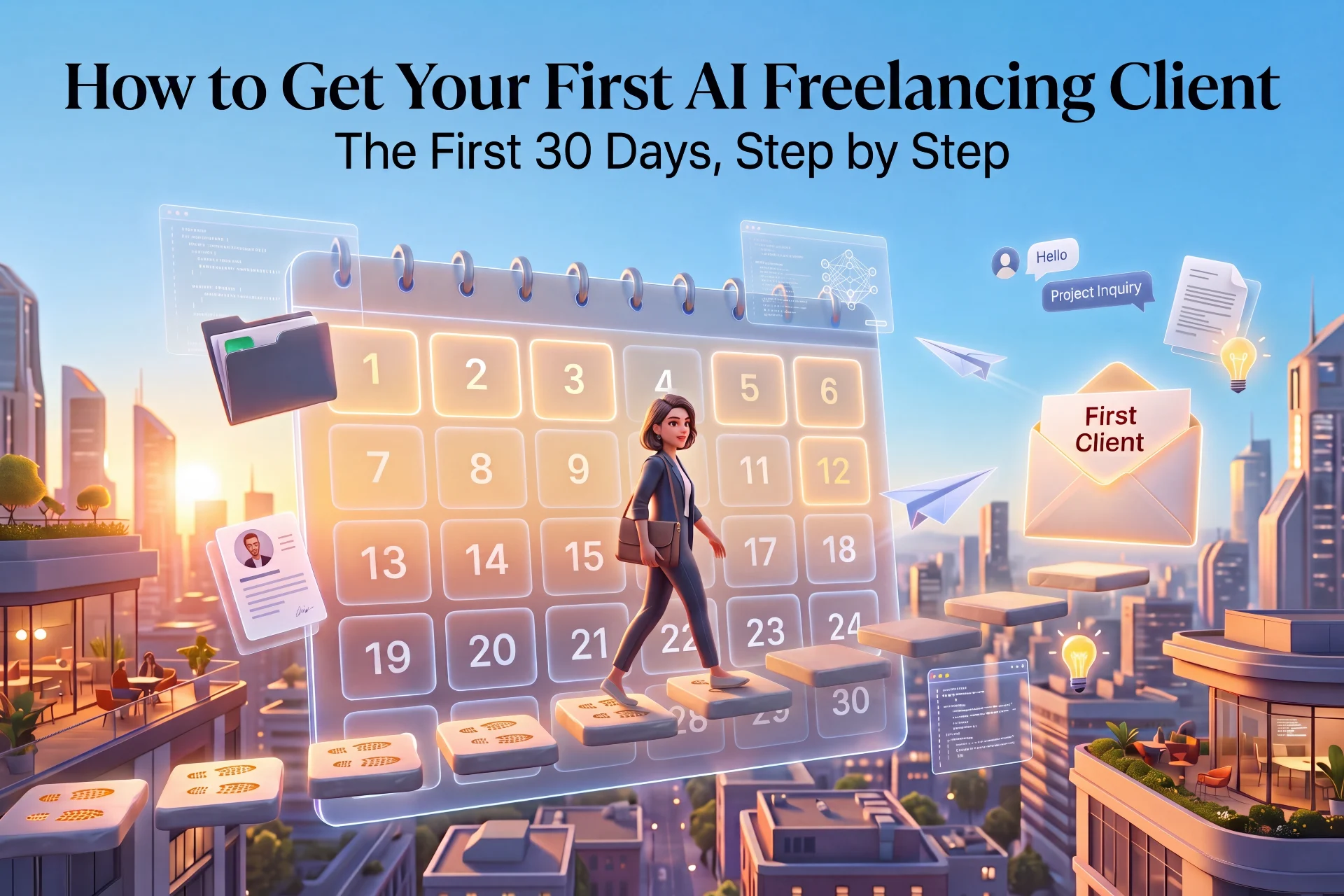
For a deeper, day-by-day breakdown of the entire process of landing your first client — including how many proposals to send and what to do if the first two weeks are silent — our guide on How to Get Your First AI Freelancing Client covers the complete 30-day system.
Stage 5 — Deliver Your First Project and Get Your First Review
Your first project has one goal that matters more than the payment — a five-star review.
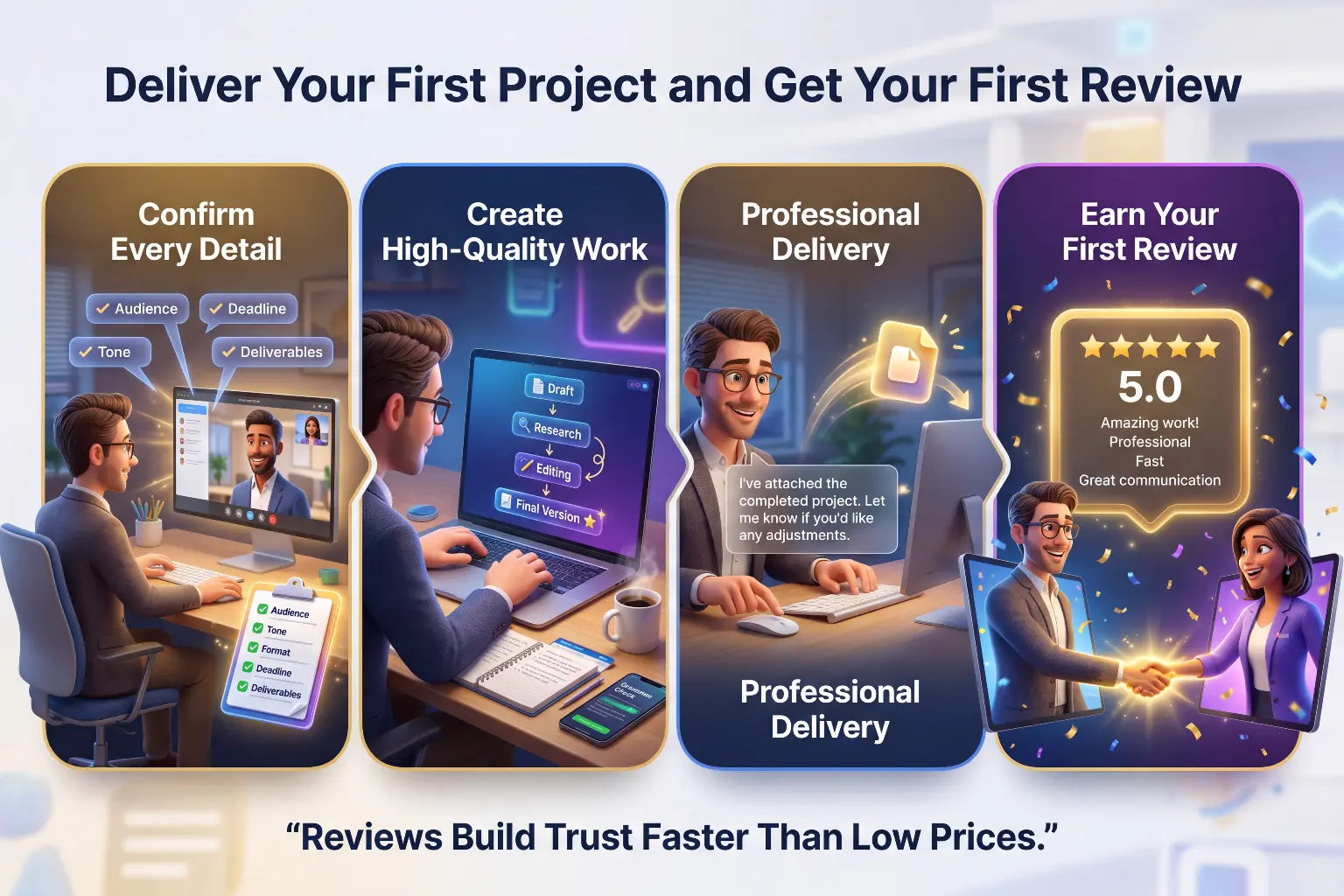
Reviews are the currency that unlocks everything else on freelancing platforms. A profile with five strong reviews consistently outperforms a profile with zero reviews at any price point. Your first three to five projects are an investment in that review count, not just in income.
The complete delivery process for every project:
- Before starting — confirm every detail in writing. What is the exact deliverable? What format? What tone? Who is the audience? Getting clear answers upfront prevents the most common source of client disappointment — the freelancer delivering something technically correct but not what the client actually imagined.
- During the project — spend equal time editing as generating. Read every AI-drafted sentence. Ask three questions about each one: is this accurate? Is this specific enough to be useful, or is it generic? Does this sound like a real expert or like an AI? Rewrite every sentence that fails any of these tests. Add at least two or three specific examples or insights from your research rather than from the AI draft.
- After delivering — invite feedback directly. “Is there anything in the tone, structure, or detail level you would like adjusted for future pieces?” This positions you as a professional who cares about quality, not someone who submits work and disappears.
- After the client is satisfied — ask for a review politely and specifically. “If you found the work helpful, a quick review on the platform would mean a lot — it helps beginners like me build credibility with future clients.” Most satisfied clients do not leave reviews unprompted even when they are completely happy. A direct, polite request converts most of them.
Landing one client proves your process works. The real challenge is making sure you do not have to start from zero every month — which is exactly what the next stage solves.
Stage 6 — Turn One Client Into Ongoing Income
Finding new clients constantly is exhausting. Keeping existing clients happy is far more sustainable — and far more profitable over time.
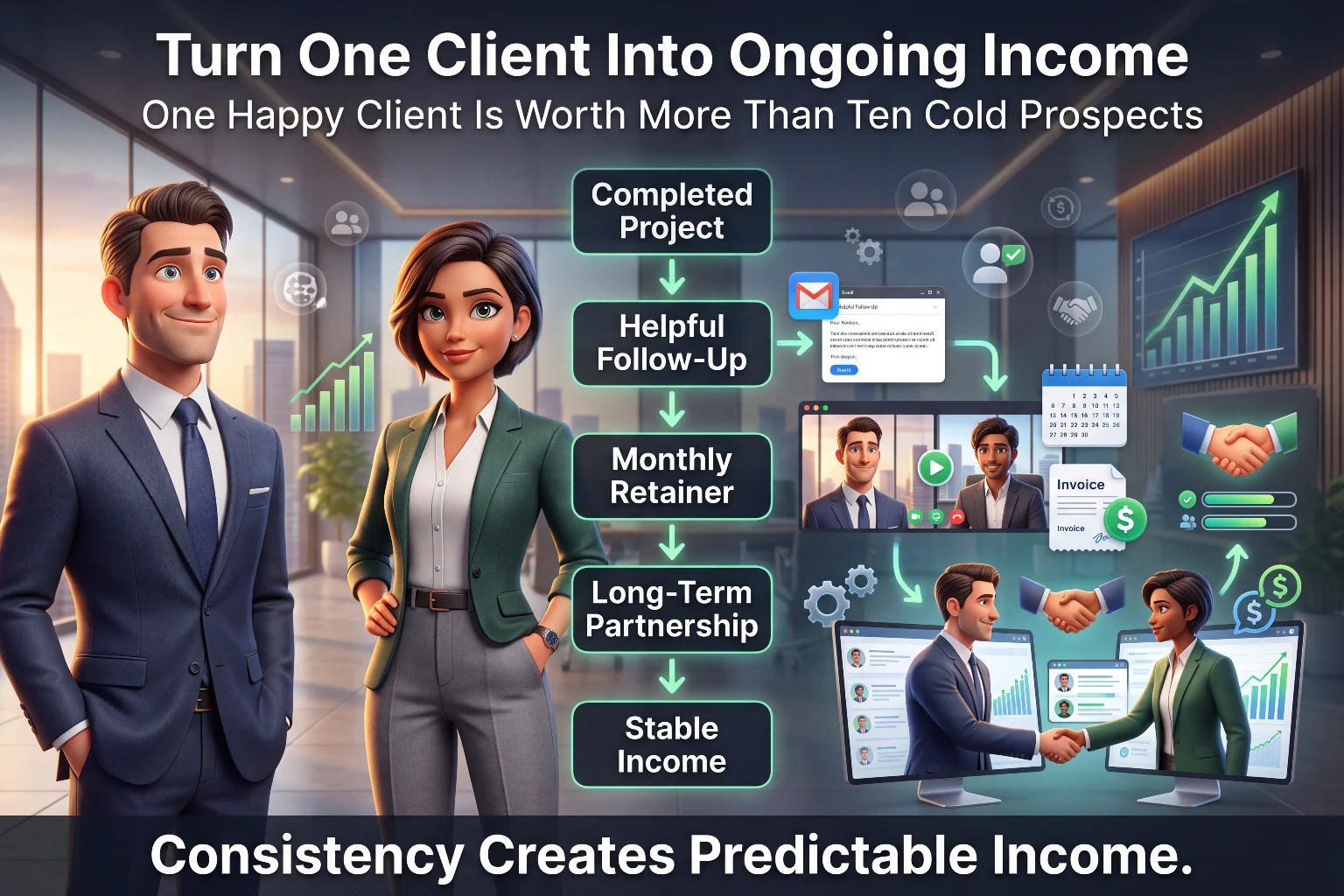
Two days after successfully delivering a project, send a brief follow-up message. Do not immediately ask for more work. Instead share one useful observation — something you noticed while working on their project that might help them. Something like: “While researching for your post, I noticed your competitors are consistently covering a topic your blog has not addressed yet — it might be worth getting ahead of that.”
Then, in that same message or a few days later, propose a retainer naturally. “If it would be helpful, I could commit to one article per week for a flat monthly rate — consistent delivery without having to post new jobs each time.” Make the proposal value-focused. Emphasize consistency and reliability, not just price.
Most clients who are happy with your first project will at least consider a retainer if you propose it clearly and professionally. Two or three monthly retainer clients is a completely different financial reality from hunting for new one-off projects every week.
A retainer client gives you stability. The next stage is making sure your rates actually grow alongside that stability instead of staying frozen at your beginner price.
Stage 7 — Raise Your Rates and Build Long-Term Growth
Most beginners start at lower rates to attract their first clients. This is correct strategy — but only temporarily.
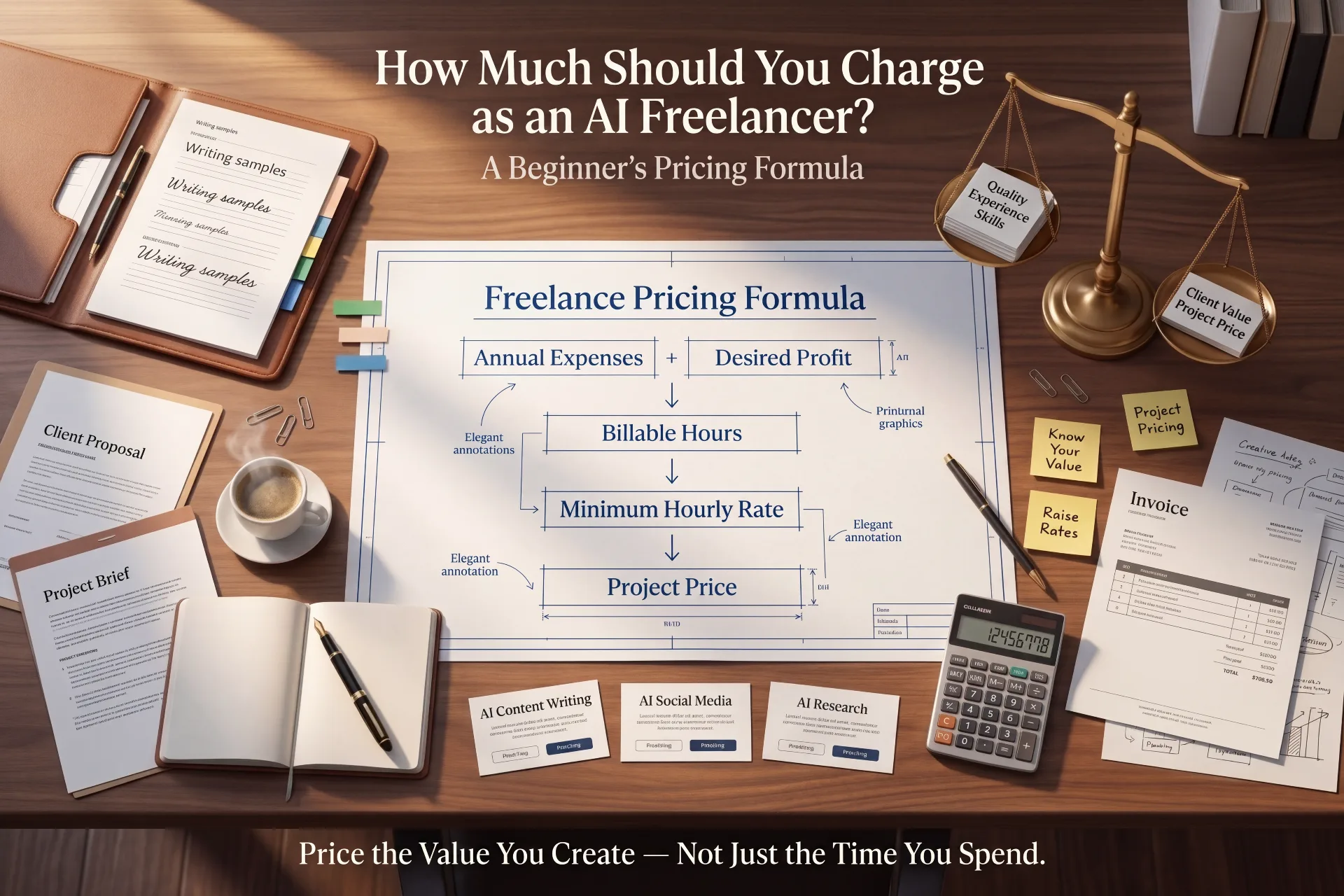
Here is the honest pricing roadmap for AI freelancers:
AI Freelancer Pricing Roadmap
3 stages · Beginner to pro rates
of market rate
market rate
above market
The most important pricing principle for AI freelancers is to charge per project rather than per hour wherever possible. AI makes you faster — and hourly billing punishes that speed. If a project that used to take four hours now takes ninety minutes with AI assistance, hourly billing means you earn less for the same quality of output. Project-based pricing means you earn the same or more while delivering faster.
Raise your rates after every five positive reviews. This creates a natural, sustainable progression from beginner rates to professional rates without one scary jump.
With your service, portfolio, profile, proposals, delivery process, retainers, and pricing all in place, you have completed every stage of the roadmap. What ties all seven stages together day to day is how you actually use AI tools while doing the work — which is what the rest of this guide covers.
For the complete formula behind this pricing roadmap — including real pricing tables and why charging per project protects your AI speed advantage — our guide on How Much to Charge as an AI Freelancer covers the full breakdown.
How to Use AI Tools in Your Professional Freelancing Workflow
Knowing which AI tools to use is only half the picture. Knowing exactly how to use them within a professional freelancing workflow is what separates beginners from professionals.
The freelancers who earn the most are not the ones who use AI the most. They are the ones who know exactly where to stop trusting AI and start trusting themselves.
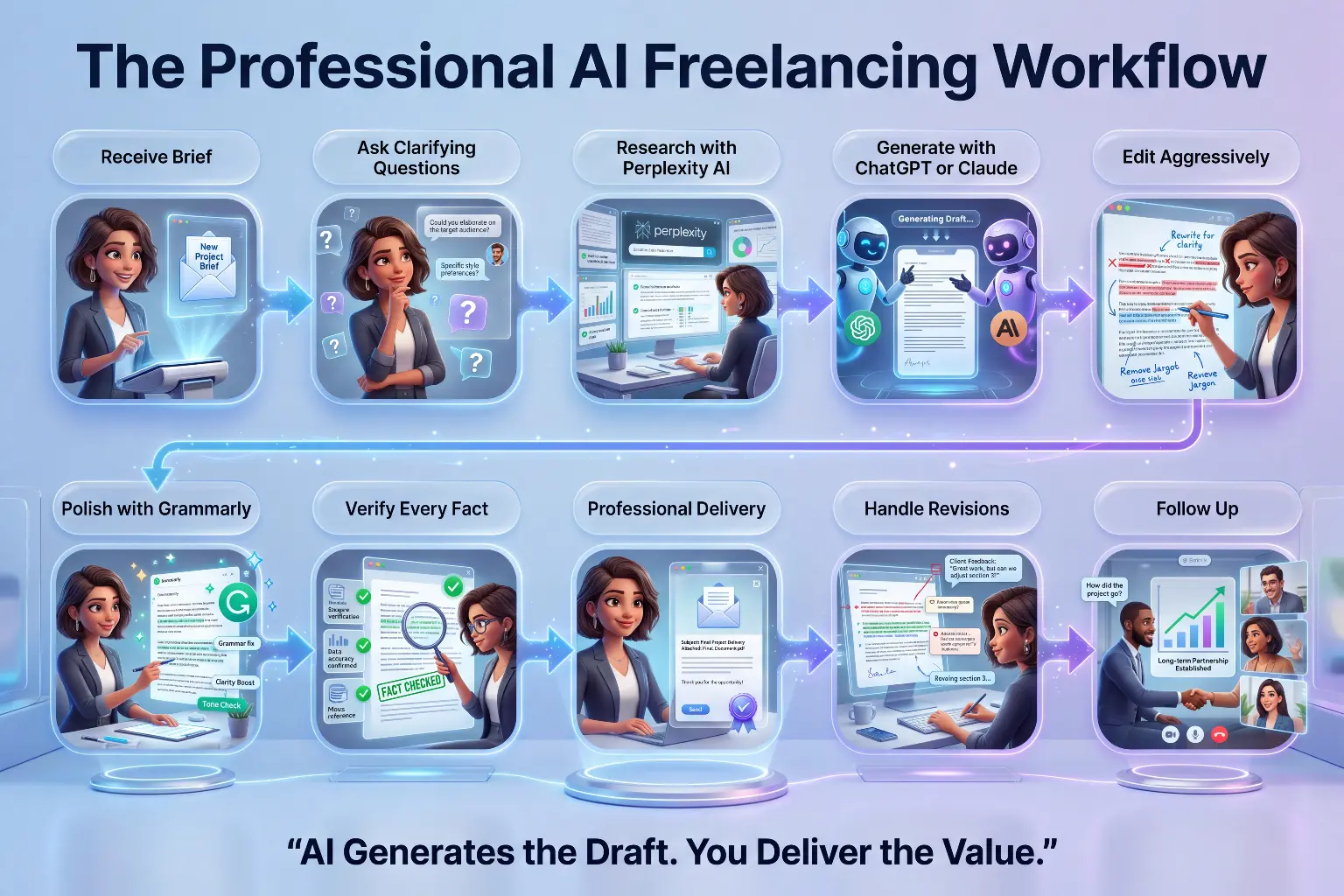
Here is the complete workflow from client brief to final delivery:
The Professional AI Freelancing Workflow:
- Receive brief — read every word carefully. Do not start working immediately. Identify everything that is unclear or missing before touching any AI tool.
- Ask clarifying questions — confirm audience, tone, format, deadline, and what success looks like for the client. Clients always appreciate this. It signals professionalism.
- Research with Perplexity AI — before drafting anything, use Perplexity AI to gather current statistics, recent developments, and angles most content on this topic misses. Save your sources. If your freelancing service includes SEO content, our guide on How to Do Keyword Research for Blogging Using AI shows you exactly how to find the right topics for your clients.
- Generate with a specific prompt — give ChatGPT or Claude the research, the context, the audience, the tone, and the specific points to cover. A detailed prompt produces a draft that needs half the editing of a generic one. Our guide on How to Write Better Prompts for AI shows you exactly how to build prompts that produce professional results.
- Edit aggressively — read every sentence. Is it accurate? Is it specific? Does it sound human or generic? Rewrite every sentence that fails any of these tests. Add your own examples and insights from the research you gathered.
- Polish with Grammarly — run the edited piece through Grammarly for grammar, clarity, and tone. Then read the entire piece aloud once. Your ear catches what your eyes miss.
- Verify every fact — check every statistic and factual claim against the original sources. AI tools occasionally misremember numbers or misattribute quotes. One wrong statistic in a delivered piece damages your reputation disproportionately.
- Deliver with a professional note — never send a file attachment without context. Include a brief message explaining what you delivered, any decisions you made, and an explicit invitation for feedback.
- Handle revisions calmly — respond without defensiveness. Confirm what the client wants changed. Redeliver within your stated timeline. If the revision is outside the original scope, it is professional to note this and propose a small additional fee.
- Follow up after completion — two days after delivery, send a useful observation about their project. Then propose ongoing work if the relationship went well.
Which AI tool to use for which task:
For drafting, brainstorming, and outlining — ChatGPT is the most versatile starting point. Our guide on How to Use ChatGPT for Beginners covers the practical workflow from setup to professional use.
For editing long documents, matching a specific tone, and reviewing complex content — Claude is particularly strong. Our guide on How to Use Claude AI for Beginners explains how to use Claude for content and research tasks effectively.
For real-time research and finding current statistics — Perplexity AI searches the web and cites sources, making it invaluable for any research-based freelancing work.
For creating visuals, social media graphics, and design assets — Canva with its AI features handles professional-quality visual content without formal design training.
For a complete overview of the most useful AI tools available right now, our guide on Best New AI Tools in 2026 covers everything worth knowing.
Knowing the workflow is one thing. Knowing how long it realistically takes before that workflow turns into actual income is what most beginners want to know next.
How Long Does It Actually Take to Earn Your First Income
This is the question every beginner wants answered honestly. Here it is.

Most beginners who follow a clear process — one service, a strong portfolio, active daily outreach — land their first client within two to four weeks. Some get there faster. Some take six to eight weeks. The main variables are how specific your service positioning is, how strong your portfolio samples are, and how consistently you are sending proposals or optimizing your gig.
The honest timeline most beginners experience:
- Weeks 1 to 2 — Setup, portfolio building, profile creation, first proposals or gig listings. No income yet. This is infrastructure, not stagnation.
- Weeks 3 to 6 — First client typically arrives during this window for consistent beginners. First payment received.
- Month 2 to 3 — First reviews collected. Second and third clients arrive. Income of $100 to $400 total is common.
- Month 4 to 6 — Reviews building, repeat clients starting, $300 to $1,000 per month becoming realistic for active freelancers.
- Month 6 onwards — For consistent freelancers with two or three retainer clients, $1,000 to $3,000 per month is achievable.
These are realistic ranges, not guarantees. Your specific results depend on your consistency, your service quality, and whether you keep going during the slow early weeks when it feels like nothing is working.
The most important thing to understand about this timeline is that the first client is always the hardest. Every subsequent client is easier because you have reviews, experience, a refined workflow, and a clearer understanding of what clients actually want. The gap between beginners who build real income and beginners who quit is almost always the willingness to stay consistent through weeks three and four when it still feels like nothing is happening.
Understanding the realistic timeline helps you stay patient. Understanding the mistakes that derail that timeline helps you avoid losing momentum altogether.
The Real Mistakes That Keep Beginners Stuck
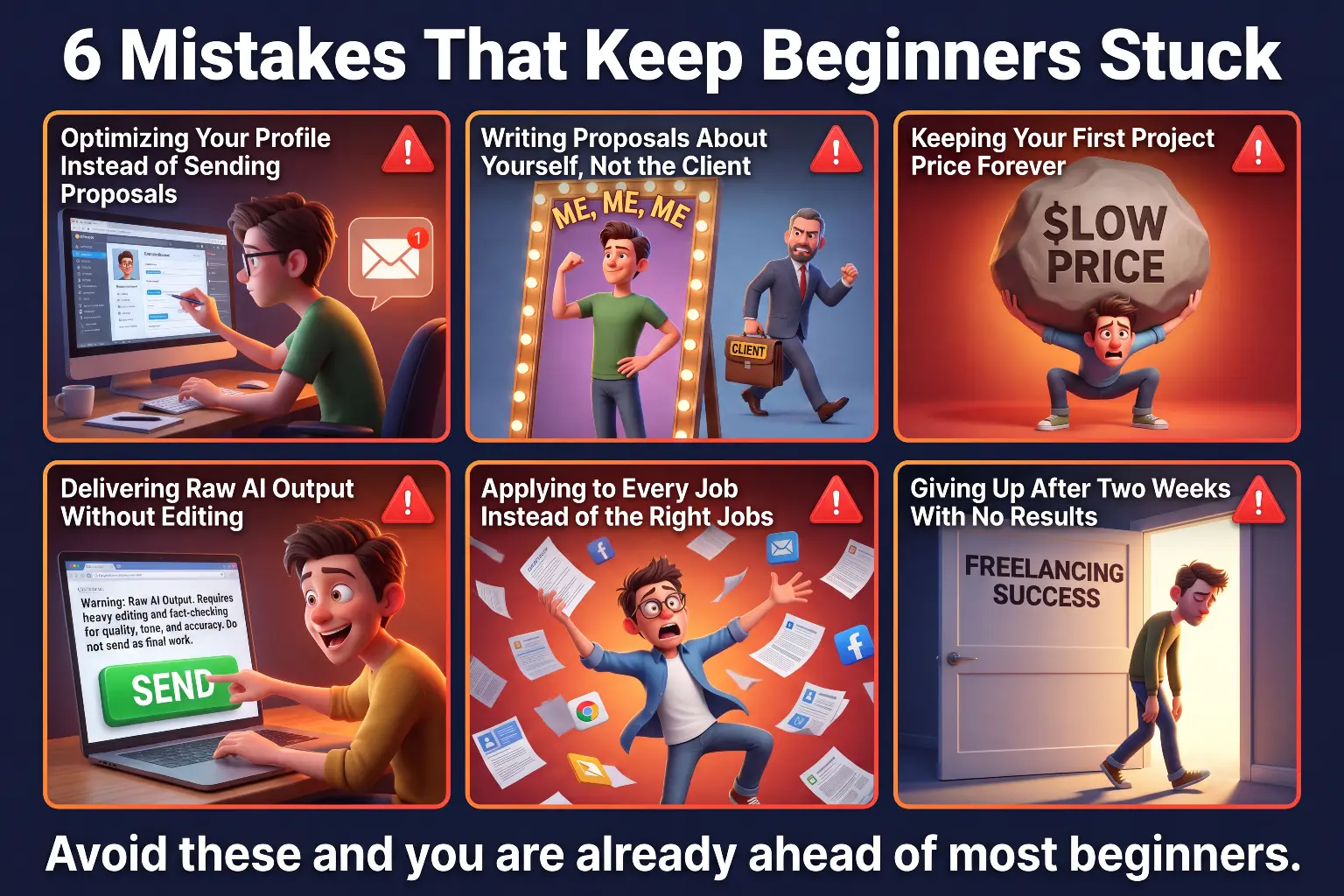
These are not generic tips copied from every other guide. These are the specific, practical mistakes that cause motivated, intelligent beginners to quit AI freelancing before they ever see results.
- Optimizing the profile instead of sending proposals — a mediocre profile with thirty strong proposals consistently outperforms a perfect profile with three generic ones. Invert the ratio of time you are spending on each.
- Writing proposals from your own perspective instead of the client’s — “I have three years of experience” is about you. “Your blog is currently ranking on page three for your main keyword — I can help you close that gap with weekly content targeting related terms your competitors are missing” is about the client. Clients respond to their situation, not your resume.
- Treating the first project price as permanent — charging low to earn reviews is the correct strategy for your first two or three projects. Staying at those rates forever makes freelancing feel unsustainable. Raise rates after every five positive reviews without exception.
- Delivering AI output without adding anything — clients can tell. Not from a detection tool — but from the particular flatness that unedited AI content carries. The vocabulary is too uniform, the examples too generic, the transitions too smooth. Use AI to draft and your own judgment to finish.
- Applying to every job instead of the right jobs — beginners often apply to dozens of mismatched jobs with generic proposals rather than ten perfectly matched jobs with specific ones. Quality of targeting beats volume of applications every time.
- Giving up after two weeks with no results — two weeks is not enough time to land a client on any platform. The beginner who quits after four weeks of proposals would, in almost every case, have gotten their first client in week five or six if they had stayed consistent. Every freelancer with a sustainable income went through the exact same slow early phase.
Final Thoughts
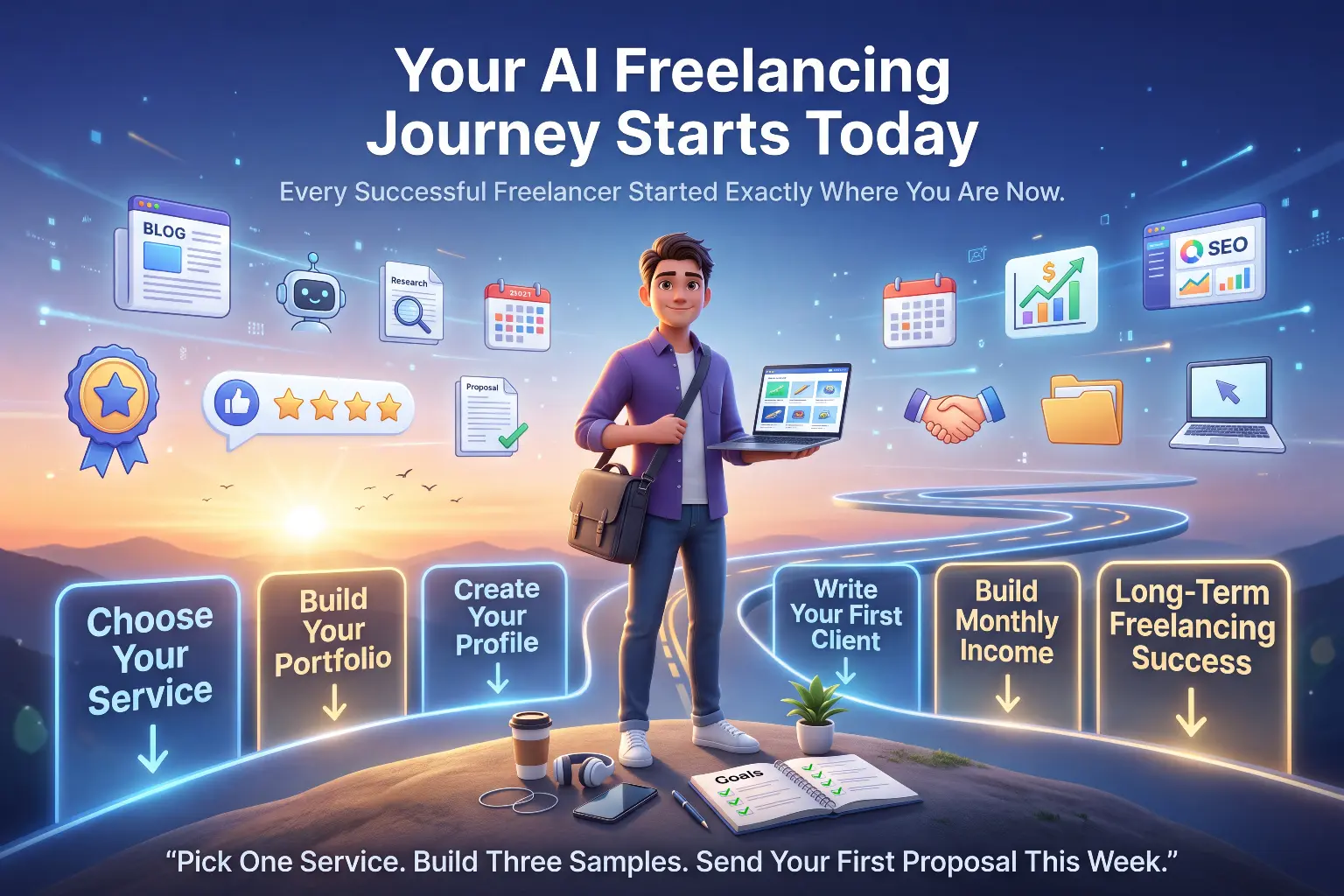
AI freelancing for beginners is one of the most realistic ways to start earning online in 2026 — not because AI does the work for you, but because it makes you capable of delivering professional-quality results from day one without years of experience.
The Arthify Freelancing Roadmap gives you the complete path. Seven stages from choosing your service to raising your rates and building long-term client relationships. Each stage builds on the one before it. None of them requires perfection before you move forward.
The gap between people who read guides like this and people who actually build a freelancing income is not skill, talent, or even time. It is the willingness to take an imperfect first step before everything feels ready. Create your profile before your portfolio is perfect. Send your first proposal before your pitch feels completely polished. Deliver your first project before you feel fully confident.
Every freelancer with ten clients and $3,000 in monthly income started with zero clients, zero reviews, and exactly the same uncertainty you might be feeling right now. The path from zero to a sustainable freelance income is not as complicated as most guides make it seem — but it is longer than most people expect, and shorter than most people fear, for the ones who stay consistent.
Pick one service. Build three samples. Create your profile. Send your first proposal before the end of this week.
If you want to understand how AI freelancing connects to every other way of earning online, our guide on How to Make Money with AI in 2026 covers every income method available to beginners right now.
Frequently Asked Questions
What is AI freelancing for beginners?
AI freelancing for beginners means offering a professional service — writing, research, social media content, design, or similar work — where you use AI tools as part of your workflow to deliver faster, better results than you could produce without them. You are not selling access to AI tools. You are selling the outcome that your combination of AI assistance and human judgment produces. The three most accessible starting services for complete beginners are AI-assisted content writing, social media content creation, and research and summarization.
Do I need experience to start AI freelancing?
No prior freelancing experience is required. What you need is one service you can demonstrate competence in, three to five strong portfolio samples you created yourself, and the consistency to keep sending proposals until your first client says yes. Most beginners who follow this process land their first client within two to six weeks, with no previous paid work history.
How do I build a portfolio when I have no clients?
Create your own samples for fictional brands or topics you choose yourself. A client evaluating your work has no way of knowing whether a portfolio piece was paid for or created as a practice exercise — they judge the quality of the output, not its employment history. Three excellent self-created samples will consistently outperform ten mediocre paid pieces when it comes to convincing potential clients to trust you.
How do I write a proposal that gets a reply?
Reference one specific detail from the job post in your first sentence. Show you understand the underlying problem the client is trying to solve. Describe how you would approach their specific project in two sentences. End with a low-pressure question rather than a request to hire you. Keep the entire proposal to five to eight sentences. Specificity and brevity consistently outperform generic length.
Will AI replace AI freelancers?
No — and here is why. Clients do not pay for AI output. They pay for someone who can understand their specific goals, use AI tools to produce a first draft, apply professional judgment to refine it, verify every fact, match the brand voice, and deliver something they would actually use. AI can generate content. It cannot manage client relationships, understand business context, take responsibility for mistakes, or communicate with empathy. Those things still belong to the freelancer — and they always will.
Should I tell clients I use AI tools?
Yes, if they ask directly — always be honest. Beyond that, most clients in 2026 understand and accept that professional freelancers use AI tools in their workflow, in the same way they accept that writers use grammar checkers or designers use templates. What clients care about is the quality and reliability of the final deliverable, not the tools used to create it. Never submit unedited AI output. Never misrepresent raw AI content as entirely hand-written. Those are the real ethical lines.
Can I start AI freelancing using only free AI tools?
Yes. ChatGPT’s free tier, Grammarly’s free tier, Canva’s free tier, and Perplexity AI’s free tier are all capable of producing professional-quality work for your first three to six months of freelancing. Do not subscribe to paid versions of any tool before landing your first client. The free tiers are not limitations — they are more than enough to build a portfolio, complete client projects, and earn your first reviews.
How long does it take to land the first AI freelancing client?
Most beginners who are actively building portfolios, setting up profiles, and sending proposals consistently land their first client within two to four weeks. Some take six to eight weeks. The biggest predictor of landing a first client is simply not stopping before week four. The first client is always the hardest. Everything becomes significantly easier after that first review lands on your profile.

Hi, I’m Harshil Patel, founder of Arthify.
I share simple, practical guides on AI tools, blogging, and online earning to help beginners work smarter and grow online.
My goal is to simplify AI tools so anyone can build skills and create opportunities in the digital world.