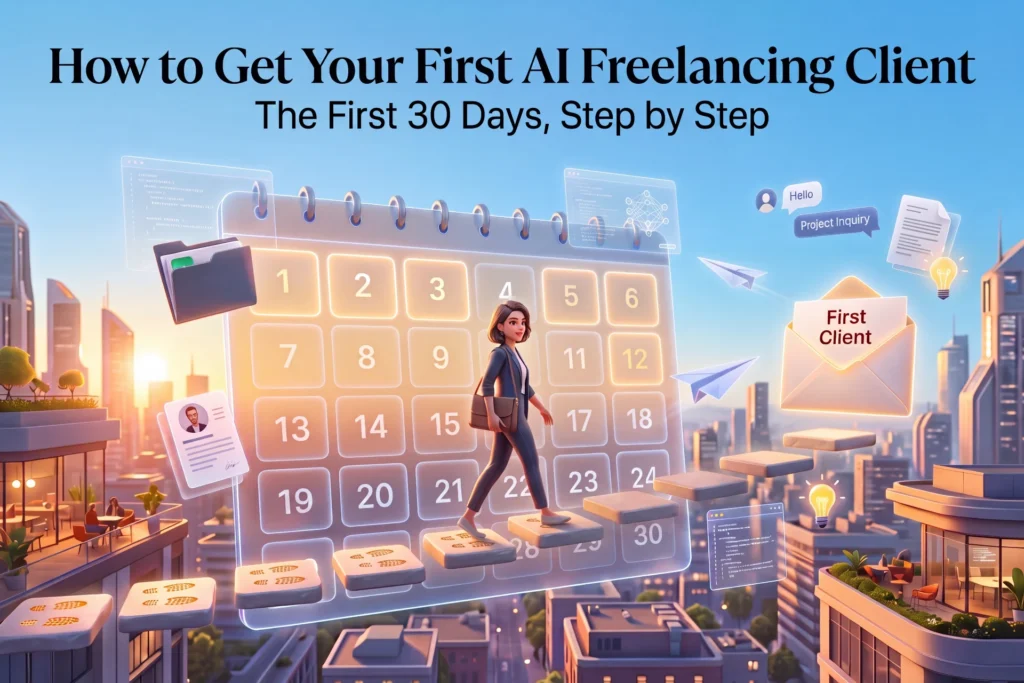
“This guide is a practical walkthrough on how to get your first AI freelancing client — how to set up a profile that gets clicked, how many proposals to send each day, and what to do in the silent first two weeks that break most beginners before they ever land a client.”
If you have already read our guide on AI Freelancing for Beginners, and our follow-up on How to Build an AI Freelancing Portfolio With No Experience, you know the pillar’s Stage 3 and Stage 4 cover profile setup and proposal writing at a high level. This guide is the operational layer underneath that — the daily mechanics of the first 30 days that turn a finished portfolio into an actual paying client.
This is not another explanation of what a good proposal looks like. You already have that. This is what to do every single day between finishing your portfolio and getting your first reply.
Why the First 30 Days Feel Different From Everything Before Them
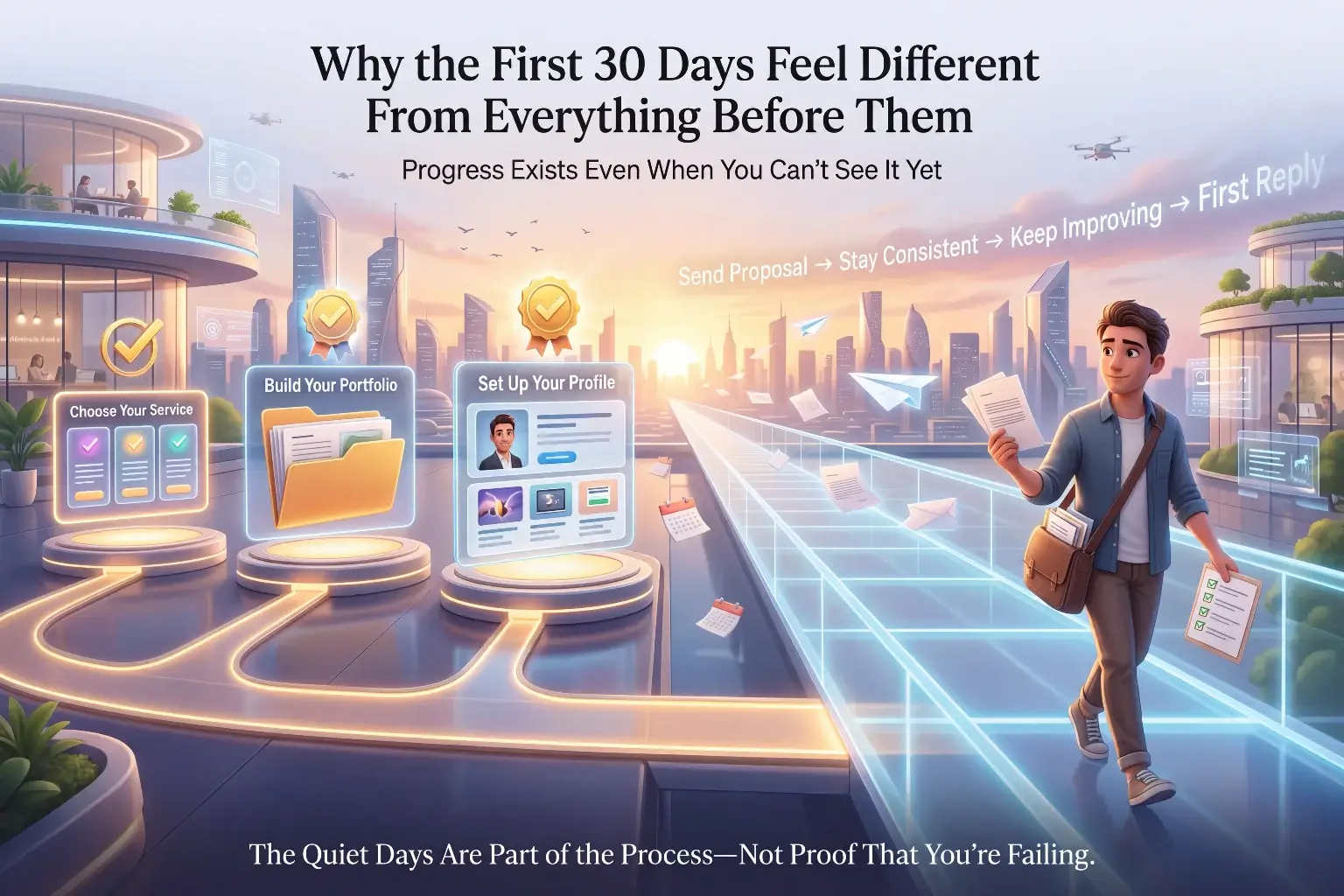
Every stage before this one has a clear finish line. You choose a service — done. You build three samples — done. You set up a profile — done. Each task has a visible endpoint you can check off.
The first 30 days of actually applying does not work that way.
- No checklist item — you cannot “complete” applying for clients the way you completed a portfolio sample
- No visible progress — sending ten proposals feels identical to sending zero if none of them get a reply yet
- No fixed timeline — unlike a task with a deadline, this stage ends whenever a client responds, which could be day 4 or day 40
That absence of visible progress is exactly why this stage breaks more beginners than any task before it. Silence feels identical to failure even when it is a completely normal part of the process — and knowing that in advance is what separates beginners who push through week two from beginners who quit and conclude that freelancing “doesn’t work for them.”
This guide gives you the shape of that process so the silence stops feeling like a verdict.
Your First 30 Days at a Glance
- Week 1 — Profile or gig fully set up. First proposals sent, or gig live and searchable.
- Week 2 — Continued daily consistency. Likely still quiet. This is the stretch that breaks most beginners.
- Week 3 — First replies typically begin appearing for consistent beginners.
- Week 4 — First client secured for many beginners who stayed consistent. Some take longer — that does not mean something is wrong.
This is a typical pattern, not a guarantee. Your specific timeline depends on your niche, your pricing, how competitive your category is, and how consistently you show up during the quiet stretch. Some beginners land a client in the first week. Others take six to eight weeks in more competitive categories. Both are normal.
Setting Up a Profile That Actually Gets Clicked
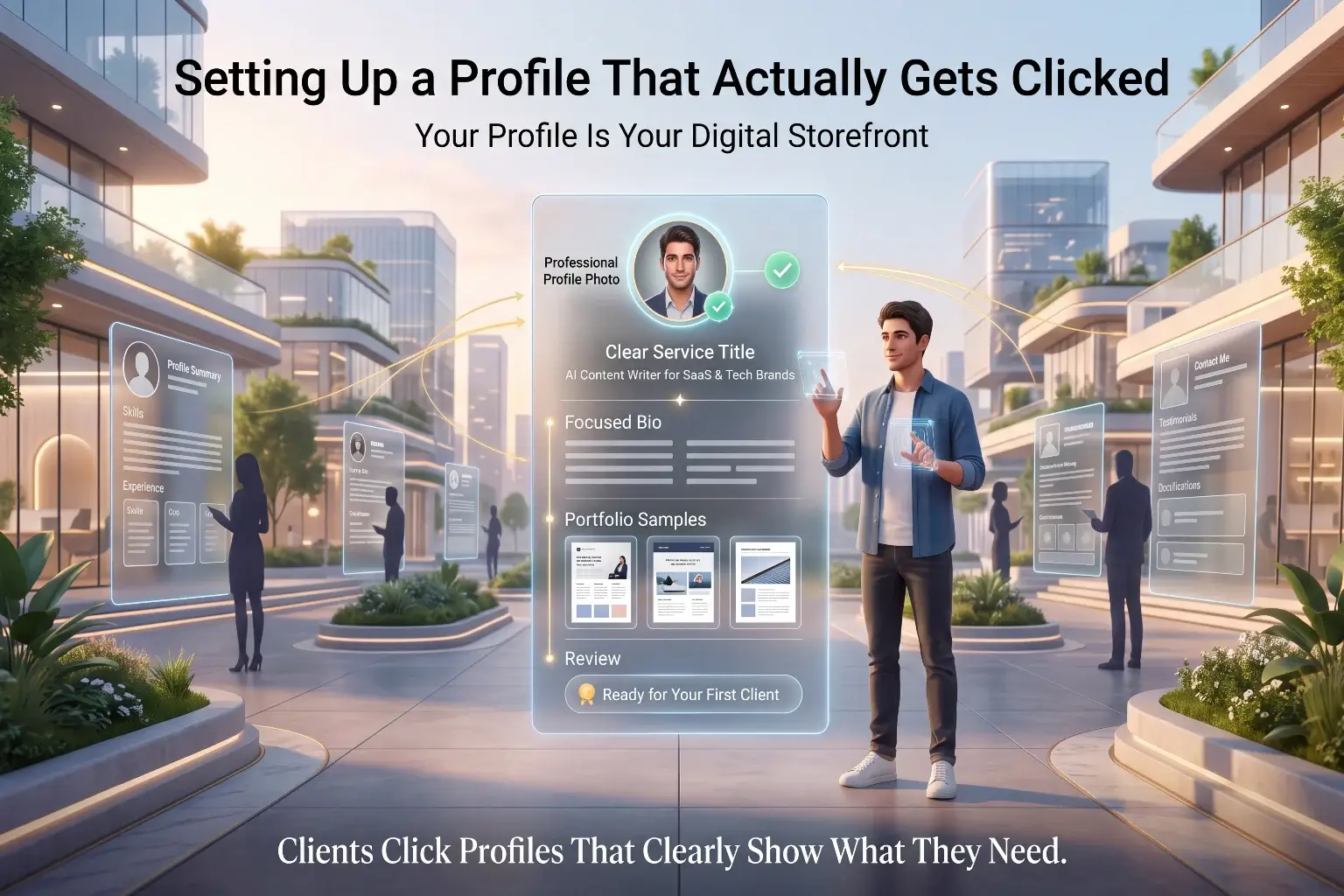
Your profile is not a formality you complete once and forget. It is the single biggest lever you control before you have a single review, and most beginners spend far less thought on it than it deserves.
If you are starting on Fiverr:
- Your gig title should describe exactly what you deliver and for whom, not a vague skill category — “I will write blog posts” competes against thousands of identical listings, while “I will write SEO blog posts for AI, tech, or SaaS brands using AI-assisted research” is specific enough to stand out
- Your thumbnail should show the actual output — a screenshot of a formatted blog post, a mockup of a designed social post, a clean preview of a research report — rather than a stock photo or a photo of yourself
- Set up your gig with three package tiers rather than one flat price: a Basic package for a single simple deliverable, a Standard package that bundles a bit more, and a Premium package for your most complete offering — buyers browsing Fiverr expect this structure, and a single-price gig looks less professional by comparison
- Keep your Basic package priced competitively as a beginner, since this is usually the entry point that earns your first few reviews
- Never leave a package description empty or vague — clearly explain exactly what is included in Basic versus Standard versus Premium, since an unclear difference between tiers makes buyers hesitate rather than upgrade
If you are starting on Upwork:
- Your title (the one-line headline under your name) should be specific and benefit-oriented — “AI-Assisted Content Writer for SaaS and Tech Brands” outperforms “Freelance Writer” because it tells a client searching for that exact skill that you are relevant
- Your overview should open with what you deliver and who you help, not your background — most beginners write it like a resume (“I am a passionate writer with a love of storytelling”), which tells a skimming client nothing useful
- A clean, professional profile photo with a clear face and simple background consistently gets more clicks than a photo without one — this costs nothing to fix and directly affects whether a client opens your profile at all
This is the same principle from AI Freelancing for Beginners Stage 3, applied specifically to how each platform’s profile fields are structured.
Fiverr vs Upwork — Which Actually Gets You a Faster First Client
Fiverr requires no ongoing proposal writing — you set up your gig once, optimize it as you learn what works, and wait for buyers to find you. This makes it genuinely the lower-effort starting point for a complete beginner, which is why our pillar guide recommends it first.
Upwork uses a credit system called Connects, and most job posts cost somewhere between 6 and 16 Connects to apply to. New accounts receive a limited number of free Connects monthly, and additional ones cost a small amount each — for someone applying actively most weeks, this typically adds up to a modest monthly cost against the value of landing even one client.
The practical approach most beginners get wrong is picking one platform and ignoring the other out of loyalty. The freelancers who land their first client fastest typically run both simultaneously from week one — a Fiverr gig quietly collecting views in the background while actively applying on Upwork, rather than treating them as sequential steps.
Before You Start Applying
Before sending a single proposal or publishing your gig, confirm you have all of this in place. This takes ten minutes and prevents the most common early mistakes.
- Portfolio completed — three to five samples, per How to Build an AI Freelancing Portfolio With No Experience
- Fiverr gig or Upwork profile fully published, not left in draft
- A clean, professional profile photo uploaded
- A short, specific bio written — not a placeholder
- Two or three proposal openers drafted in advance, ready to personalize for each job rather than writing from scratch every time
- Notifications turned on for your email and the platform app, so you never miss a client message in the first hours after it arrives
Once every item on this list is checked, you are ready to start.
How Many Proposals You Should Actually Send

This is one of the most searched questions among new freelancers, and most answers are either “as many as possible” or an arbitrary fixed number — neither of which is genuinely useful advice.
The honest answer is this — quality and targeting matter more than raw volume. On Upwork specifically, popular beginner-level job posts can attract a large number of proposals within hours, which understandably makes beginners think their odds are hopeless. They are not. Many of those proposals are generic templates sent without reading the job post — a genuinely specific, personalized proposal still stands out far more than most beginners expect, even in a crowded inbox.
A realistic daily target for a beginner:
- On Upwork — 2 to 3 high-quality, fully personalized proposals per day, targeting jobs specifically rather than applying to everything in your category
- On Fiverr — no daily proposal quota exists, since buyers come to you, but spend 10 to 15 minutes weekly reviewing and refining your gig based on what is and is not getting clicks
How to choose which jobs to apply to on Upwork:
- Jobs with fewer proposals already submitted — better odds of actually being read
- Jobs posted recently — you are more likely to be an early applicant, which matters because clients often stop reviewing once they have enough responses
- Jobs from newer clients with fewer hires — they tend to be more willing to take a chance on a freelancer without an established track record
- Jobs with detailed, specific descriptions — vague one-line job posts attract low-quality clients and enormous, unfiltered competition
This filtering step is what actually moves the needle. Two or three carefully chosen, carefully written proposals sent to well-matched jobs will consistently outperform ten generic proposals blasted at anything remotely related to your service.
What a real proposal actually looks like:
Thanks!
This is short, references something specific from the job post, offers a relevant sample without being asked, and ends with a low-pressure next step. Use this structure as a starting point, not a script to copy word for word — the specificity is what makes it work, and specificity has to come from the actual job post in front of you.
What to Do During the Silent First Two Weeks
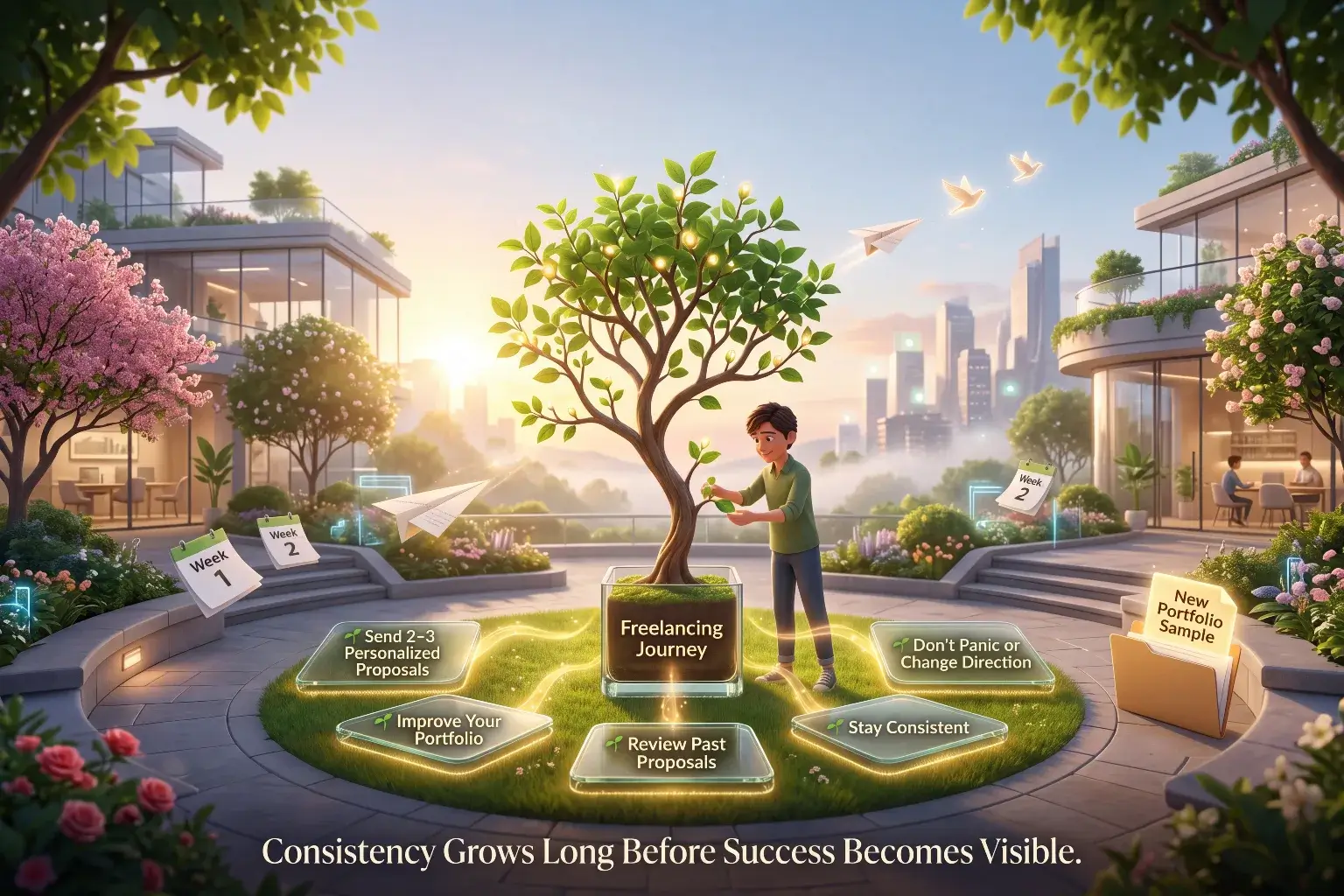
This is the part almost no guide addresses honestly, and it is exactly where most beginners quit.
You will very likely send proposals or have your gig live for a week or two with no response at all. This is normal, not a signal that something is wrong. Here is what to actually do during that window instead of spiraling into doubt or abandoning the process.
- Keep sending 2 to 3 proposals daily on Upwork, or refining your Fiverr gig weekly — consistency during the silent phase is what determines whether week three looks different from week one
- Add one new portfolio sample during this window — every completed sample slightly strengthens every proposal you send afterward, and this is genuinely productive use of the waiting time. Our guide on How to Write Better Prompts for AI can help you generate a stronger first draft faster if you are short on time
- Review your last five proposals critically — are they specific to each job, or do they feel like the same message with the client’s name swapped in? Our guide on AI Freelancing for Beginners covers the four-part proposal structure that gets replies, and week two is the right time to audit your own proposals against it honestly
- Resist the urge to lower your price out of panic — a lower price does not fix a proposal or profile that is not getting read, and training yourself to discount at the first sign of silence creates a habit that is hard to break later
- Do not switch services or niches after one week of silence — one to two weeks is not enough data. Give any single approach at minimum three to four weeks of consistent effort before deciding to change direction
The freelancers who get their first client are rarely the ones with the single best proposal. They are the ones who kept a consistent, quality-focused daily habit going through the silent stretch that convinces everyone else to quit.
One of the fastest ways to lose momentum here is comparing your first week to someone else’s highlight reel — most freelancers only post their wins, never the weeks they spent sending proposals into silence.
How to Follow Up Without Sounding Desperate
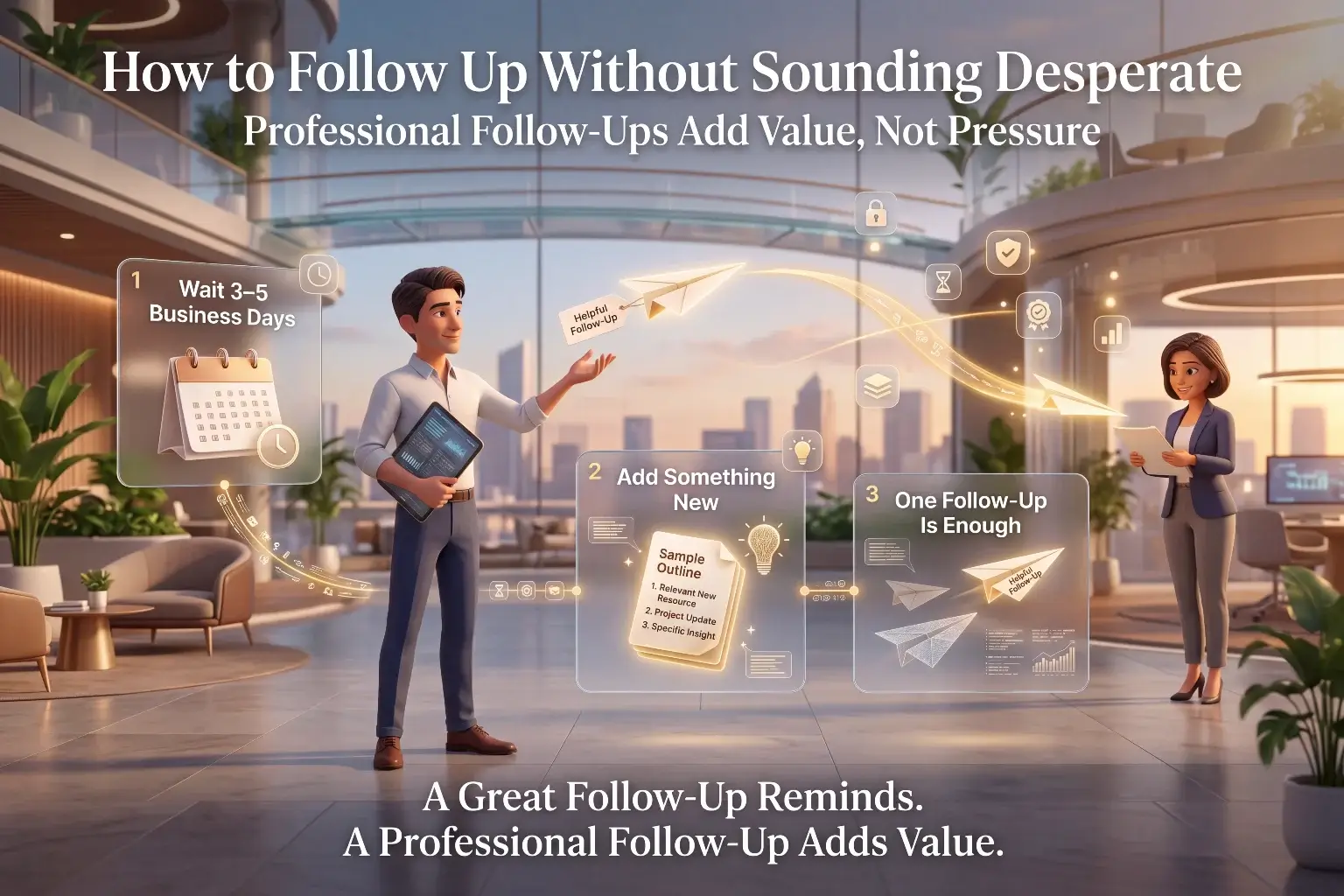
A follow-up message on an unanswered proposal is not pushy when done correctly — it is a normal, professional part of freelancing that most beginners avoid out of fear.
- Wait three to five business days after your original proposal before following up once
- Send only one follow-up per unanswered proposal — more than that starts to feel like pressure and can work against you
- Add something new rather than just checking in — for example, offering a quick sample outline related to the client’s project gives them a reason to respond rather than just a nudge to feel obligated
- If there is still no response after one follow-up, move on — redirect that energy into your next proposal instead of sending a second or third message on the same job
A follow-up that works reads something like: “I wanted to follow up on my proposal for your blog content project. I also put together a quick sample outline based on your brief in case it’s useful for your decision — happy to share if helpful.” Short, adds value, low pressure.
Handling Your First Client Message With Zero Reviews
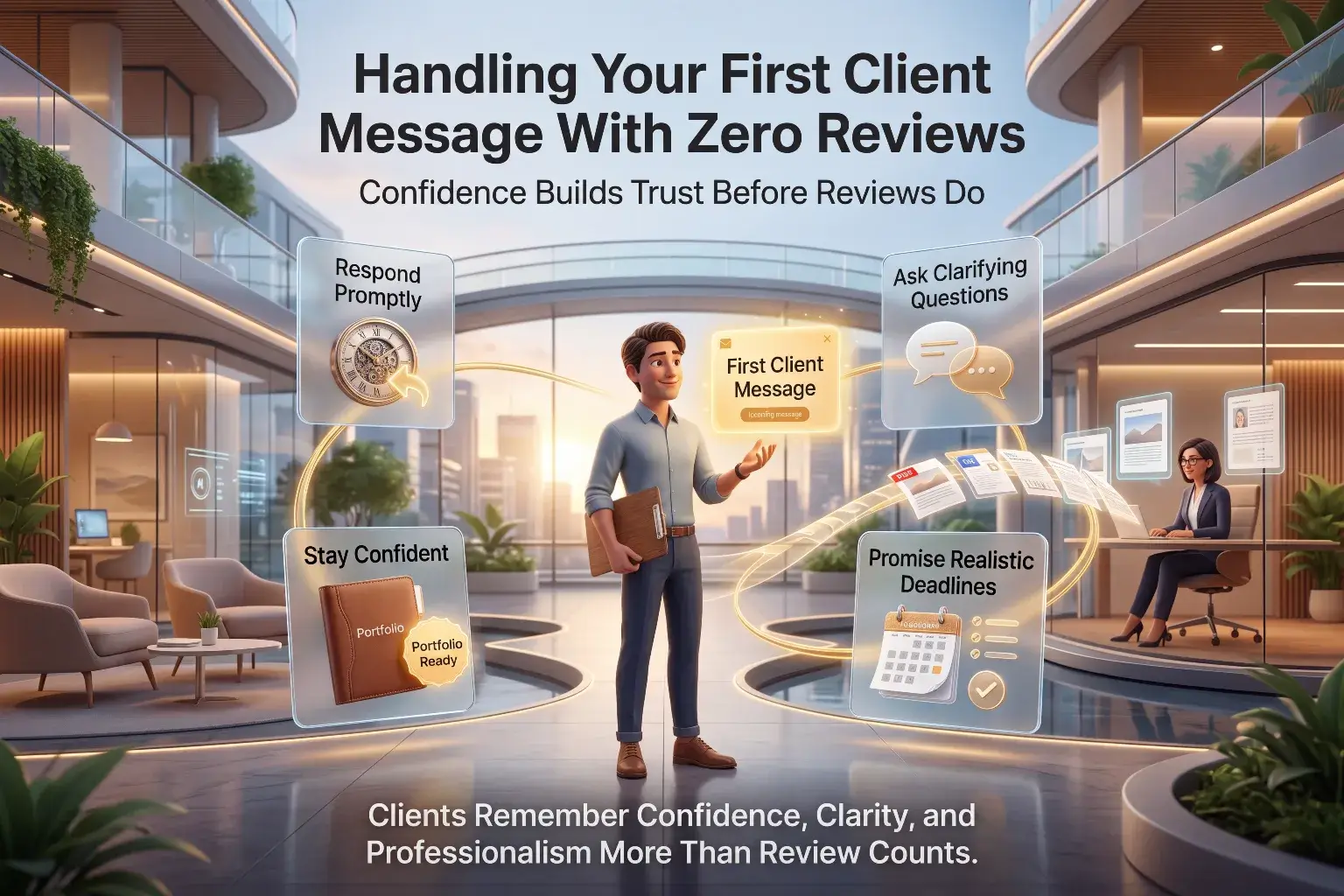
The moment a client actually responds is genuinely nerve-wracking when you have no reviews yet, and how you handle that first conversation matters as much as how you handled the proposal that got you there.
- Respond quickly — within a few hours if possible. Fast, clear responses are one of the strongest signals of professionalism a beginner can send
- Answer every question the client asks directly and completely, and ask one or two clarifying questions of your own about the project
- Do not apologize for having no reviews or minimize your ability — a confident, honest line works far better than an apology
- Never promise a deadline you are not confident you can meet, even if it feels like the safer answer in the moment — a missed first deadline does far more damage than a slightly longer, realistic one
A confident opening line works better than an apology — something like “This will be one of my early projects on the platform, and I’m bringing the same process I used to build my portfolio samples, which I’m happy to walk you through.” This is honest and reframes “no reviews yet” as a normal starting point rather than a weakness.
If the client seems hesitant specifically because of the lack of reviews, it is completely reasonable to offer a small good-faith gesture — a slightly reduced rate for this first project, or a short free revision round — in exchange for their first review once the work is delivered. This is a common, accepted practice for landing a first client, not a sign of desperation.
How to Avoid Common Freelancing Scams
Watch For These Red Flags
Common freelancing scam patterns
Most clients on Fiverr and Upwork are genuine, but beginners are specifically targeted by a small number of recurring scams precisely because they are eager for their first opportunity. Knowing these patterns in advance costs nothing and protects you completely.
- Never pay to apply for work or “unlock” a job — legitimate clients never ask a freelancer to pay them anything. If a message asks for a fee before starting, it is a scam
- Be cautious of anyone pushing to move the conversation off-platform immediately — a request to “continue on Telegram” or WhatsApp before any real project discussion has happened is one of the most common scam patterns on both Fiverr and Upwork
- Keep all payments and communication on the platform — platform payment protection only applies to work paid and tracked through the platform itself. Off-platform payment removes your ability to dispute non-payment
- Be skeptical of unusually high pay for very little described work — offers that sound too generous for a first project, with vague details about the actual task, are a common lure
- Watch for fake interview or “training” requests that ask for personal financial information — a legitimate client project never requires your bank login, ID scans beyond standard tax paperwork, or upfront software purchases on your end
- Use milestone payments for larger projects — breaking a bigger project into paid milestones protects both you and the client, and any client who resists this structure entirely on a large first project is worth extra caution
- Be cautious of “test assignments” that ask for substantial work — a short, reasonable sample task is normal, but if someone asks for a large piece of usable, commercial-quality work before any payment or commitment, that is a common way clients get free work from beginners. Treat any unpaid task beyond a small writing or design sample as a red flag
If something about a message feels off, it usually is. Trust that instinct, and when in doubt, stay strictly on-platform where dispute protection actually applies.
The Honest Shape of the First 30 Days
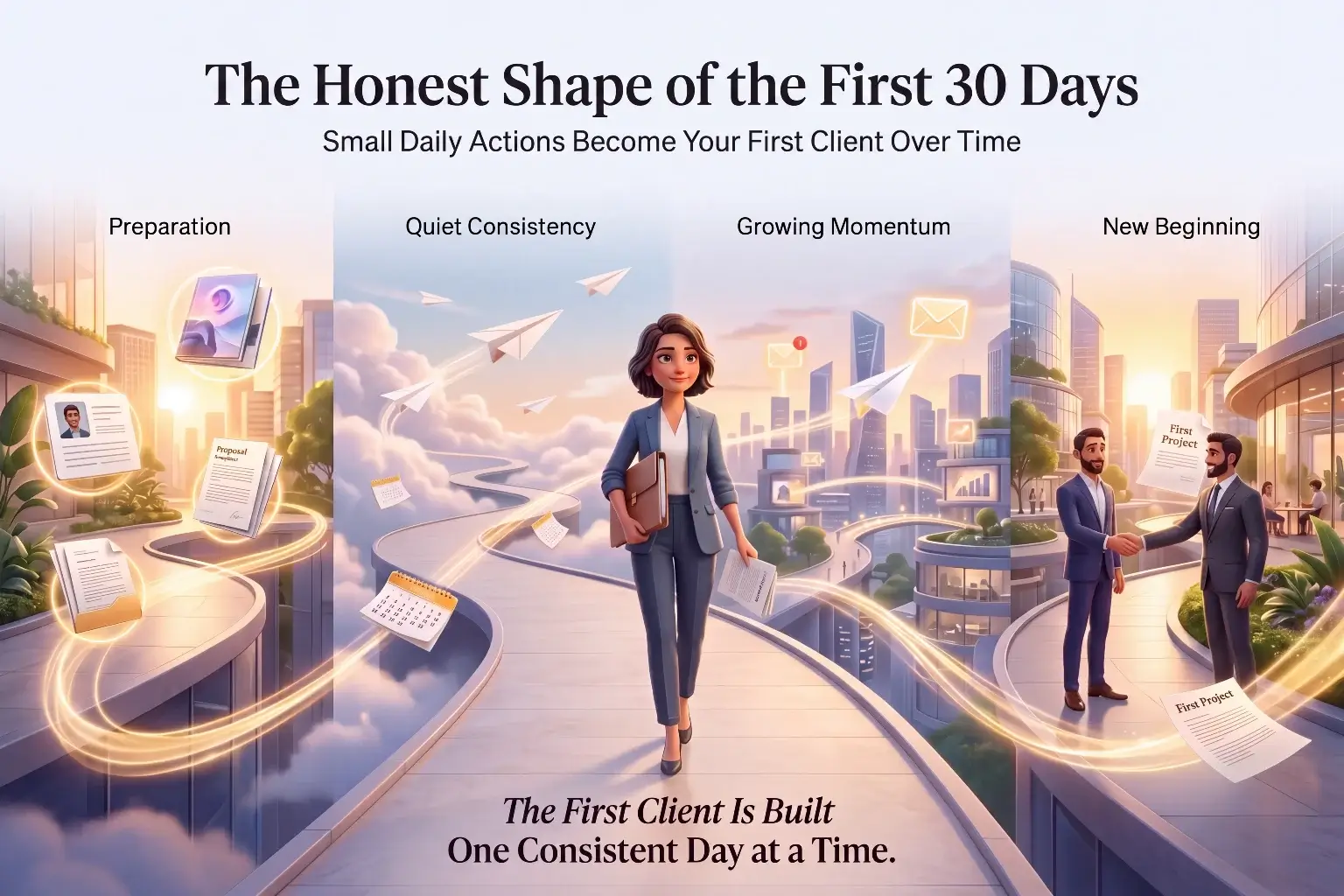
Here is what a realistic first month tends to look like for a consistent beginner, based on common patterns across both platforms — treated as a typical shape, not a fixed promise.
Many beginners see their first client reply somewhere in the second or third week, with an actual first project following shortly after for those who stayed consistent through the quiet early stretch. Others take longer, particularly in more competitive niches or during slower seasonal periods — and that does not mean the approach is failing.
What the data does suggest clearly is this: freelancers who land their first client within the first month or so are meaningfully more likely to build sustainable income on these platforms, while those who go much longer without adjusting anything are more likely to drop off entirely. This is exactly why the daily habits in this guide matter more than any single perfect proposal — consistency across these weeks is the actual mechanism that produces a first client, not luck, and not a single well-timed application.
Once a client actually says yes, the next real question is what to do first. Our guide on What to Do After Your First AI Freelancing Client Says Yes covers exactly that.
Mistakes That Quietly Slow Down Your First 30 Days
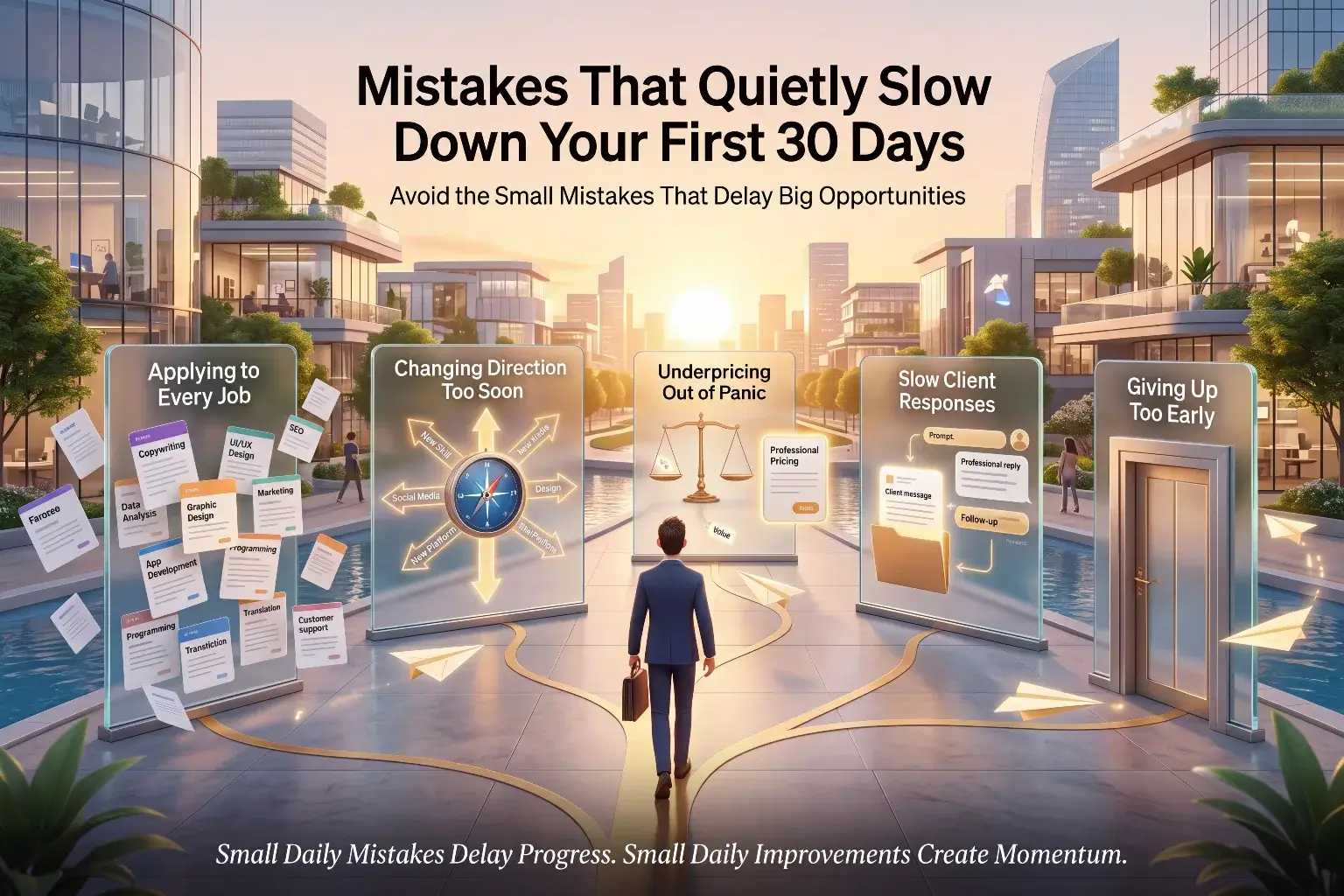
- Applying to every job regardless of fit — spreading generic proposals across unrelated jobs performs worse than fewer, carefully targeted ones, and burns through Upwork Connects unnecessarily
- Changing your service or niche after a few days of silence — a few days is not enough data. Give any consistent approach three to four weeks before concluding it needs to change
- Under-pricing dramatically out of panic — a client who only responds to an unreasonably low price is rarely a client worth keeping long-term, and it is difficult to raise rates later with that same client
- Going silent yourself after sending a proposal — check messages daily and respond quickly once a client does reply. A slow response after finally getting attention can lose the opportunity as easily as never applying at all
- Treating the first 30 days as a test of whether freelancing “works” — it is a test of consistency, not a referendum on the entire path. Most beginners who eventually succeed had a first 30 days that looked identical to one where they might have quit
Final Thoughts

How to get your first AI freelancing client ultimately comes down to this — your portfolio proves you can do the work. Your profile gets you noticed. But the first 30 days of actually applying is where freelancing stops being preparation and starts being a real, if uncomfortable, process — and it is the stage most guides skip because it is harder to make sound exciting than “build your portfolio” or “write a great proposal.”
The honest truth is that the first 30 days rarely feel productive while you are in them. Two to three proposals a day on Upwork, weekly refinement on Fiverr, one follow-up when appropriate, staying alert to the scam patterns above, and the discipline to keep going through a week or two of silence — that is genuinely the entire system. It is not complicated. It is just uncomfortable to do consistently when nothing seems to be happening.
Every freelancer earning a steady income today went through a first 30 days that looked exactly like this. The difference was never a secret proposal template or a perfect profile. Your first client rarely arrives because you finally discovered a secret technique. It usually arrives because you kept showing up long after most beginners stopped.
If you have not yet built your portfolio, our guide on How to Build an AI Freelancing Portfolio With No Experience covers exactly what to create before you start this process. For the bigger picture of every way to earn online with AI beyond freelancing specifically, our guide on How to Make Money with AI in 2026 covers the full landscape.
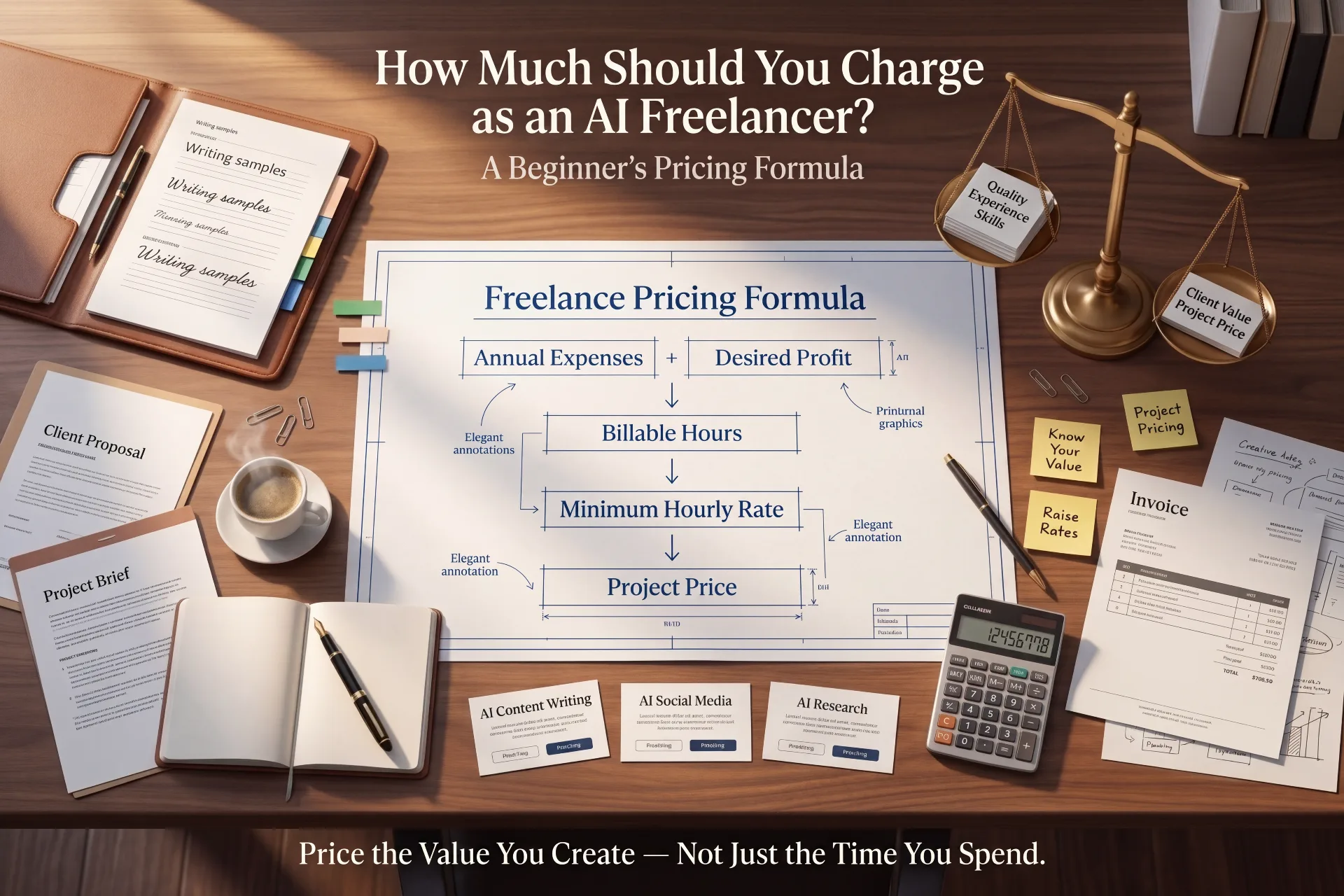
Once a client conversation is underway, the next real decision is what to actually charge them. Our guide on How Much to Charge as an AI Freelancer gives you the exact formula and real pricing tables.
Frequently Asked Questions
How long does it typically take to get your first freelancing client?
It varies meaningfully by niche, pricing, and platform, so treat any specific number as a general pattern rather than a guarantee. Many beginners see their first reply within the first few weeks on Upwork, and a first order within a few weeks on Fiverr with a well-optimized gig. Others take longer, especially in competitive categories. Freelancers who stay consistent through the early quiet stretch are meaningfully more likely to succeed than those who slow down or quit.
How many proposals should a beginner send per day on Upwork?
2 to 3 highly targeted, fully personalized proposals per day is more effective than sending many generic ones, particularly since each proposal costs Connects. Focus on jobs with fewer existing proposals, posted recently, from newer clients — these consistently offer better odds for a beginner with no reviews yet.
Should I start with Fiverr or Upwork to get my first client faster?
Fiverr is generally faster for a complete beginner because it requires no proposal writing — you set up a gig once and buyers find you. Upwork requires active daily proposal writing and often takes a bit longer, but tends to lead to higher-value, more ongoing client relationships. Running both simultaneously from the start is the most effective approach for most beginners.
What should I do if I have sent proposals for two weeks with no response?
This is normal and does not mean your approach is failing. Continue sending 2 to 3 quality proposals daily, add one new portfolio sample to strengthen future applications, and audit your last five proposals for genuine specificity rather than generic phrasing. Give any consistent approach three to four weeks before concluding it needs to change.
How do I follow up on a proposal without seeming pushy?
Wait three to five business days, then send one brief, value-adding follow-up rather than a simple check-in — for example, offering a quick sample outline related to the client’s project. Send only one follow-up per unanswered proposal. If there is still no response, move your energy to your next proposal rather than following up again.
How do I avoid scams when I am just starting out?
Never pay to apply for or “unlock” work, be cautious of anyone pushing to move the conversation off-platform before any real discussion has happened, keep all payments on-platform where dispute protection applies, and be skeptical of unusually generous offers for vague, poorly described work. When something feels off, trust that instinct.
How should I respond to my first client message when I have zero reviews?
Respond quickly, answer every question directly, and avoid apologizing for having no reviews. A confident, honest framing — explaining that this will be one of your early platform projects using the same process behind your portfolio — works better than minimizing your experience. Never promise a deadline you are not confident you can meet.
Can I get my first freelancing client without using Fiverr or Upwork?
Yes. LinkedIn outreach, cold email to small businesses in your chosen niche, relevant Facebook groups, and direct outreach to local businesses are all valid ways to find a first client outside the two major platforms. Fiverr and Upwork are recommended for beginners mainly because they come with built-in traffic and payment protection, but they are not the only path — the same portfolio and proposal principles in this guide apply anywhere you reach out to a potential client.

Hi, I’m Harshil Patel, founder of Arthify.
I share simple, practical guides on AI tools, blogging, and online earning to help beginners work smarter and grow online.
My goal is to simplify AI tools so anyone can build skills and create opportunities in the digital world.