

“This guide explains how to make money with AI in 2026 using beginner-friendly methods – from AI-assisted freelancing and content creation to blogging and digital services – with honest expectations, practical steps, and the right tools to get started.”
If you have been hearing about people earning online using AI tools and wondering whether it is actually real – the answer is yes. But it probably does not look the way most articles describe it.
Making money with AI in 2026 is not about pressing a button and watching income appear. It is about using AI tools to work faster, produce better output, and offer more value – whether you are writing content for clients, building a blog, creating digital products, or teaching others what you know.
The opportunity is genuinely bigger than ever. But alongside that opportunity is a lot of noise. Most articles on this topic list twenty methods in two minutes without telling you what is realistic, what takes time, and what to actually do first. This guide is different. It gives you a real framework, honest expectations, and a clear starting point – even if you have never earned a single dollar online before.
If you are brand new to AI tools, start with our guide on How to Use AI Tools as a Beginner which walks you through the basics before diving into earning.
Can You Actually Make Money with AI as a Beginner?
Yes – but with one important condition. You need to pick one method and stay consistent with it for at least 60 to 90 days before expecting meaningful results.
The biggest reason beginners fail with AI income is not the tools. It is switching from one method to another every two weeks without giving any single approach enough time to work. AI tools lower the barrier to starting – but they do not eliminate the need for consistency and effort.
Here is what makes 2026 genuinely different from earlier years. The tools are mature. ChatGPT, Claude, Canva, and dozens of other AI platforms are now stable, capable, and accessible to anyone with a laptop and an internet connection. You no longer need coding skills, expensive equipment, or years of expertise to produce professional quality work. You just need to learn the tools and apply them consistently to a specific income method.
The best part for beginners is that AI does not require you to be technically advanced. It requires you to be curious, willing to learn, and willing to keep going even when results are slow at the start.
Why AI Income Is Growing So Fast in 2026
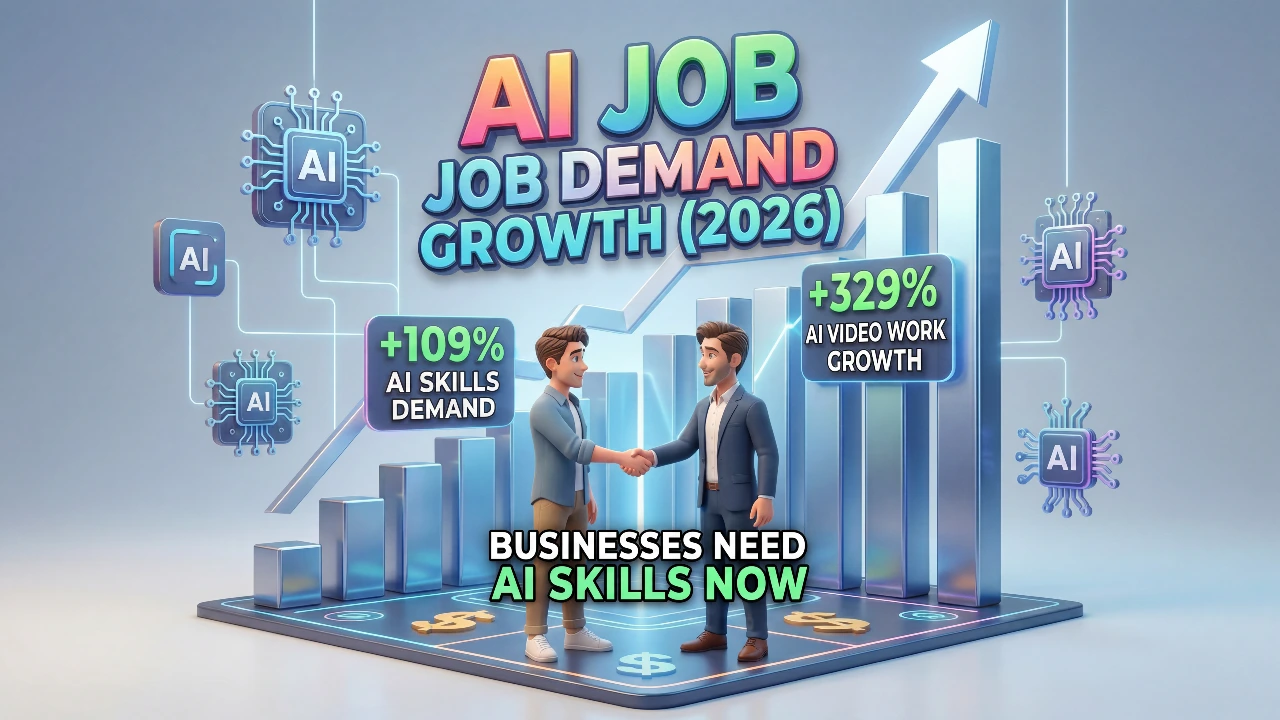
The reason AI income opportunities are expanding so quickly right now comes down to one simple shift – businesses need AI-skilled people but most of their existing staff do not have those skills yet.
Every business – from a local restaurant to a global ecommerce brand – is trying to create more content, automate more tasks, and serve customers faster. AI tools make all of this possible. But using these tools effectively takes time to learn, and most business owners simply do not have that time.
This is where beginners with AI skills step in. You do not need to be a developer or an AI researcher. You just need to know how to use the tools better than the business owner does – and then use that knowledge to solve a real problem for them.
The numbers confirm this shift. Demand for AI-related freelance skills on Upwork grew 109% year-over-year, with AI video work surging 329% to become the fastest-growing category on the platform. These are not projections – they are real spending numbers from actual completed projects across millions of client transactions.
The Arthify Framework: 3 Types of AI Income for Beginners
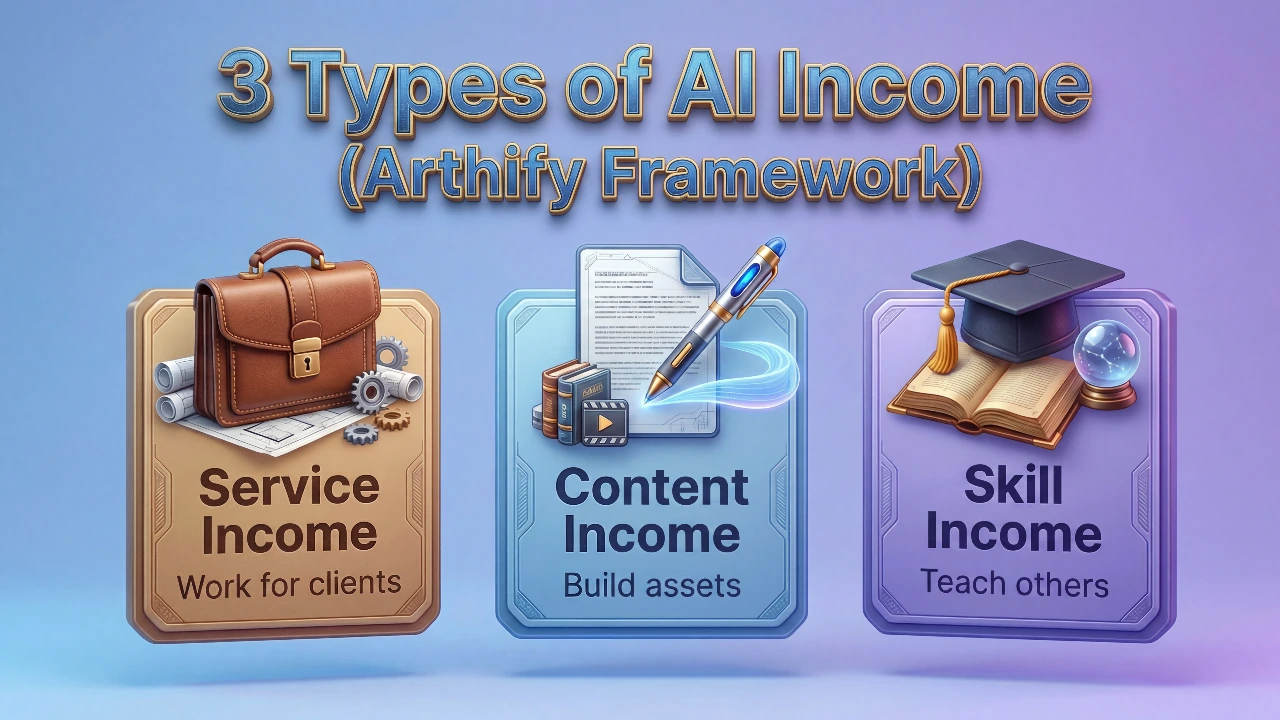
Instead of listing twenty methods with no structure, here is a simple framework to understand all AI income opportunities. Every legitimate way to make money with AI falls into one of three categories.
- Type 1 – Service Income: You use AI tools to offer a skill or service to clients and get paid per project or on a monthly retainer. This is the fastest way to earn your first income with AI.
- Type 2 – Content Income: You create content – a blog, a YouTube channel, or digital products – that earns money through ads, affiliate links, or sales. This takes longer to build but creates income that works even when you are not actively working.
- Type 3 – Skill Income: You teach others how to use AI tools through courses, coaching, or consulting. This works best once you have experience with the tools yourself.
Most beginners should start with Type 1 because it produces income the fastest. Then as they build skills and confidence, they layer in Type 2 and eventually Type 3.
Type 1 – Service Income: Offer AI-Powered Skills to Clients

This is the most direct path to earning with AI. You learn how to use specific AI tools well, offer that as a service to businesses or individuals, and get paid for the results you deliver.
AI-Assisted Content Writing
Content writing was already one of the most in-demand freelance skills before AI. Now with tools like ChatGPT, Claude, and Jasper, writers can produce significantly more content in the same amount of time – which means more clients and more income.
Businesses pay between $300 to $1,500 per month for consistent blog content and website copy. As a beginner, you would start at the lower end and raise rates as you build a portfolio and reviews.
The key is to use AI as an assistant, not a replacement for your judgment. AI writes the first draft quickly. You refine it, add your own insights, match the client’s tone, and check everything for accuracy. Clients pay for results and quality – not for how fast you wrote it.
To learn how to write better with AI tools, our guide on How to Use AI for Content Creation is a practical starting point.
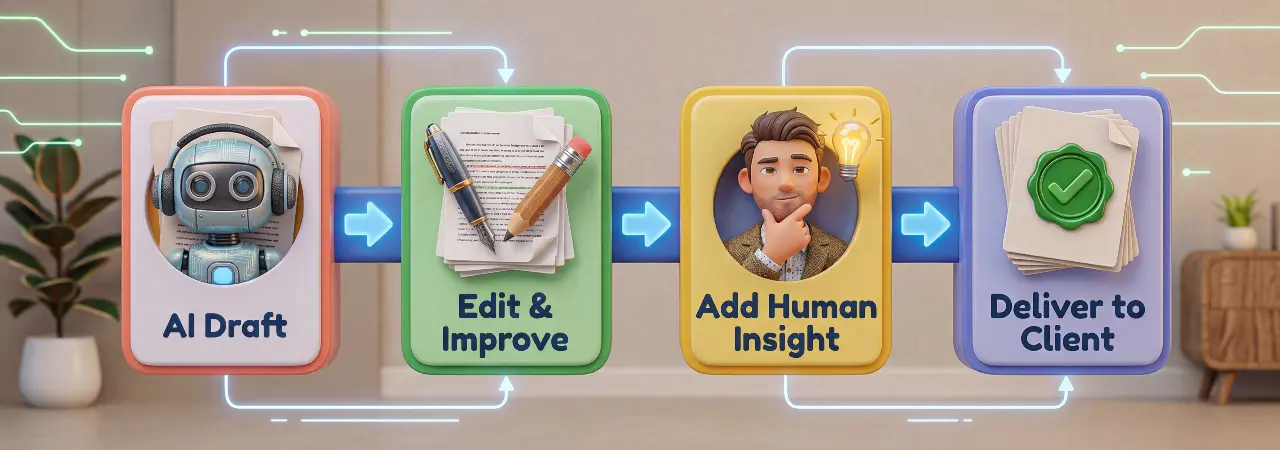
Businesses commonly pay for AI-assisted content writing in these areas:
- Blog posts and SEO articles – $50 to $300 per article depending on length and niche
- Website copywriting – $200 to $800 per page
- Email newsletters – $100 to $400 per sequence
- Product descriptions – $10 to $50 per product
- Monthly content retainers – $300 to $1,500 per month for consistent blog content
Example – AI content writer on Fiverr
A beginner creates a Fiverr gig offering “SEO blog posts written with AI assistance.” They price their basic package at $30 for a 1,000-word article. In their first month they complete eight orders and earn $240 before fees. By month three, with twelve five-star reviews, they raise their price to $60 per article and start getting repeat clients. Six months in they are writing for four regular clients on monthly retainers.
No portfolio. No prior client. Just a Fiverr gig, good delivery, and patience.
If you are starting from zero with no previous clients, our guide on How to Build an AI Freelancing Portfolio With No Experience shows you exactly what to create this weekend before sending your first proposal.
AI Video Editing and Short-Form Content
AI video work is the fastest-growing freelance category in 2026. Tools like Runway can now generate, edit, and enhance video content in ways that previously required expensive software and years of expertise.
Short-form video editing for Instagram Reels, YouTube Shorts, and TikTok is in massive demand from businesses and creators who do not have time to edit their own content. Beginners charge $50 to $150 per video. With five clients ordering two videos per week, that adds up quickly.
You do not need to be a professional video editor to start. AI tools handle the technically complex parts. You just need an eye for what looks good and the ability to deliver consistently.
Clients currently pay for AI-assisted video work including:
- Short-form Reels and YouTube Shorts editing – $50 to $150 per video
- Faceless YouTube video creation with AI voiceover – $100 to $300 per video
- AI-enhanced thumbnail design – $15 to $50 per thumbnail
- Caption and subtitle generation – $20 to $60 per video
AI Chatbot Building for Local Businesses
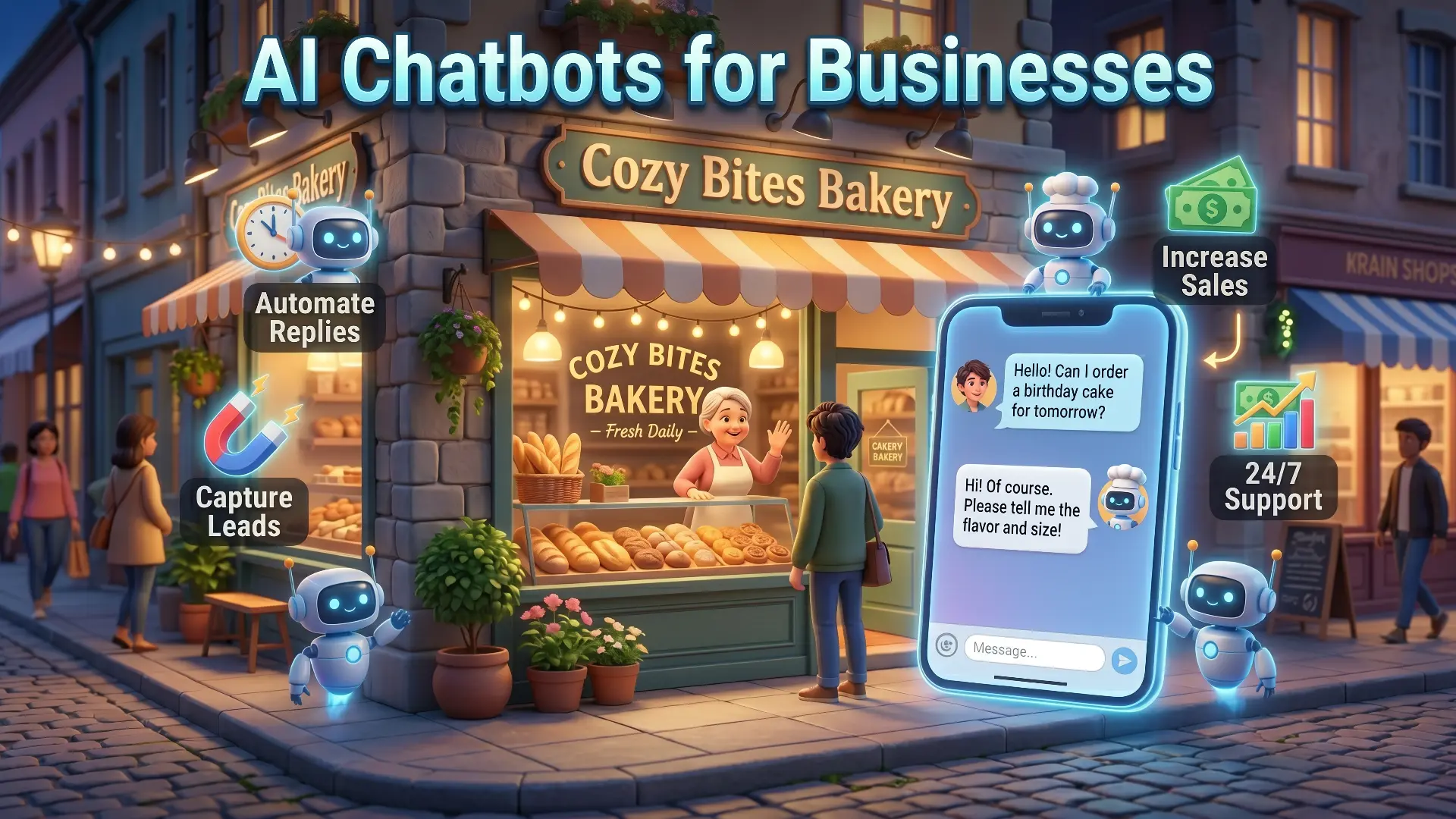
Local businesses lose potential customers every day because nobody answers their website inquiries after hours. An AI chatbot solves this problem. Local restaurants, dentists, salons, real estate agencies, and retail shops are willing to pay someone to build and maintain a simple customer service chatbot.
Beginners charge $300 to $1,500 to set up a working chatbot. This is a one-time setup fee plus a monthly maintenance retainer. Platforms like Voiceflow and Botpress make it possible to build functional chatbots without writing any code at all.
This is one of the highest-paying beginner AI services available right now because the demand is real, the competition is low, and local businesses genuinely need it.
Local businesses that commonly pay for AI chatbots include:
- Restaurants and cafes – for reservations and menu inquiries
- Dentists and clinics – for appointment booking and FAQs
- Real estate agencies – for property inquiries and lead capture
- Salons and spas – for booking and service information
- Retail shops and boutiques – for product queries and order tracking
AI-Powered Virtual Assistance
Smart virtual assistants who use AI tools to automate repetitive tasks for founders and small business owners are earning $500 to $2,000 per month on monthly retainers. Tasks include managing emails, scheduling, creating social media content, writing newsletters, and researching topics using AI tools.
The difference between a regular virtual assistant and an AI-powered one is speed and volume. Because you are using tools like ChatGPT and Notion AI to handle the repetitive parts, you can serve more clients in the same amount of time.
For the complete step-by-step guide to building your AI freelancing career from scratch — including how to build a portfolio with no experience, write proposals that get replies, and turn your first client into ongoing income — our dedicated guide on AI Freelancing for Beginners covers every stage of the Arthify Freelancing Roadmap in detail.
Type 2 – Content Income: Build Something That Earns While You Sleep
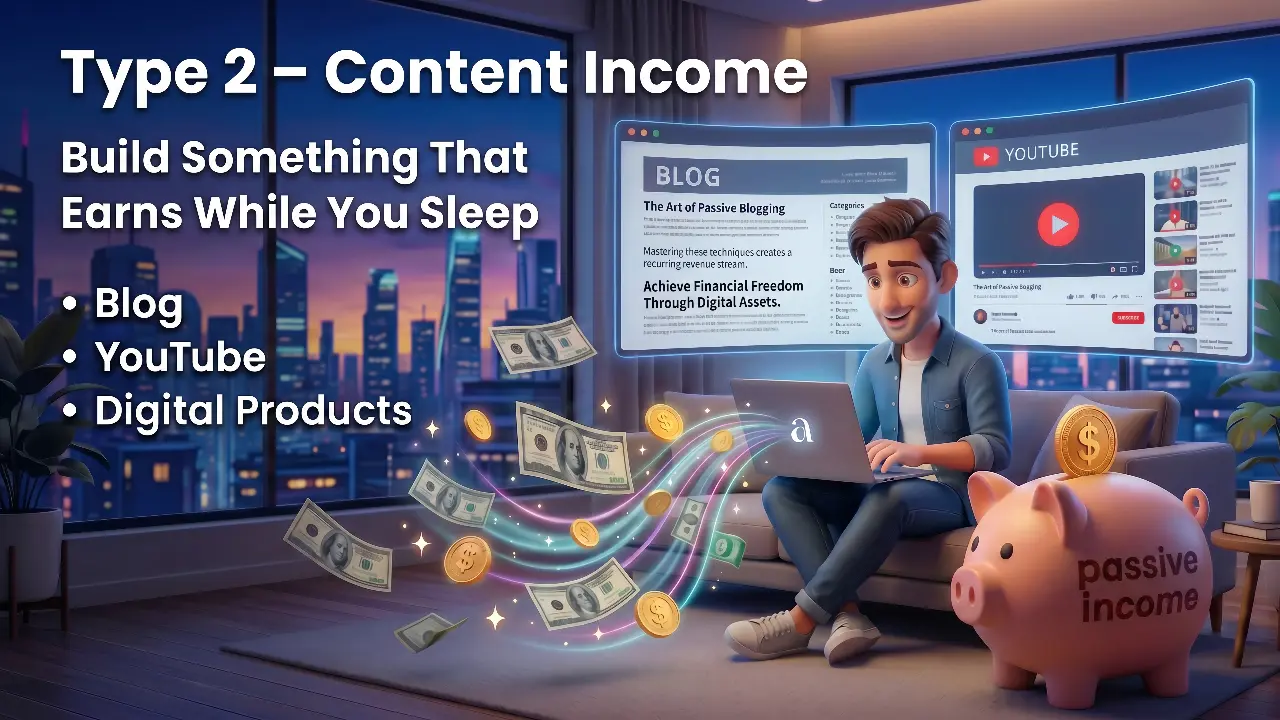
Content income takes longer to build than service income – but once it is established, it works continuously without you having to trade time for every rupee earned. This is the type of income that compounds over time.
Start a Blog Using AI
Blogging is one of the most accessible and sustainable ways to build online income – and AI has made it faster and more practical than ever before. A blog earns money through affiliate links, display advertising, and sponsored content. Once an article ranks on Google and attracts consistent traffic, it continues earning without you having to update it constantly.
Getting consistent traffic from Google starts with how well each article is optimized before it goes live. Our guide on On-Page SEO for Blog Posts walks through every optimization step beginners need to follow.
The realistic timeline is three to six months before a new blog starts seeing meaningful organic traffic. This is not a quick path. But it is one of the most reliable long-term income streams available to beginners.
If you want to understand exactly how to build and grow a blog using AI tools, our guide on How to Start Blogging with AI walks through the full process from setting up your site to publishing your first articles.
Create a YouTube Channel with AI Tools
YouTube is one of the largest search engines in the world and it rewards consistent, helpful content. AI tools make it possible to script, record, and produce YouTube videos much faster than before.
You no longer need expensive camera equipment to start. Screen recording tutorials, AI-narrated explainers, and slideshow-style educational videos all perform well on YouTube – especially in the AI tools and online income niche.
YouTube channels monetize through the YouTube Partner Program which requires 1,000 subscribers and 4,000 watch hours. The realistic timeline is six to twelve months for most beginner channels to reach monetization. After that, income comes from ads, affiliate links in descriptions, and brand partnerships.
Example – Faceless AI YouTube channel
A beginner starts a YouTube channel about AI tools for students. They use ChatGPT to write scripts, ElevenLabs for voiceovers, and simple screen recordings to show the tools in action. They publish one video per week. After five months they have 1,100 subscribers and cross the YouTube monetization threshold. Income starts from ads and affiliate links to the tools they review.
No camera. No face on screen. No expensive equipment. Just consistent publishing and the right AI tools.
Sell AI-Generated Digital Products
Digital products are files or resources that people download and use – ebooks, templates, prompt libraries, design packs, and educational guides. Once created, a digital product can be sold unlimited times with no additional cost per sale.
AI tools make creating digital products faster than ever. A prompt library for marketers, a set of Canva templates for small businesses, or a beginner’s guide to using ChatGPT for productivity – any of these can be created with AI assistance and sold on platforms like Gumroad or Etsy.
The realistic earning potential for digital products varies widely for beginners – from modest initial sales to consistent passive income as your audience grows. This works especially well alongside a blog or social media presence that drives traffic to your products.
Type 3 – Skill Income: Teach What You Know About AI

Once you have spent time learning and using AI tools, you know more than most beginners. That knowledge has value. Teaching others is one of the most scalable ways to earn with AI because your content – whether a course or a coaching session – can reach many people without requiring proportionally more of your time.
Create and Sell an Online Course
Online courses have low marginal cost after creation. You build the course once and sell it repeatedly. Platforms like Teachable, Gumroad, and Udemy make it possible to publish and sell a course without technical expertise.
You do not need to be an AI expert to teach a course. You just need to be genuinely helpful to your target audience. A course on “How to Use ChatGPT for Freelancers” or “How to Write Blog Posts 10 Times Faster Using AI” could help thousands of beginners and generate consistent income.
Offer AI Coaching or Consulting
One-on-one coaching is the fastest way to monetize your AI knowledge because it requires no audience, no platform, and no upfront investment. You simply offer to help someone learn or implement AI tools for their specific situation – and charge for your time and expertise.
Beginners typically start at $500 to $2,000 per month for ongoing consulting relationships. As you build a track record and testimonials, rates increase naturally.
This works particularly well for targeting small business owners who know they need to adopt AI in their work but do not know where to start.
Once you have chosen freelancing as your income method, our guide on How to Get Your First AI Freelancing Client covers exactly what to do in your first 30 days to actually land that first paying project.
Where to Find Clients and Customers as a Beginner
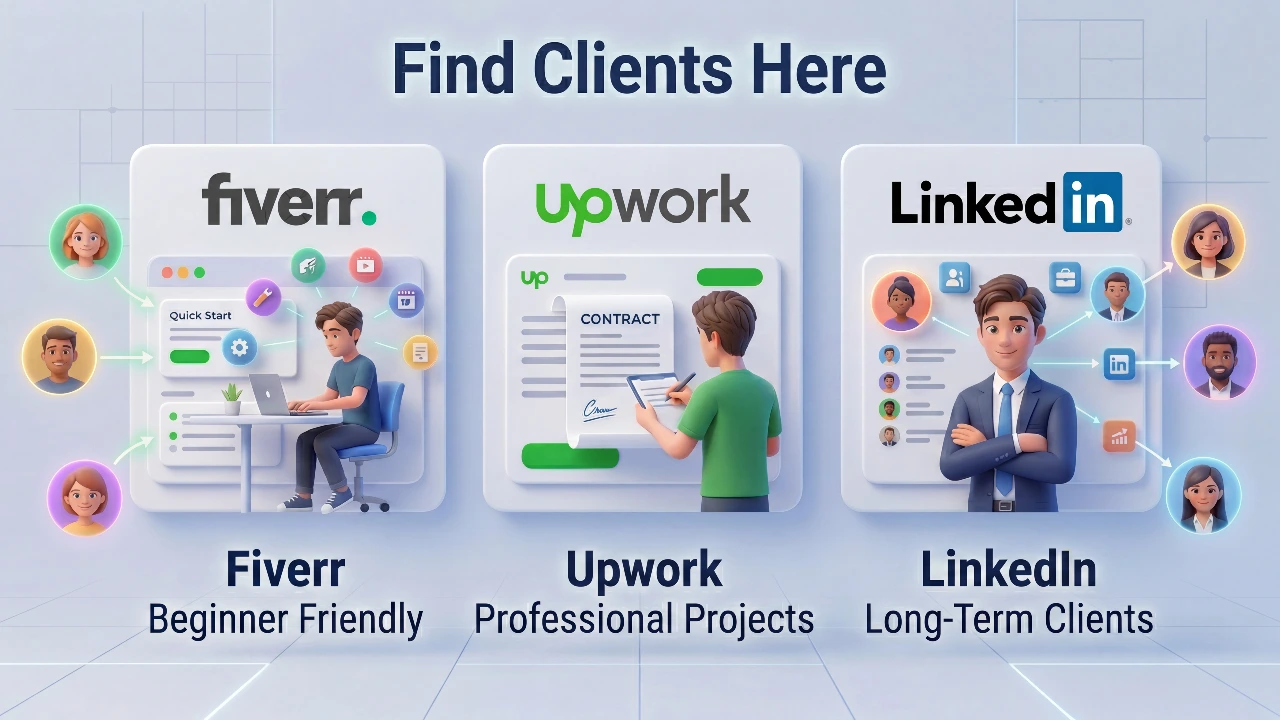
Knowing what to offer is only half the equation. You also need to know where to find people who will pay for it.
Fiverr
Fiverr is the best platform for beginners offering packaged services. Instead of applying for jobs, you create a “gig” listing describing what you offer, at what price, and how long it takes. Clients browse and purchase directly from your listing.
Fiverr takes a flat 20% commission on every order. The advantage is that you do not need to write proposals or hunt for clients – they come to you. The disadvantage is that getting your first few reviews takes time and patience. Start with a competitive price, deliver excellent work, and ask every happy client to leave a review. Once you have five to ten positive reviews, your gig starts appearing higher in search results and orders pick up.
Upwork
Upwork is better for ongoing professional relationships and larger projects. You apply to client-posted jobs by submitting a proposal. Upwork charges a variable service fee, currently ranging from 0% to 15% per contract, which is shown to you before you submit a proposal..
The competition on Upwork is higher than Fiverr, but the projects are often more substantial and better paid. Beginners do best by targeting job posts with fewer than 15 proposals and writing a proposal that directly addresses the client’s specific problem rather than using a generic template.
LinkedIn is the most underused platform for AI freelancers – and it is completely free. Posting consistently about your AI work, sharing what you have learned, and engaging with relevant communities builds visibility over time.
Unlike Fiverr or Upwork, LinkedIn does not take any commission. Clients who find you here tend to be higher quality and more interested in long-term relationships. The trade-off is that building a LinkedIn presence takes more time and consistency than listing a gig.
For beginners, the best approach is to use all three. Start on Fiverr for quick wins, use Upwork for larger projects, and build LinkedIn in the background for long-term client relationships.
How Much Can You Realistically Earn with AI?
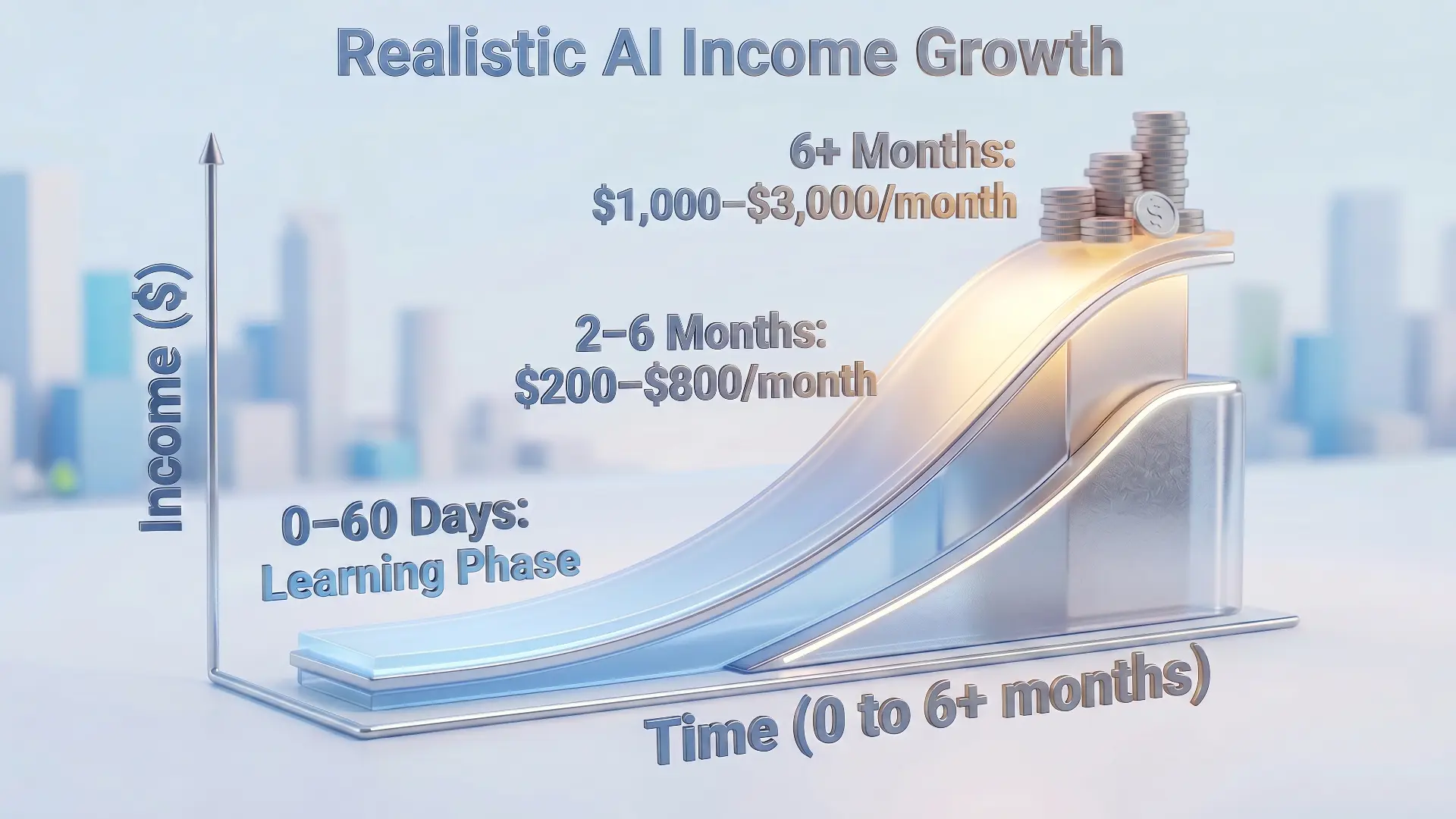
Let’s be direct about this because most articles either exaggerate or avoid the question entirely.
- In the first 30 to 60 days, most beginners earn very little. You are building your first profile, completing your first projects, and gathering your first reviews. This phase requires consistency even when results are slow.
- Between 60 and 180 days, with consistent effort, service-based AI income can reach $200 to $800 per month for beginners. This is not guaranteed it – depends on the method chosen, the quality of work delivered, and how actively you are marketing yourself.
- Beyond six months, with strong reviews, a growing profile, and refined skills, monthly income can grow to $1,000 to $3,000 for freelancers. Bloggers with growing traffic start seeing affiliate income in this window.
The honest truth is that there are no shortcuts. AI tools make you faster and more capable – but the income still requires genuine effort, consistency, and time. Anyone promising instant income with zero work is selling something, not sharing a real opportunity.
The blogs that earn the most consistent income are the ones Google trusts the most. Our guide on How to Build Topical Authority for Your Blog explains how to build that trust through a structured content approach.
The Biggest Mistakes Beginners Make When Trying to Earn with AI
Understanding what goes wrong is as important as knowing what to do right.
- Choosing the most complicated method first – Building an agency or complex automation system sounds exciting but if you have never earned online before, starting simple and proving the concept with one client or one article is far more valuable.
- Trying everything at once – Switching between blogging, freelancing, and digital products every two weeks means you never build momentum in any one area. Pick one method and commit to it for 90 days before evaluating.
- Relying entirely on AI output – AI generates content quickly but also makes mistakes and produces generic results. Your judgment, editing, and personal insight are what make the work genuinely valuable to clients.
- Giving up too early – Most beginners quit after three to four weeks without visible results. Three weeks is not enough time to rank a blog post, build Fiverr reviews, or grow a YouTube audience. Every successful AI earner went through a slow early phase.
How to Pick the Right AI Income Method for You
There is no single best method. There is only the best method for your specific situation, skills, and available time.
- Have no prior experience at all → Start with content writing on Fiverr – the lowest barrier entry point
- Want income within 30 to 60 days → Offer AI-assisted content writing or virtual assistance on Fiverr or Upwork
- Want long-term passive income → Start a blog and combine it with affiliate marketing
- Have knowledge or expertise in any field → Turn it into an AI-assisted course or consulting offer
- Have creative skills → Offer AI video editing or AI graphic design services
The most important thing is not which method you pick – it is that you pick one and start today.
Best AI Tools to Start Making Money in 2026
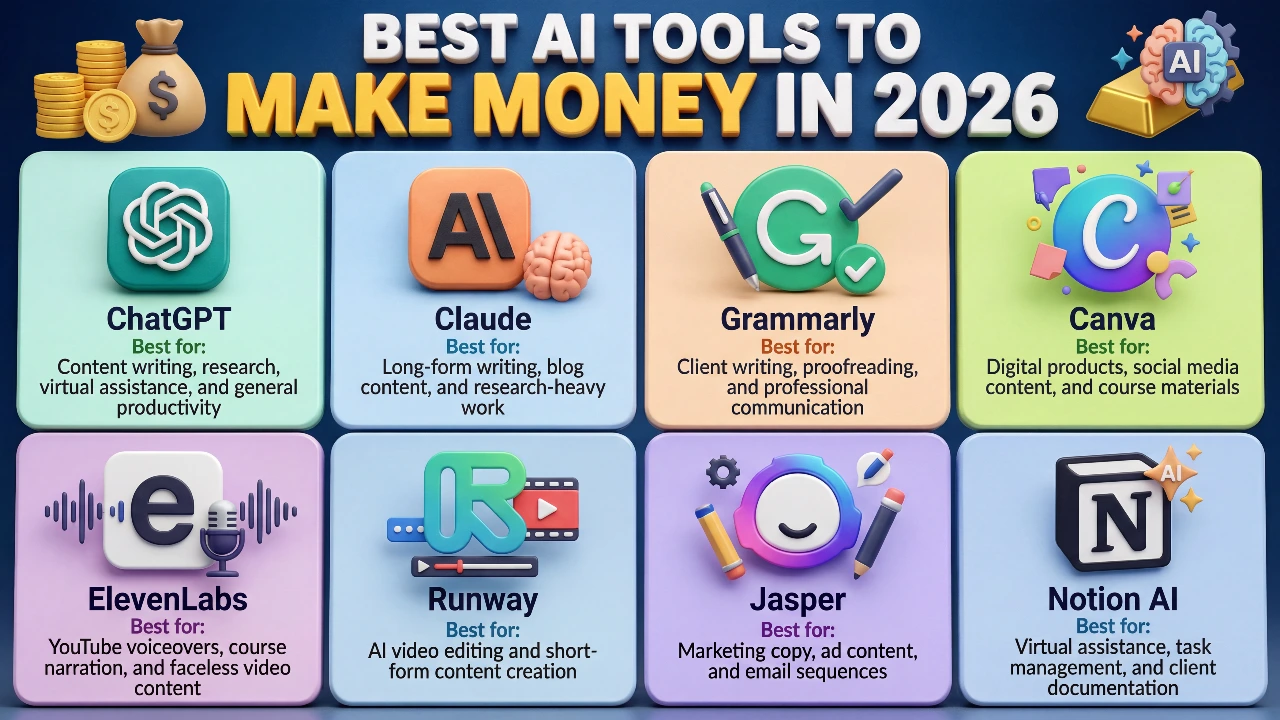
You do not need dozens of tools to get started. Here are the most practical ones based on which income type you are pursuing.
ChatGPT – Use ChatGPT to generate first drafts for client blog posts, write scripts for YouTube videos, research topics in minutes, and handle the repetitive writing tasks that would otherwise slow you down.
To learn how to use it step by step, read our beginner guide on How to Use ChatGPT for Beginners.
Best for: Content writing, research, virtual assistance, and general productivity
Claude – Use Claude when your writing work requires longer documents, careful reasoning, or a more natural tone. It is particularly strong for blog content, in-depth research summaries, and professional writing that needs to sound polished without sounding robotic.
If you want a full walkthrough of Claude, our guide on How to Use Claude AI for Beginners covers everything from setup to daily use.
Best for: Long-form writing, blog content, and research-heavy work
Canva – Use Canva to create every visual asset your income method needs — thumbnails for YouTube, graphics for social media, covers for digital products, and slide decks for online courses.
Best for: Digital products, social media content, and course materials
Grammarly – Use Grammarly on every piece of client work before delivering it. It checks grammar, tone, and clarity in real time so you never send writing with errors that damage your professional reputation.
Best for: Client writing, proofreading, and professional communication
ElevenLabs – Use ElevenLabs to add professional voiceovers to YouTube videos, online courses, and client presentations without needing a microphone, a quiet room, or any recording experience.
Best for: YouTube voiceovers, course narration, and faceless video content
Runway – Use Runway to edit short-form videos for clients, create AI-enhanced visuals, and produce content for Instagram Reels and YouTube Shorts faster than any traditional editing workflow.
Best for: AI video editing and short-form content creation
Jasper – A dedicated AI writing platform built specifically for marketing content – blog posts, ad copy, email sequences, and social media content. Used by freelancers who specialize in content marketing.
Best for: Marketing copy, ad content, and email sequences
For a comparison of the best AI writing tools available for beginners, our guide on Best AI Writing Tools for Beginners covers all the top options in detail.
Notion AI – A combination productivity and AI writing tool. Used by virtual assistants and AI-powered freelancers to manage client work, create documents, and automate repetitive tasks.
Best for: Virtual assistance, task management, and client documentation
For a full review of the best AI tools available right now, our guide on Best New AI Tools in 2026 covers everything in detail.
What AI Will Not Do For You

This is worth saying clearly because most articles on this topic never do.
AI will not replace the effort, consistency, and judgment that any real income stream requires. It will not write a perfect article on the first try without your input. It will not find you clients, build your reputation, or make decisions about your business. It will not guarantee income by a specific date. And it will not work if you switch methods every two weeks looking for faster results.
What AI will do is make you significantly more capable than you would be without it. It will help you produce more output in less time, learn new skills faster, and serve clients with a level of quality that would otherwise take years to develop manually.
The people earning real income with AI in 2026 are not the ones who found a magic tool. They are the ones who picked a method, learned the relevant tools deeply, and kept going long enough for the results to show up.
That combination – the right method, the right tools, and consistent execution – is what actually works.
Final Thoughts
Making money with AI in 2026 is one of the most realistic opportunities available to beginners – not because AI does the work for you, but because it makes you significantly more capable than you would be without it.
The framework is simple. Choose one income type. Learn the tools it requires. Start small, deliver quality, and build consistency over time. The compounding effect of steady effort applied to one method over six to twelve months is what separates people who earn real income online from people who spend years searching for shortcuts.
AI tools give you an enormous advantage if you use them properly. They reduce the time it takes to produce professional work. They help you serve more clients, create more content, and learn faster. But they do not replace the decisions, the consistency, and the genuine care for quality that make any income method actually work.
Start today. Pick one method from this guide that fits your situation. Spend one week learning the tools it requires. Then take your first real step – whether that is creating your first Fiverr gig, writing your first blog post, or reaching out to your first potential client.
That first step is the only one that actually matters right now.
Frequently Asked Questions
Can a complete beginner make money with AI?
Yes. Many of the most accessible AI income methods – content writing, virtual assistance, digital products, and blogging – require no prior experience. What they do require is a willingness to learn the tools and consistent effort over time. AI lowers the skill barrier significantly, making it genuinely possible for beginners to start earning within their first 60 to 90 days.
How much money can you realistically make with AI as a beginner?
In the first 60 days, most beginners earn very little as they are building their first profile and completing initial projects. Between two and six months of consistent effort, service-based beginners can expect $200 to $800 per month. Beyond six months with strong reviews and refined skills, income can grow to $1,000 to $3,000 per month. These are realistic ranges – not guarantees.
What is the fastest way to make money with AI?
Offering a service on Fiverr or Upwork is the fastest path to first income. AI-assisted content writing, video editing, and virtual assistance are the most accessible starting points. Service income does not require an audience or a product – just a skill and a profile.
Do I need to know coding to make money with AI?
No. The most in-demand AI income methods in 2026 – content writing, video editing, virtual assistance, blogging, and digital products – require no coding knowledge at all. Tools like ChatGPT, Canva, and Runway are designed for non-technical users.
Is AI income passive or does it require active work?
It depends on the method. Service income is active – you earn when you work. Content income – blogging, YouTube, and digital products – is semi-passive once established. It requires upfront work to create the content but then earns without proportional ongoing effort. Most beginners start with active service income and build passive content income alongside it over time.
Which AI tool should a beginner start with?
Start with ChatGPT. It is the most versatile, beginner-friendly, and widely supported AI tool available. Once you are comfortable with it, add tools specific to your chosen income method – Canva for visual content, Grammarly for writing quality, ElevenLabs for voice, and Runway for video.
How long does it take to start making real money with AI?
Most beginners see their first meaningful income between 30 and 90 days if they choose service income and are actively finding clients. Blog income typically takes three to six months to develop. The key variable is consistency – how much time and focus you apply every week matters more than any other factor.

Hi, I’m Harshil Patel, founder of Arthify.
I share simple, practical guides on AI tools, blogging, and online earning to help beginners work smarter and grow online.
My goal is to simplify AI tools so anyone can build skills and create opportunities in the digital world.