“This beginner-friendly guide explains how to create a content plan for blog using AI in 2026, including topic research, content clustering, publishing schedules, and simple workflows that help you stay consistent and grow your blog faster.”
Starting a blog feels exciting at first.
You write your first article, then your second… and slowly you begin to enjoy the process.
But after a few days or weeks, something unexpected happens.
You open your laptop and think:
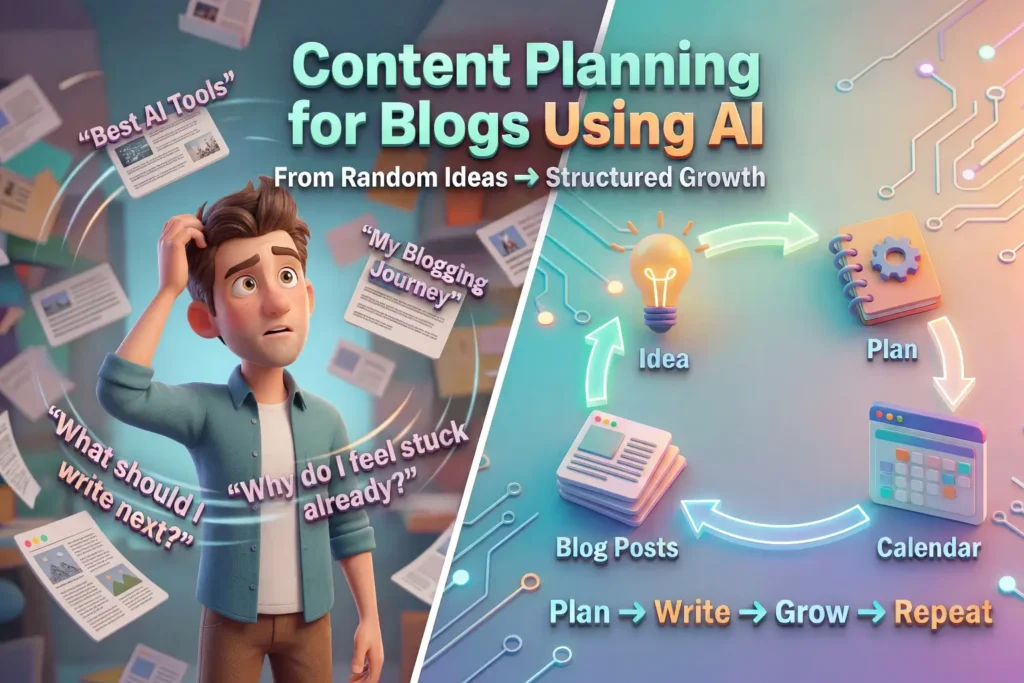
- “What should I write next?”
- “Am I choosing the right topics?”
- “Why do I feel stuck already?”
This is one of the biggest problems beginners face.
Not because they lack ideas. Not because they are not capable.
But because:
They don’t have a content plan.
If you haven’t started your blog yet, check out this complete guide on How to start blogging with AI before creating your content plan.
The Reality Most Beginners Don’t Understand
In 2026, blogging is not about writing random articles.
It is about:
- Writing the right topics
- In the right order
- With a clear strategy
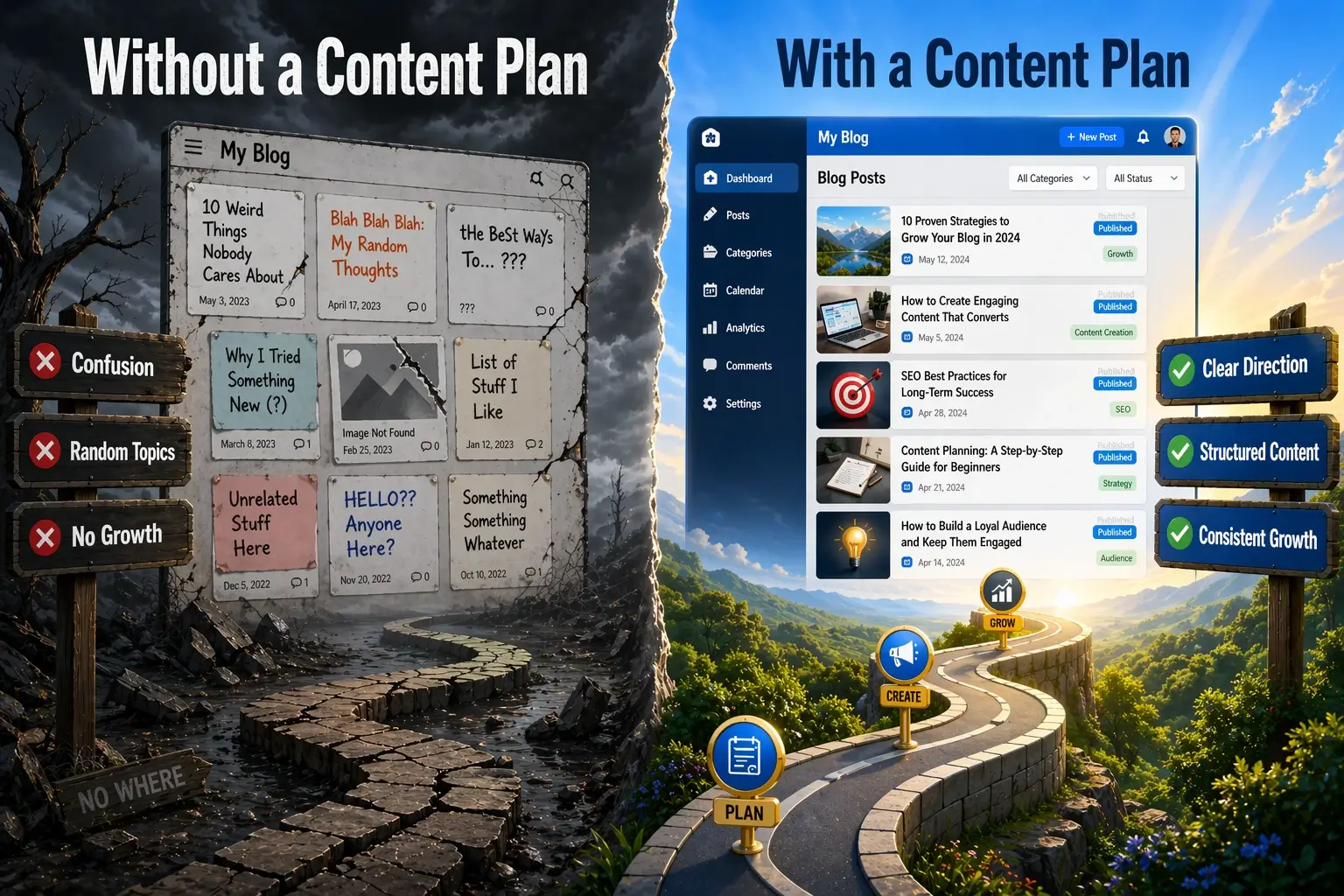
Without a content plan:
- You feel confused
- You publish inconsistently
- Your blog looks unstructured
With a content plan:
- You know exactly what to write
- You stay consistent
- You build authority
- Your chances of ranking increase
And the best part?
AI can help you build this entire system step by step.
If you’re completely new to AI, it’s important to first understand the basics before planning content. You can follow this step-by-step guide on How to use AI tools as a beginner.
Why Most Bloggers Fail Without a Content Plan
Before we build a system, you need to understand the real problem.
Most beginners don’t fail because of writing skills. They fail because of lack of direction.
What Actually Happens
A beginner usually writes like this:
- Day 1 – “Best AI Tools”
- Day 3 – “My Blogging Journey”
- Day 5 – “How to Use ChatGPT”
These topics are not connected.
From your perspective, it feels fine.
But from Google’s perspective, it looks like:
“This blog has no clear focus.”
Why This Is a Problem
Google tries to understand:
- What your website is about
- Who should see your content
- Whether your blog is trustworthy
If your topics are random:
- Google gets confused
- Your content does not rank
“A blog grows when content is connected, not when it is random.”
This is why having a clear content plan is not optional, it is essential for growth.
What Is a Content Plan (Simple Explanation)
Let’s make this very simple.
A content plan is:
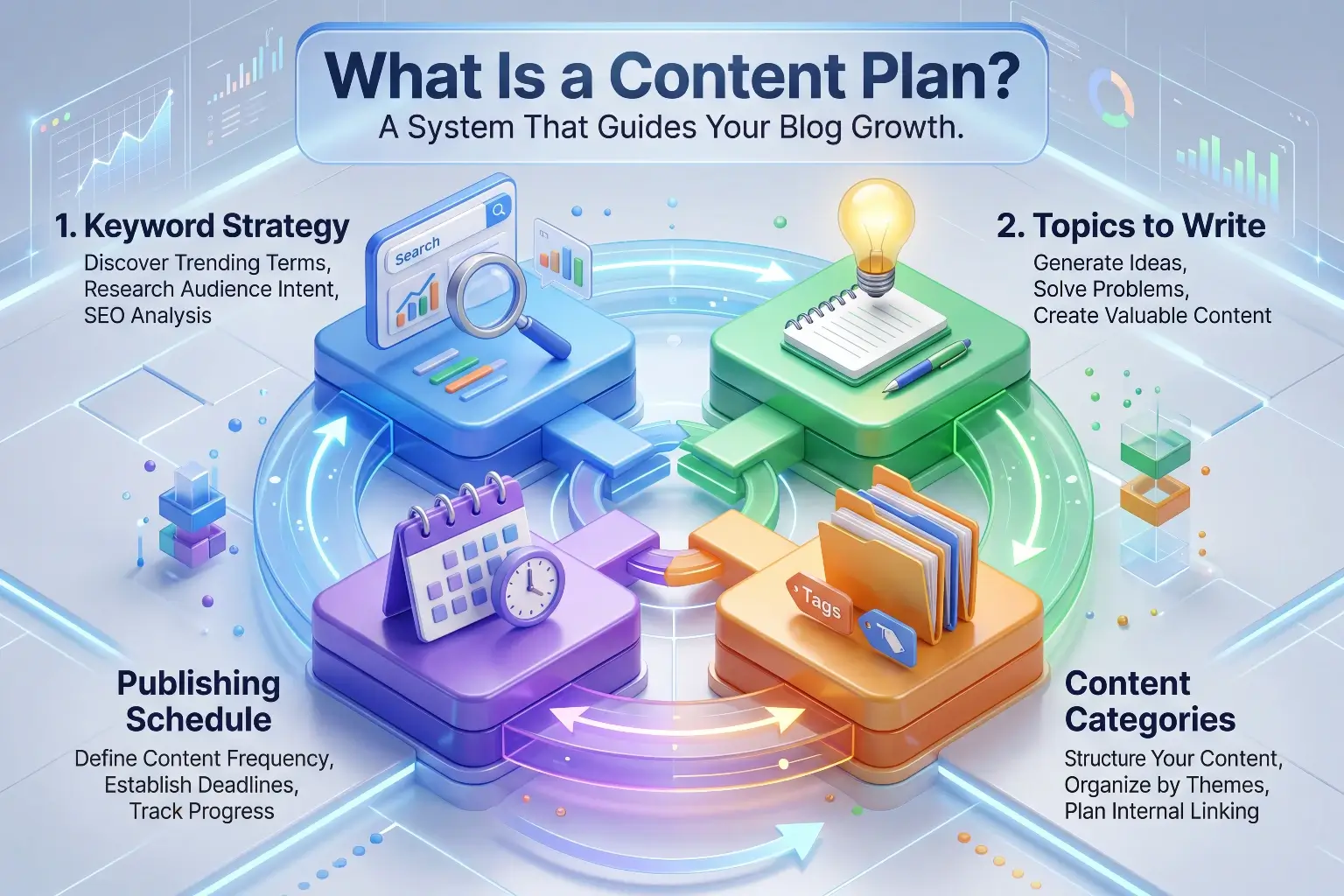
“A structured roadmap of what you will write, when you will publish, and why each article matters.”
A Proper Content Plan Includes:
- Clear blog categories
- Topic ideas
- Publishing schedule
- Keyword-focused articles
- Content flow (what comes first, what comes next)
Simple Example
Without a plan:
“You think before every article”
With a plan:
“You already know your next 5-10 articles”
Why This Matters
When you remove decision-making:
- You save time
- You stay consistent
- You reduce confusion
How AI Makes Content Planning Easier
AI is especially helpful when you feel stuck or confused about what to do next. For example, instead of spending hours thinking about your next blog topic, you can simply ask AI to suggest ideas based on your niche.
It can also turn one idea into multiple related topics, which helps you build a complete content plan instead of writing random articles. Earlier, content planning was difficult.
You had to:
- Search manually
- Analyze competitors
- Guess what people want
Now AI can help you:
- Generate topic ideas
- Identify search intent
- Organize content
- Build structured plans
- Create content calendars
AI is not magic. It does not replace your thinking.
It helps you:
- Think faster
- Organize better
- Avoid confusion
A strong content plan always starts with proper keyword research. Learn How to do keyword research for blogging using AI.
Step-by-Step: Create a Content Plan Using AI
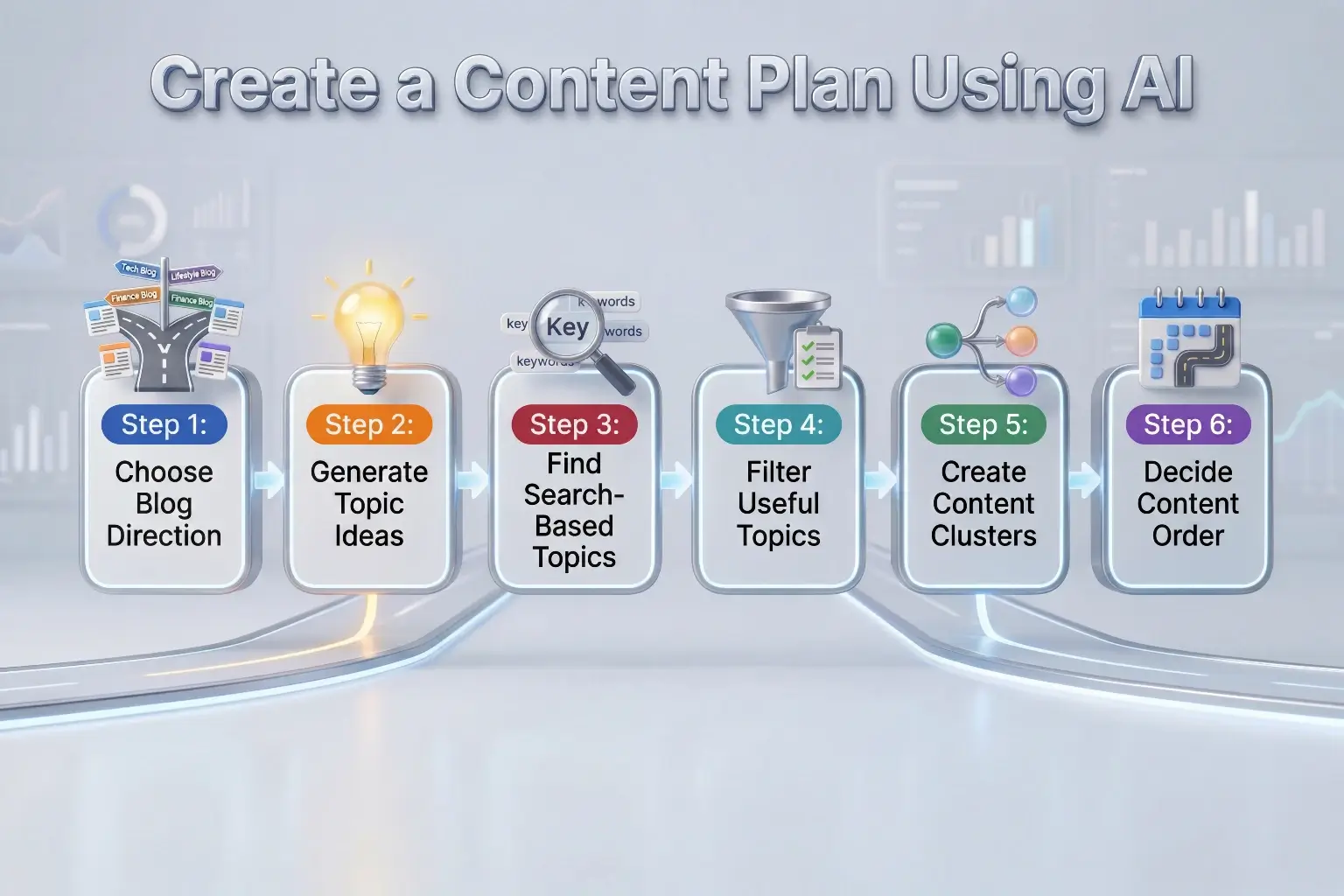
Now let’s build your system step by step.
Step 1: Choose a Clear Content Direction
Ask yourself:
“What is my blog mainly about?”
Examples:
- AI Blogging
- AI Tools
- Productivity with AI
Why This Matters
If your direction is not clear:
“Your content will always feel random”
Step 2: Generate Topic Ideas Using AI
Use tools like ChatGPT or Claude.
Prompt:
“Give me 20 beginner-friendly blog topics about AI Blogging”
What You Get
- Structured ideas
- Beginner-focused topics
- Relevant content
“Do not use topics exactly as they are.
Refine them based on:
- Clarity
- Simplicity
- Usefulness
Step 3: Convert Ideas into Search-Based Topics
Take one topic:
“Blog traffic”
Ask:
“What do beginners search about blog traffic?”
You’ll Get:
- How to get blog traffic
- Why blog is not getting traffic
- How to increase blog visitors
These are real search queries that have higher chances of ranking on Google.
Step 4: Filter the Right Topics
Choose topics that are:
- Beginner-friendly
- Problem-solving
- Easy to understand
- Search-focused
Avoid:
- Personal opinions
- Very advanced topics
- Unclear ideas
For example, a topic like “My blogging journey” may feel interesting to you, but most beginners are not searching for that.
Instead, a topic like “how to start blogging for beginners” solves a real problem and has better chances of ranking.
This small difference is what separates low-traffic blogs from growing blogs.
Step 5: Group Topics into Content Clusters
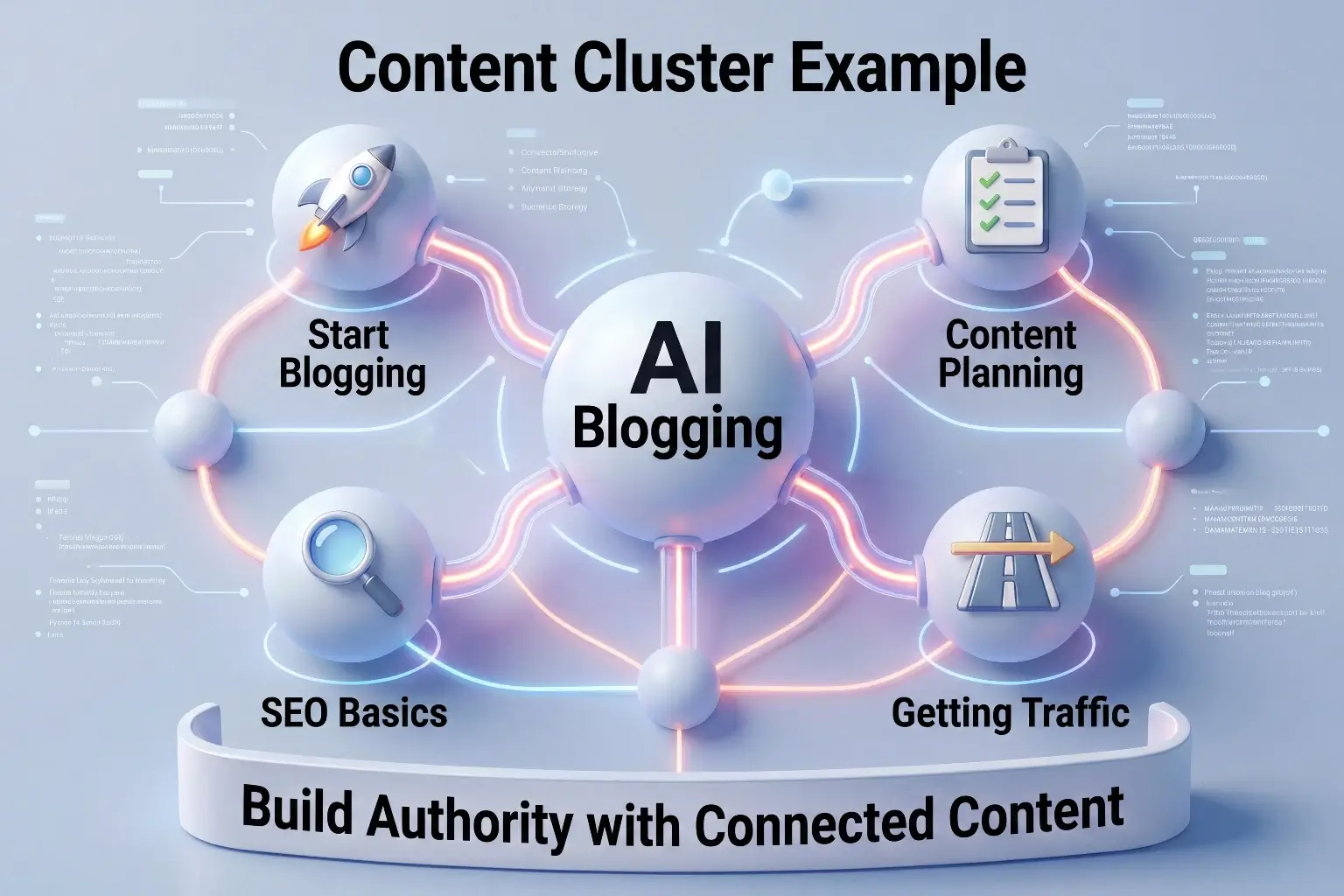
Example cluster:
AI Blogging
- How to start blogging
- Content planning
- SEO basics
- Getting traffic
Why This Is Powerful
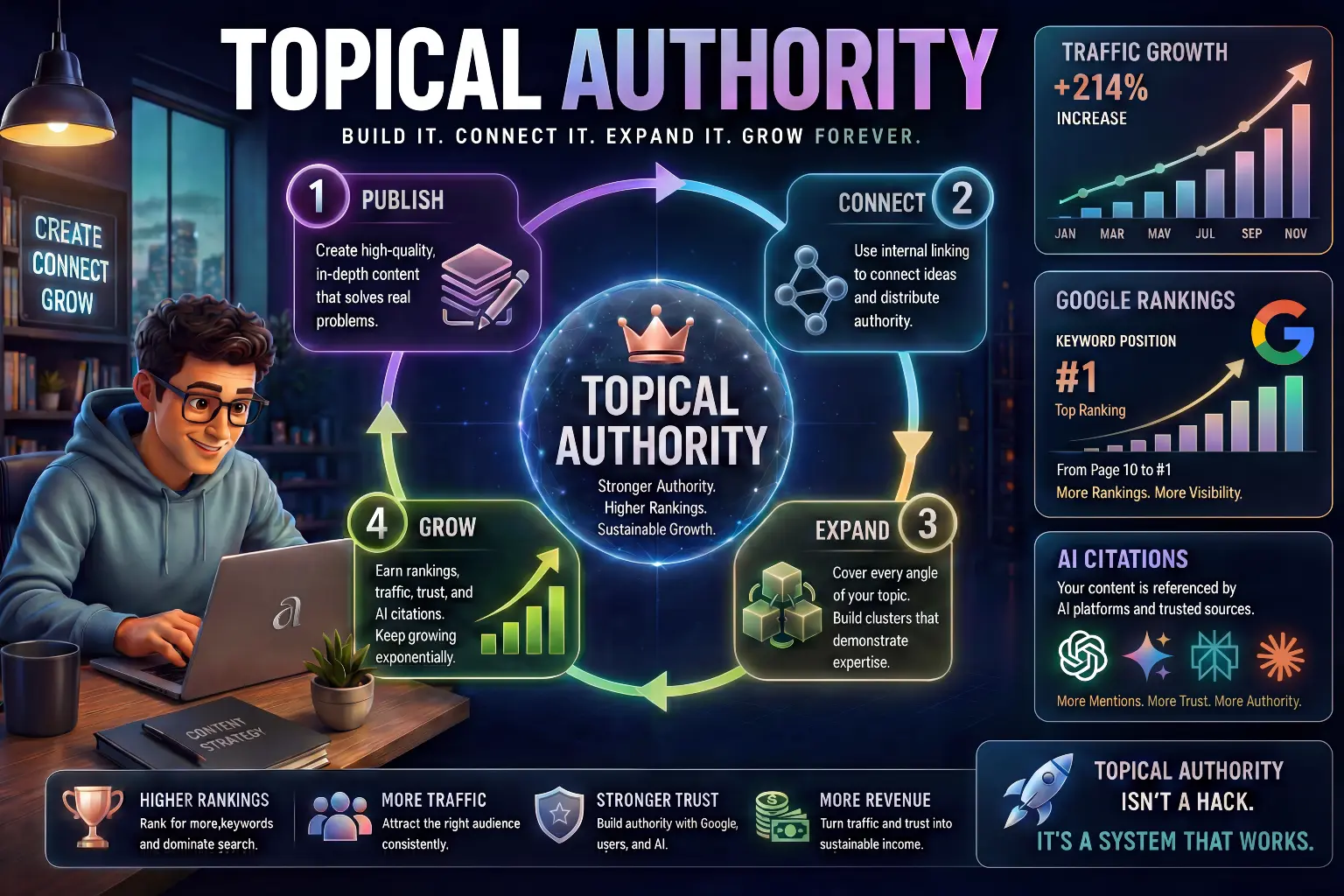
This builds topical authority.
Google understands:
“This website deeply covers one topic”
Which leads to:
- Better rankings
- Higher trust
- More traffic
Step 6: Decide the Content Order
Order matters.
Best Beginner Flow:
- Start (basics)
- Plan (structure)
- Write (content)
- Grow (traffic)
This creates a learning journey + SEO structure
Once your plan is ready, you can use AI to actually create your content faster. This guide explains How to use AI for content creation step by step.
How Content Planning Builds Topical Authority
This is something most beginners don’t understand.
When you consistently write about one main topic and cover it from different angles, Google starts recognizing your blog as a helpful source on that subject.
Instead of ranking just one article, it may start ranking multiple articles from your website, which increases your overall traffic.
When your content is:
- Connected
- Structured
- Focused on one topic
Google starts trusting your site.
This is why random blogging rarely works. Growth happens when your content is connected, not scattered.
Instead of seeing separate articles, it sees:
“A complete knowledge system”
This is called:
“Topical authority”
And this is one of the biggest ranking factors in 2026. Our guide on How to Build Topical Authority for Your Blog explains the full system behind this approach.
How to Build a Monthly Content Calendar
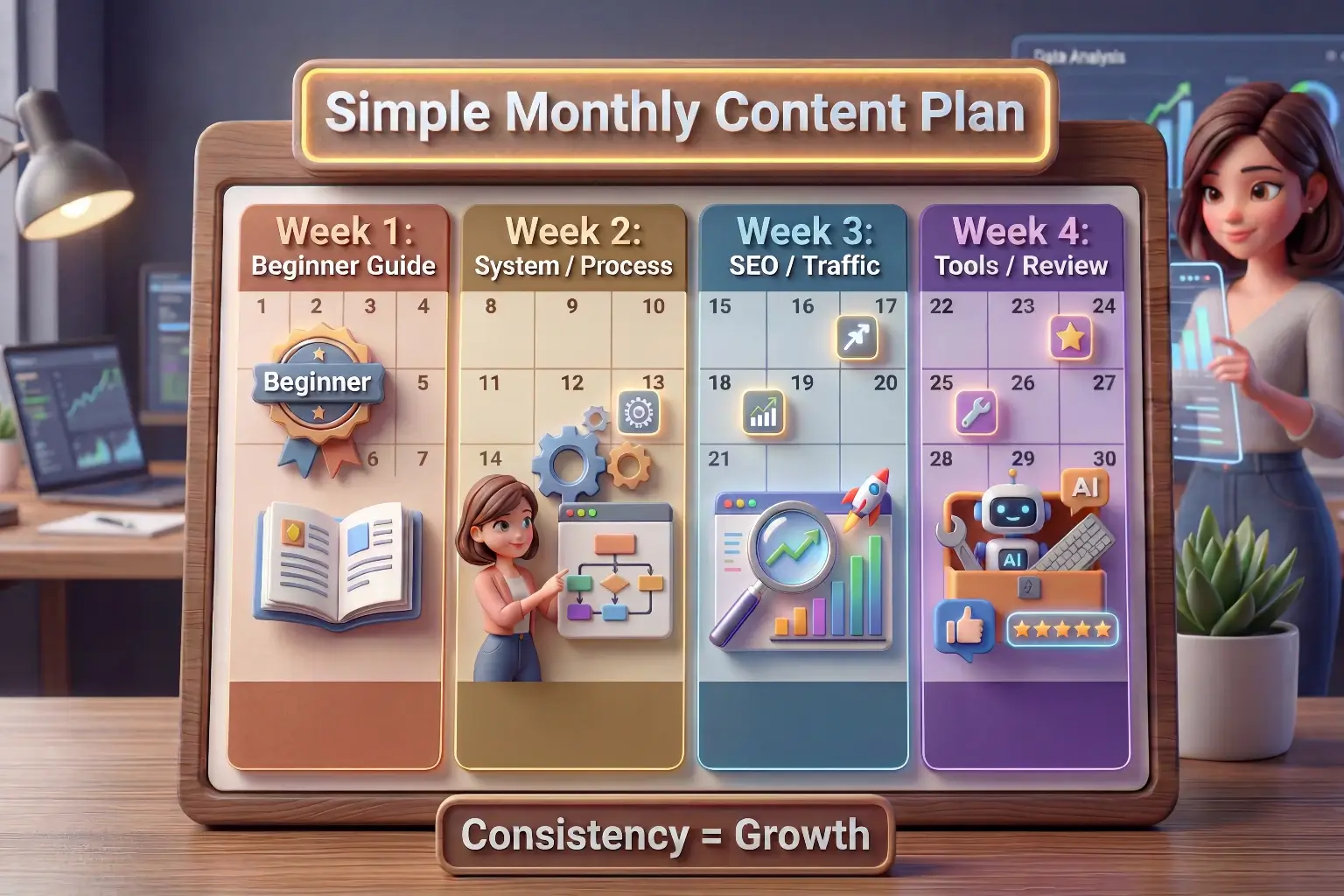
Let’s make this practical.
Simple Beginner Plan (4 High-Quality Articles Per Month)
- Week 1 – Beginner guide
- Week 2 – System/process
- Week 3 – SEO/traffic
- Week 4 – Tools/review
Example:
- Week 1 – Start blogging
- Week 2 – Content planning
- Week 3 – Get traffic
- Week 4 – Best tools
Why This Works
It balances:
- Learning
- Execution
- Growth
You do not need a complicated system to start. Even a simple list of 4 planned articles for the month is enough.
The goal is not perfection, but clarity. When you already know what to write next, you avoid delays and stay consistent.
Once you have a plan, the next challenge is actually following it every day. That’s where AI can help you manage your tasks and stay on track. Learn more in our guide on How to Use AI for Daily Productivity.
How to Choose the Right Topics
Choosing the right topics is one of the most important skills in blogging.
Many beginners make the mistake of writing topics based on what they want to write instead of what people are actually searching for.
Before writing any article, ask yourself:
- Is someone actively searching for this topic?
- Does this topic solve a real problem?
- Is it easy for a beginner to understand?
- Can I explain this clearly?
If all answers are “YES” – Write it
What Is Search Intent (Simple Explanation)
Search intent means:
Why someone is searching for something on Google
For example:
If someone searches: “how to start a blog”
They want:
- A step-by-step guide
- Beginner-friendly explanation
- Clear instructions
If your article gives:
- Personal story
- Advanced tips
It will not rank
How AI Helps You Choose Better Topics
AI can help you validate your topic before writing.
You can ask:
- “Is this topic beginner-friendly and search-focused?”
- “What problems does this topic solve?”
- “What type of content should I write for this topic?”
This helps you avoid writing content that no one is searching for.
Always choose topics that solve specific problems, not general ideas.
Bad topic:
“Blogging tips”
Better topic:
“How to start a blog for beginners step by step”
Don’t write what you want. Write what people need.
The quality of your content plan depends heavily on how you give instructions to AI. Learn How to write better prompts for AI to get better results.
Content Planning Mistakes to Avoid
1. Writing Without a Plan
- This is the most common mistake.
- When you don’t have a plan, you keep thinking before every article, which leads to confusion and inconsistency.
How to fix it:
Create a simple list of your next 5-10 blog topics in advance.
2. Ignoring Search Intent
- Even well-written articles fail if they don’t match what users are looking for.
- If your content does not answer the exact question behind the search, Google will not rank it.
How to fix it:
Before writing, ask:
“What does the reader expect from this topic?”
3. Overplanning Without Writing
- Some beginners spend too much time planning and never start writing.
- Planning is useful only when it leads to action.
How to fix it:
Keep your plan simple and start writing immediately.
4. Copying Others Blindly
- Looking at competitors is helpful, but copying them exactly removes your originality.
- Your blog needs its own clarity and voice.
How to fix it:
Use others for ideas, but explain topics in your own simple way.
5. Inconsistency
- This is the biggest reason most blogs fail.
- Publishing randomly breaks your content flow and slows down growth.
How to fix it:
Follow a simple schedule like 2 article per week and stick to it.
Best AI Tools for Content Planning
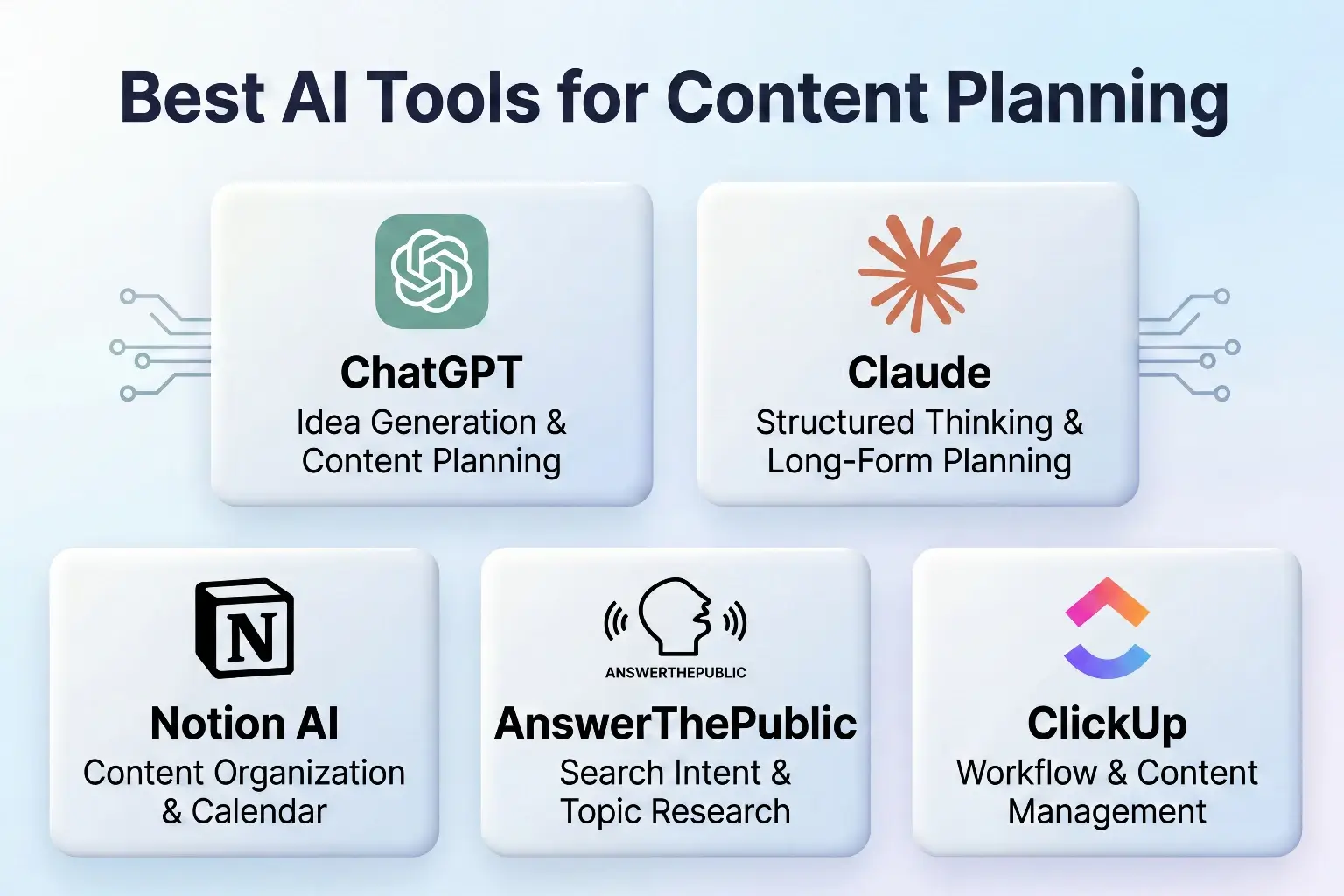
You do not need too many tools to create a good content plan. A small set of the right tools is enough to help you think clearly, organize your ideas, and stay consistent.
Here are some of the most useful tools for beginners.
1. ChatGPT – Idea Generation & Content Assistance
ChatGPT is one of the most powerful AI tools for brainstorming and content creation.
You can use it to:
- Generate blog topic ideas
- Create content outlines
- Rewrite and simplify content
- Improve clarity and readability
Example prompt you can use:
“Create a beginner-friendly content plan for an AI blogging website”
Why this tool matters:
It helps you quickly move from ideas → structured content, especially when you feel stuck.
For example, tools like ChatGPT can help you generate blog topic ideas, create content calendars, and structure your posts. If you’re new, here’s a step-by-step guide on How to use ChatGPT for beginners.
2. Claude – Idea Generation & Content Planning
Claude is one of the best AI tools for structured thinking and content planning.
If you prefer more structured and thoughtful outputs, Claude can help you build detailed content plans and weekly schedules. Learn more in our guide How to use Claude AI.
You can use it to:
- Generate blog topic ideas
- Create content outlines
- Plan your article flow
- Simplify complex ideas
Example prompt you can use:
“Give me 20 beginner-friendly blog topics about AI blogging”
Why this tool matters:
It helps you move from confusion → clarity by giving you direction.
3. Notion AI – Content Planning & Organization
Notion AI is perfect for organizing your ideas into a structured content plan.
You can use it to:
- Create content calendars
- Organize blog topics
- Track published articles
- Plan weekly or monthly content
Example:
Create columns like: Idea → Writing → Editing → Published
Why this tool matters:
It turns your ideas into a clear, actionable system.
4. AnswerThePublic – Topic Validation & Search Intent
AnswerThePublic helps you understand what people are actually searching on Google.
You can use it to:
- Find real user questions
- Discover long-tail keywords
- Build FAQ sections
- Understand search intent
Example use:
Search “blog content planning” and explore real questions users ask.
Why this tool matters:
It ensures you write what people need, not just what you think.
5. ClickUp – Content Workflow & Task Management
ClickUp is a powerful tool for managing your entire content workflow in one place.
You can use it to:
- Plan your content calendar
- Track article progress (Idea → Writing → Published)
- Set deadlines and reminders
- Manage multiple blog posts easily
Example:
Create task stages like: To Do → Writing → Editing → Published
Why this tool matters:
It helps you stay organized, consistent, and productive as your blog grows.
Start with 1-2 tools and master them.
You can also explore some of the Best AI tools for beginners in 2026 to build your content plan more efficiently.
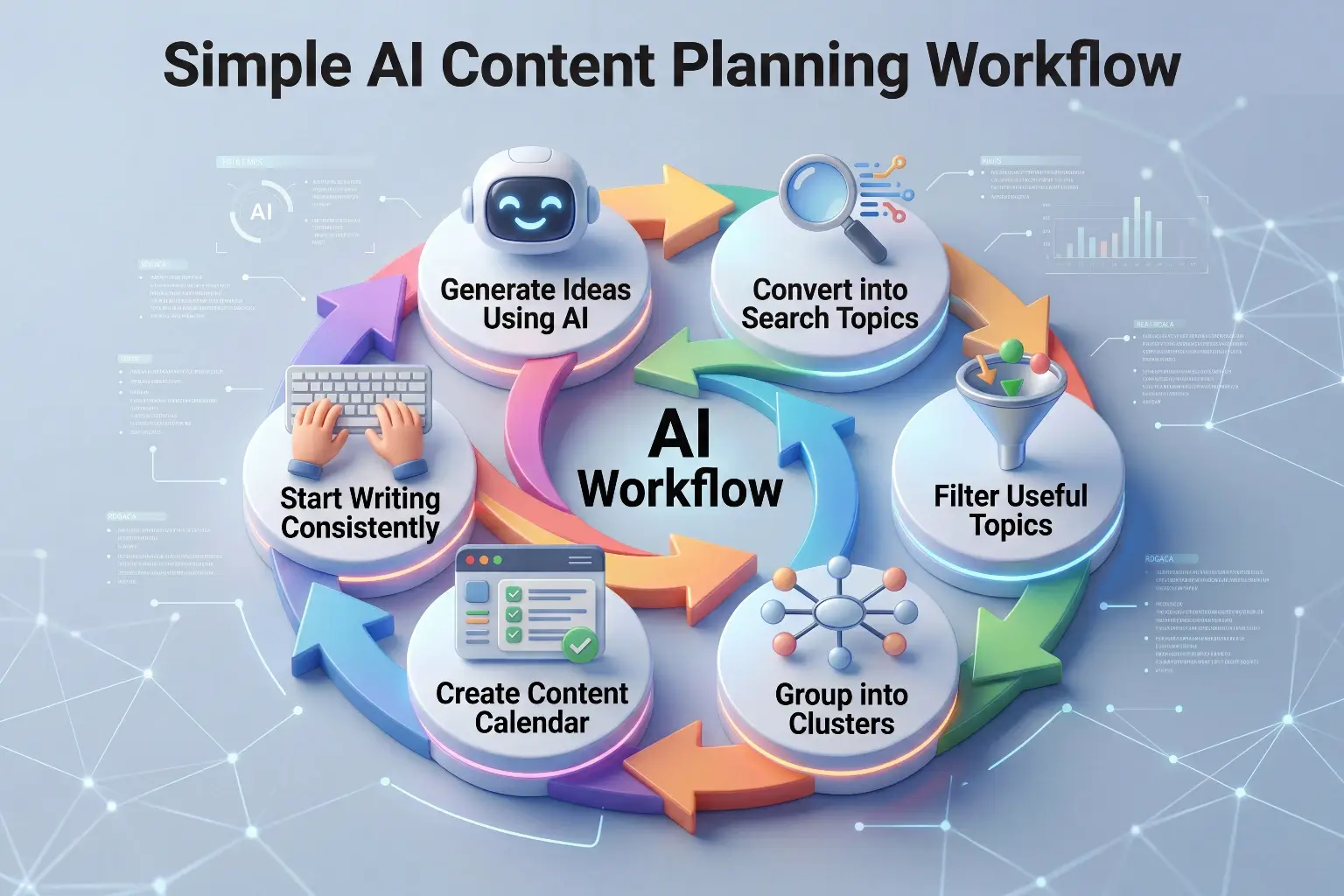
Simple AI Content Planning Workflow
Follow this system:
- Generate ideas using AI
- Convert into search topics
- Filter useful topics
- Group into clusters
- Create content calendar
- Write consistently
This becomes your long-term blogging system
At the beginning, this process may feel slow, but after a few articles, it becomes much faster. You will start understanding how to choose better topics and structure your content more clearly.
Over time, this simple workflow becomes your natural way of blogging.
Having a solid content plan is only valuable when the articles you publish are optimized to be found. Our guide on On-Page SEO for Blog Posts gives you the complete step-by-step checklist for every article you write.
How Long It Takes to See Results
This is one of the most important things to understand because many beginners quit too early.
Blogging does not give instant results. It takes time for search engines to understand your content, trust your website, and start showing it to users.
Here is a realistic expectation:
Month 1 – You are learning and publishing
Month 2 – Your content becomes more structured
Month 3 – Google starts recognizing your blog
Month 4–6 – You may start getting initial traffic
But this only happens if you stay consistent and follow a clear system.
Most bloggers quit before results start. Focus on building a system, not chasing quick traffic
Your goal should be:
- Writing better articles
- Choosing better topics
- Building a clear structure
If you stay patient and keep publishing helpful content, your blog will grow step by step.
A strong content plan is the foundation of content income – one of the three main ways beginners can earn online with AI. You can read about all three in our guide on How to Make Money with AI in 2026.
Final Thoughts
Content planning is not optional. It is the foundation of blogging.
Without it:
“You feel stuck”
With it:
“You move forward clearly”
AI makes this easier, but your success depends on:
- Consistency
- Clarity
- Patience
“A successful blog is not built by writing more. It is built by writing with a plan.”
Your next step is simple. Do not overthink it. Create a small content plan with your next 3-4 blog topics and start writing your first article. Action is what turns planning into real results.
A content plan gives you direction, but traffic is what grows your blog. If you want to turn your plan into real results, follow this guide on How to Get Traffic to Your Blog Using AI.
Frequently Asked Questions
What is a content plan for a blog?
A content plan is a structured strategy that defines what topics you will write, when you will publish them, and how each article connects to your overall blog growth and SEO goals.
Can AI really help with blog content planning?
Yes, AI can help generate topic ideas, identify search intent, organize content into clusters, and create a structured content calendar, making the planning process faster and easier for beginners.
How many articles should I plan in advance?
Beginners should plan at least 2 to 4 weeks of content in advance. This helps maintain consistency and reduces confusion about what to write next.
What is topical authority in blogging?
Topical authority means covering a specific topic deeply with multiple related articles. When your content is structured and connected, search engines start trusting your blog more, which improves rankings.
Which AI tools are best for content planning?
Tools like Claude, Notion AI, AnswerThePublic, ChatGPT, and ClickUp are highly useful for planning, organizing, and researching blog content effectively.
Is content planning necessary for blogging success?
Yes, without a content plan, blogging becomes inconsistent and unstructured. A proper plan helps you stay focused, publish regularly, and improve your chances of ranking on Google.
How long does it take to see results from content planning?
Most blogs start showing early progress within 2 to 3 months, while consistent traffic growth usually happens between 4 to 6 months, depending on content quality and consistency.

Hi, I’m Harshil Patel, founder of Arthify.
I share simple, practical guides on AI tools, blogging, and online earning to help beginners work smarter and grow online.
My goal is to simplify AI tools so anyone can build skills and create opportunities in the digital world.