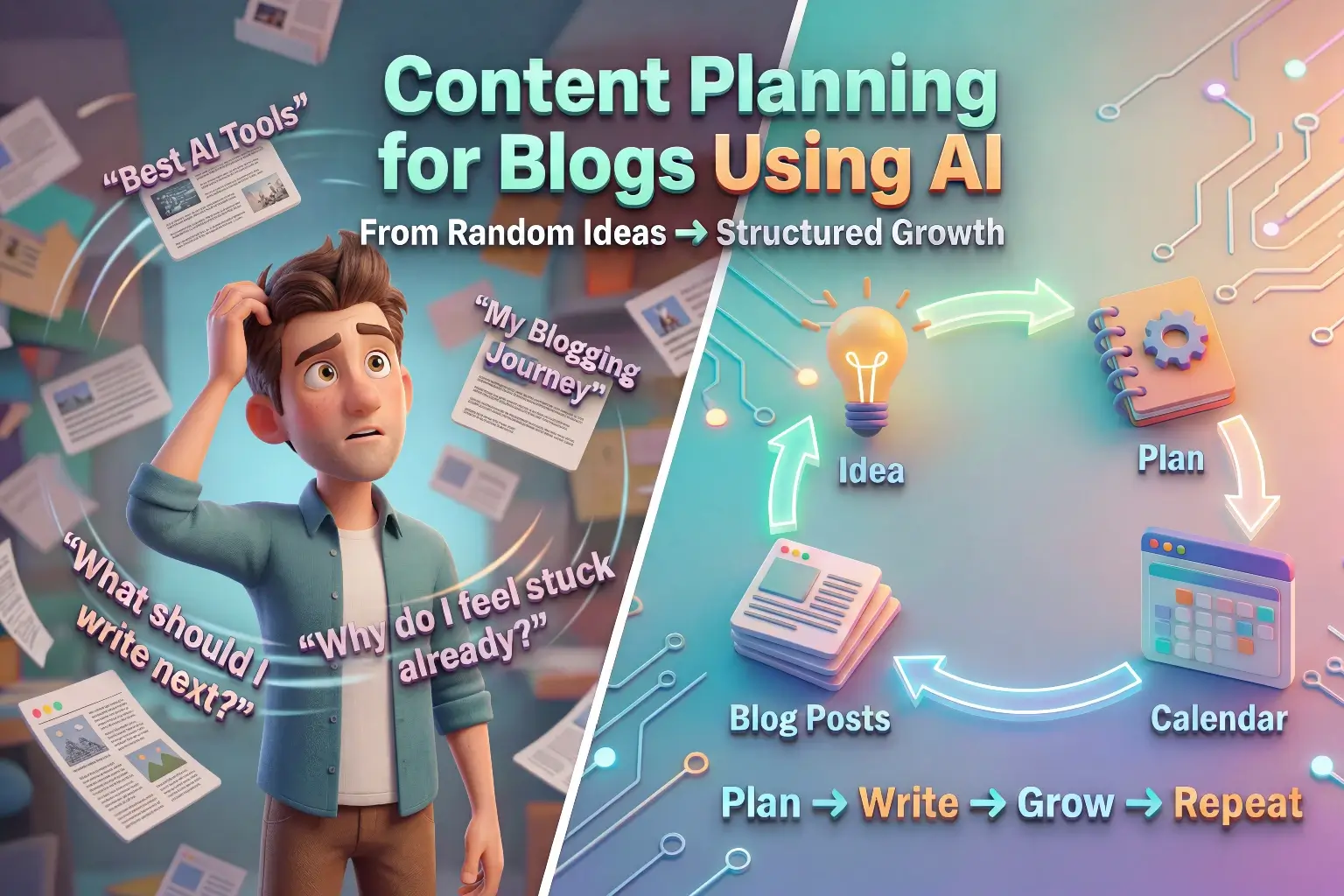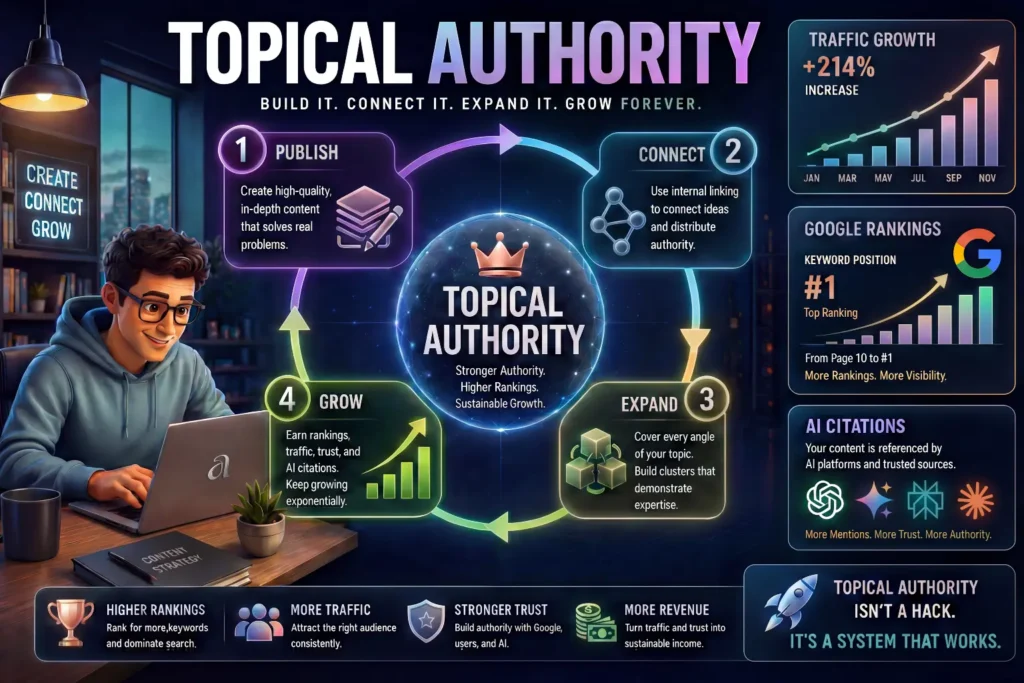
“This guide explains what topical authority is, why Google rewards blogs that have it, and exactly how to build topical authority step by step using AI tools — so your blog stops being invisible and starts ranking consistently.”
You have published articles. You have done your keyword research. You have optimized your on-page SEO. And yet your blog traffic is still not growing the way you expected.
If this sounds familiar, the problem is almost certainly not your writing. It is your content structure.
Most beginner blogs make the same mistake. They write articles about whatever feels interesting or relevant at the moment — a tool review here, a how-to guide there, a trending topic somewhere in between. Each article is written well. Each one is optimized properly. But together they form no recognizable pattern. Google looks at the blog and cannot figure out what it is genuinely an expert on.
This is the topical authority problem. And it is the single most common reason that blogs with fewer articles and lower domain authority outrank blogs with more content, more backlinks, and more effort behind them.
The good news is that topical authority is completely buildable from scratch. You do not need a large team, an expensive agency, or years of experience. You need a clear strategy, consistent publishing, and the right AI tools to help you execute it faster.
If you have already read our guide on How to Do Keyword Research for Blogging Using AI and our guide on On-Page SEO for Blog Posts, this article is the next piece. Keyword research tells you what to write. On-page SEO tells you how to optimize it. Topical authority explains how to organize everything into a structure that Google actually trusts.
What Is Topical Authority and Why Should Beginners Care

Topical authority is what happens when a website consistently covers one specific subject so thoroughly and so well that Google begins treating it as a trusted expert on that topic.
It is not a score you can check in a dashboard. It is not something you apply for. It is a signal that Google builds over time by looking at how comprehensively your blog covers a topic, how well your articles connect to each other, and whether your content answers the full range of questions a reader might have.
Think of it like this. Imagine two blogs.
The first blog has published 30 articles about 30 completely different topics — AI tools, travel tips, recipe ideas, fitness routines, and financial advice. Each article is well written but they have nothing to do with each other.
The second blog has published 20 articles all focused on one subject — how to use AI tools for blogging and online income. Every article supports the others. Every article connects back to the same core theme.
Which blog does Google trust more as an expert on AI blogging? The second one — even though it has fewer articles.
That is topical authority in practice. And understanding it early is one of the most valuable things a beginner blogger can do. The bloggers who grasp this concept from the start build blogs that rank faster, hold rankings longer, and grow more predictably than those who publish randomly and hope for the best.
Why Topical Authority Matters More Than Ever in 2026
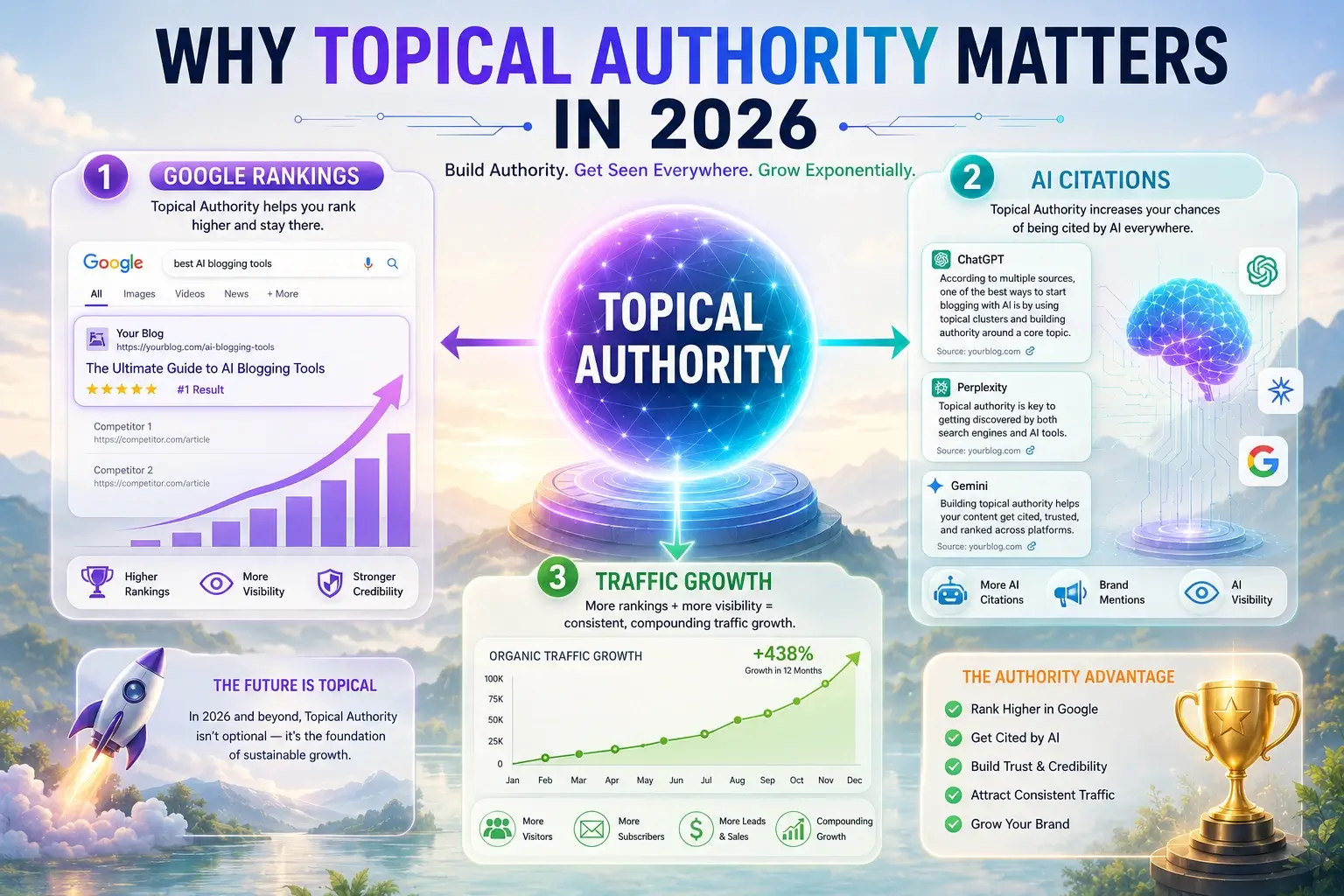
Google has been moving toward evaluating topical depth as a primary quality signal for years. In 2026 that shift is impossible to ignore for three specific reasons.
Google’s March 2026 Core Update made it official
Google’s helpful content system is now fully integrated into its core ranking algorithm. This means a blog with 20 deeply connected articles on one specific subject will consistently outrank a blog with one brilliant 5,000-word guide on the same subject. Depth across a topic beats depth within a single article. This is not a theory — it is the standard Google has enforced through multiple algorithm updates since 2022 and confirmed with the March 2026 update.
AI search tools reward topical authority too
When tools like ChatGPT, Perplexity AI, and Google AI Overviews generate answers and cite sources, they do not just look for the best single article. They look for the source that has consistently demonstrated expertise across the full subject area. A blog that covers AI blogging from ten different angles is far more likely to be cited than a blog that covered it once brilliantly. Building topical authority is now both an SEO strategy and a strategy for getting cited by AI tools — which is one of the most valuable traffic sources emerging right now.
The traffic impact is measurable
Research from 2026 shows that blogs implementing content cluster strategies see significantly higher organic traffic growth compared to blogs publishing without structure. The difference is not marginal — blogs that transition from random publishing to organized topic clusters report traffic growth ranging from 40% to over 200% within six to twelve months of consistent effort.
The Difference Between a Scattered Blog and an Authority Blog
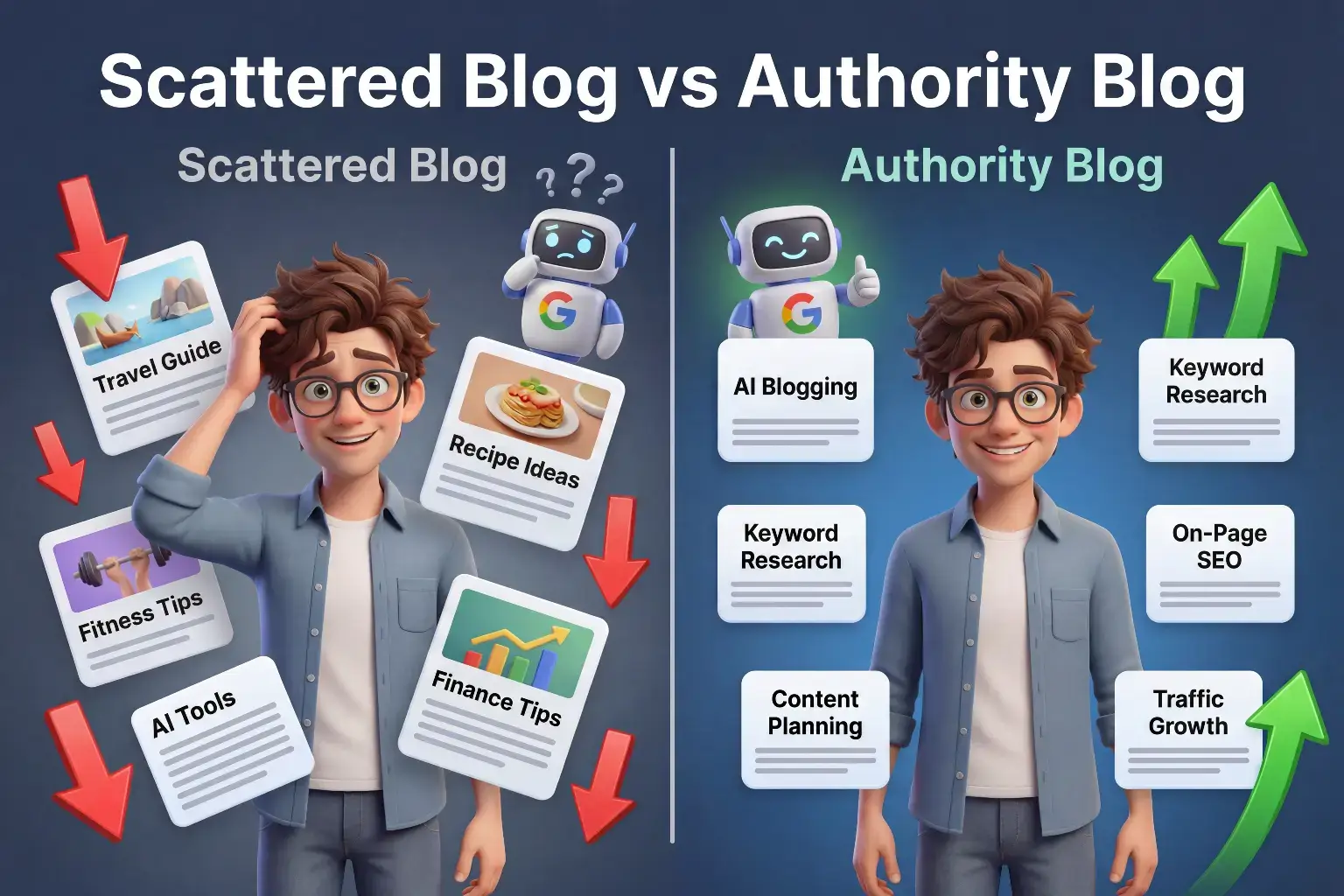
The easiest way to understand topical authority is to compare two approaches side by side.
A scattered blog publishes like this:
- Week 1 — a review of ChatGPT
- Week 2 — a recipe for banana bread
- Week 3 — a travel guide to Paris
- Week 4 — a comparison of AI writing tools
- Week 5 — a fitness tip article
The AI content is good but Google cannot tell whether this is an AI blog, a food blog, or a travel blog. None of the articles support each other. Google has no clear picture of what this site is about.
An authority blog publishes like this:
- Month 1 — a beginner guide to AI tools (pillar article)
- Month 2 — how to use ChatGPT for writing (supporting article)
- Month 3 — how to use Claude for research (supporting article)
- Month 4 — the best AI writing tools compared (supporting article)
- Month 5 — how to use AI for content creation (supporting article)
Every article is about the same core subject. Every article connects to the others. Google can clearly see what this blog is about, who it serves, and why it deserves to rank.
The authority blog does not just rank better. It ranks faster. New articles on an authority blog often start appearing in search results within weeks because Google already trusts the site on that topic. New articles on a scattered blog can sit unranked for months or never rank at all.
Internal linking is the mechanism that makes this work. Without internal links connecting your articles to each other, even a focused blog misses the opportunity to signal its cluster structure to Google. The links are the glue that holds the system together.
The Arthify Method: How to Build Topical Authority Step by Step
The Arthify Method
7 steps · Build topical authority
Here is a practical, beginner-friendly system for building topical authority on your blog from scratch. Follow these steps in order and do not skip ahead.
Step 1: Choose One Core Topic and Stick to It
Before you write anything, get clear on what your blog is actually about — not in a vague sense, but in a specific, narrow sense.
Your core topic should be:
- Specific enough that you can write 20 to 30 articles about it without running out of ideas
- Narrow enough that every article clearly belongs to the same subject area
- Focused on one audience with one clear set of problems to solve
For example:
- “Blogging” is too broad — “Blogging with AI tools for beginners” is focused
- “AI tools” is too broad — “AI tools for content creators” is focused
- “Make money online” is too broad — “Make money online using AI tools” is focused
The narrower your core topic, the faster you build authority on it. A blog that completely owns one narrow topic will always outrank a blog that covers many topics poorly.
Step 2: Map Your Topic Clusters Before You Write
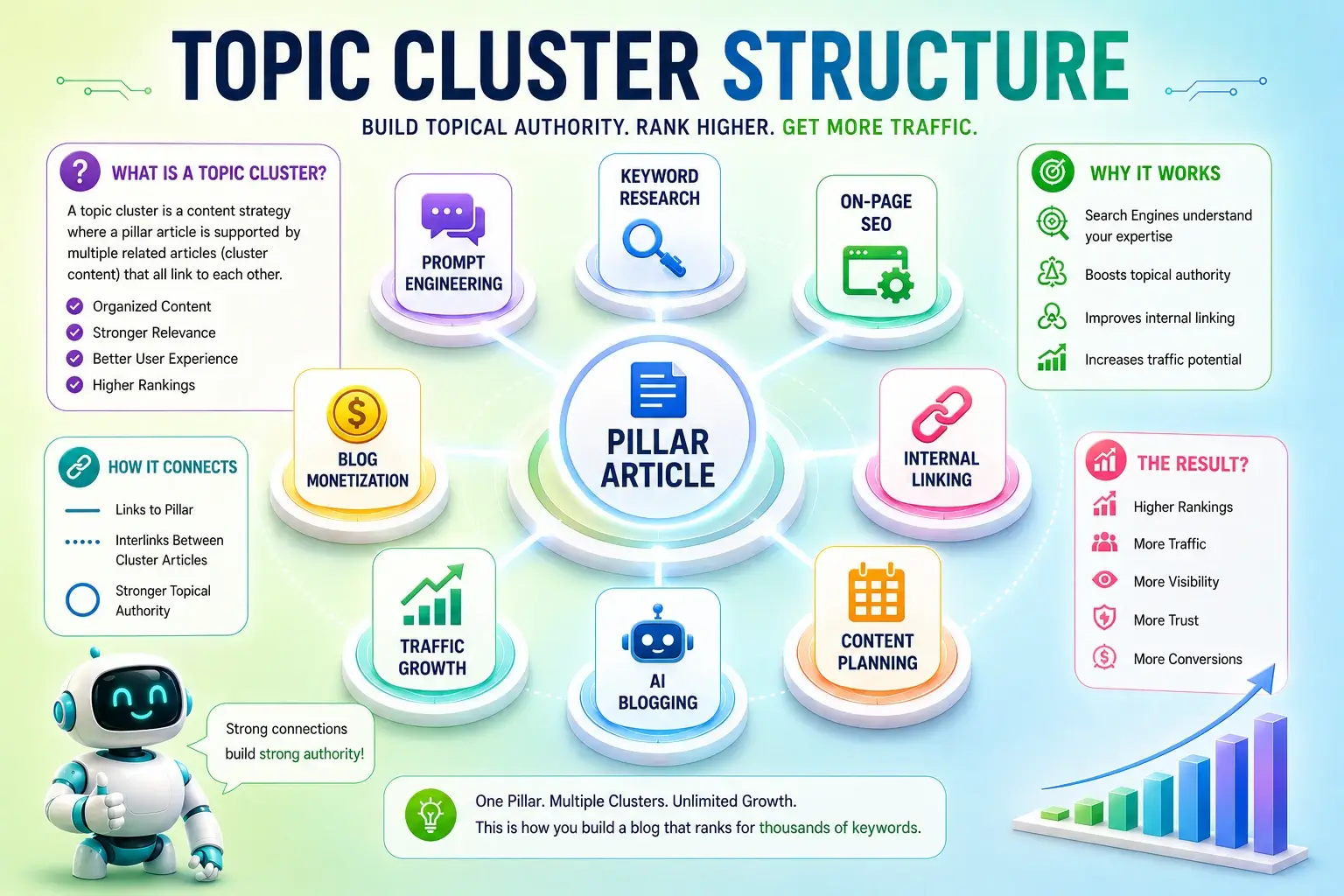
A topic cluster is a group of articles that all cover different aspects of the same core subject. Every cluster has two types of content:
- A pillar article — the broad, comprehensive guide that covers your core topic at a high level. Everything else links back to this. Think of it as the hub of a wheel.
- Supporting articles — each one goes deeper on one specific part of the pillar topic. Each targets a narrower keyword and answers one specific question in detail. Think of these as the spokes.
Before writing, map out your full cluster by asking: what are all the questions someone interested in my core topic might search for? Each question becomes a supporting article idea.
Aim for at least 8 to 10 supporting articles per pillar to establish meaningful topical authority. Use search suggestions, People Also Ask boxes in Google, and AI tools to find every angle your readers might approach from.
Step 3: Build Your Pillar Article First
Your pillar article is the foundation of your entire cluster. It should be your most comprehensive article — a complete beginner’s guide that covers all the main aspects of your core topic without going too deep on any single one.
A good pillar article does three things:
- Introduces the core topic clearly for complete beginners
- Gives readers enough information to understand the full landscape of that topic
- Links naturally to every supporting article in the cluster for readers who want to go deeper
Your pillar article is also the one you mark as Pillar Content in Rank Math. This signals to your SEO plugin which article is the central hub of each cluster.
Step 4: Write Supporting Articles That Go Deeper
Each supporting article picks one specific aspect of the pillar topic and covers it in complete detail. Where your pillar gives an overview of keyword research, your supporting article covers every step, every tool, and every technique in depth.
The rule for supporting articles is simple:
- Every supporting article should answer a question that a reader of your pillar article would naturally ask next
- Every supporting article should link back to the pillar at least once
- Every supporting article should link to two or three other relevant supporting articles in the same cluster
- The pillar article should link out to every supporting article where relevant
Step 5: Connect Everything With Internal Links
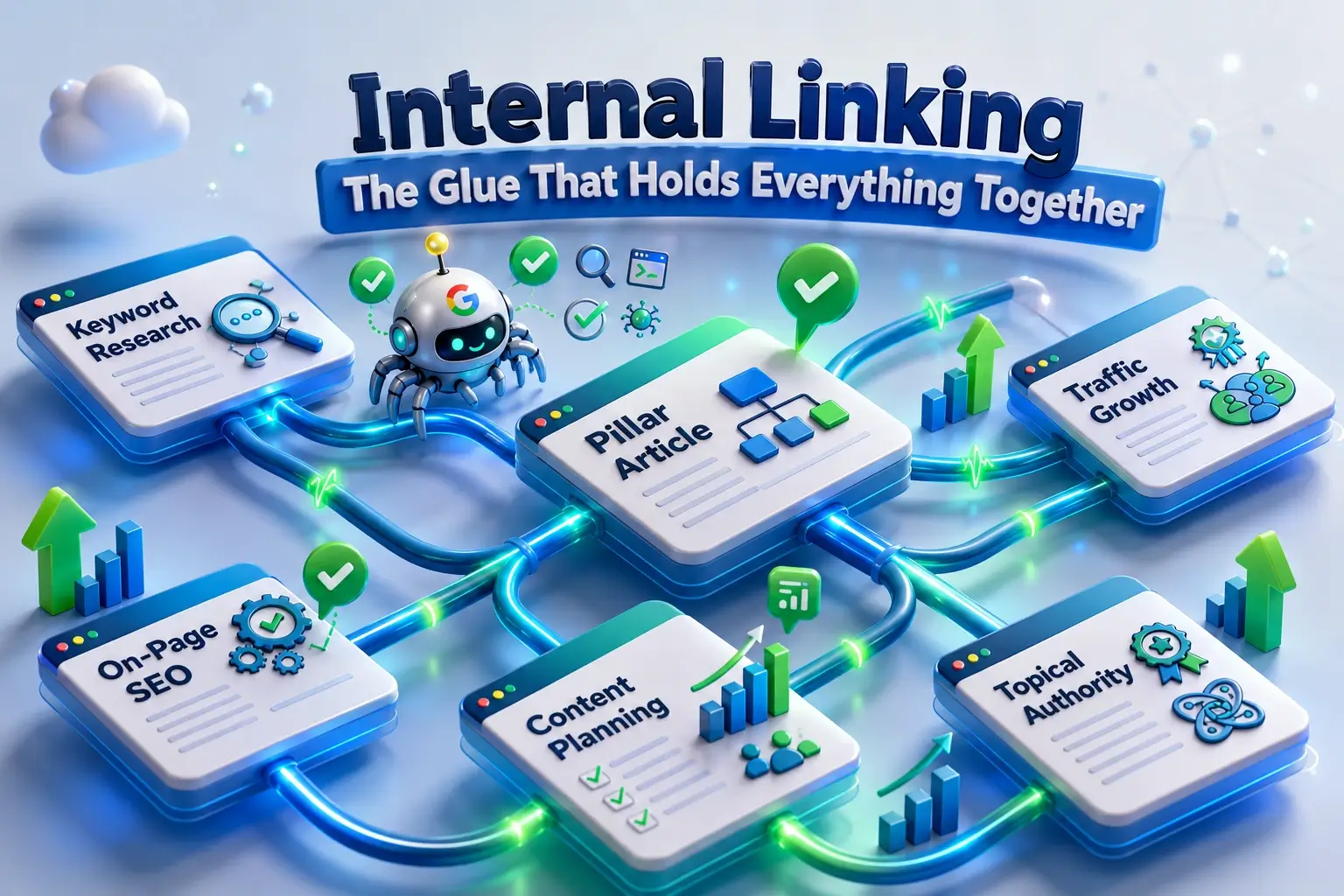
Internal linking is the mechanism that actually builds topical authority in practice. It is how you show Google the connections between your articles and demonstrate that they belong to the same topic cluster.
Every time you publish a new article, do these two things:
- Add internal links from the new article to relevant existing articles in your cluster
- Go back to two or three older articles and add links pointing to the new one
Over time this creates a web of interconnected content where every article supports every other. Google follows these links, understands the relationships between your pages, and recognizes your blog as a comprehensive resource on that topic.
Use descriptive anchor text for every internal link. “Our guide on How to Start Blogging with AI” is better anchor text than “click here” or “read more.” The anchor text tells both the reader and Google exactly what the linked article is about.
For a detailed practical guide on how to use internal links correctly in every article, our guide on On-Page SEO for Blog Posts covers this step by step.
Step 6: Cover Every Angle Your Reader Might Search For
One of the most common topical authority mistakes is only covering the obvious angles of a topic.
If you write a blog about AI blogging you might naturally cover:
- How to start a blog
- How to use ChatGPT
- How to get traffic
But a reader interested in AI blogging also searches for:
- How to do keyword research
- How to build topical authority
- How to optimize on-page SEO
- How to make money from a blog
- How to create a content plan
- How to write better prompts for AI
The more completely you cover the full range of questions your reader has, the stronger your topical authority becomes. Think about it this way — if someone asked 50 questions about your topic, could your website answer all of them well? If you have only answered 10 of those questions, your topical authority is limited no matter how good those 10 articles are.
Step 7: Keep Your Content Fresh and Updated
Topical authority is not built once and maintained forever. It requires ongoing attention because:
- AI tools are updated constantly
- Search algorithms shift
- New tools launch and old ones get discontinued
- Reader questions and needs evolve over time
Every three to six months, go back through your published articles and update any information that has become outdated. Update statistics, add references to newer tools, and refresh any sections that no longer reflect the current state of your topic.
Google rewards content that stays accurate and current. An article that is regularly updated often climbs in ranking position compared to the same article left unchanged for a year or more.
How AI Tools Help You Build Topical Authority Faster
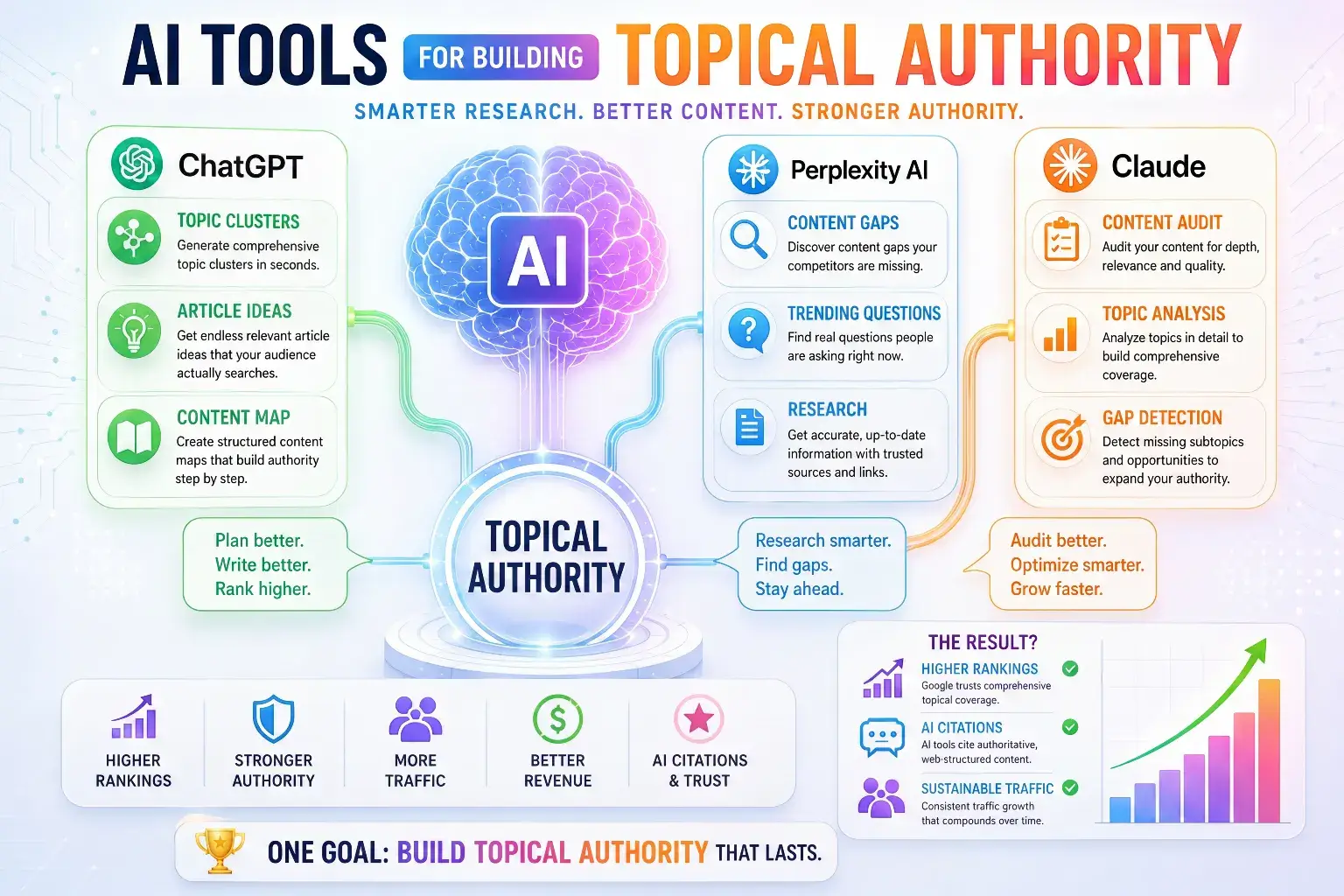
Building topical authority used to require extensive manual research, competitor analysis, and content planning. AI tools have changed this dramatically. Here is exactly how to use them.
Using ChatGPT to Map Your Topic Clusters
ChatGPT is one of the most practical tools for topical authority planning. Use it to:
- Generate comprehensive lists of article ideas within your core topic
- Identify subtopics you may have missed
- Build out the full map of your content cluster before you start writing
- Find the questions your readers are asking that your existing articles do not answer
A prompt that works well: “I run a beginner-friendly blog about using AI tools for blogging and online income. Give me a complete list of every article topic I should cover to build full topical authority on this subject. Organize them into clusters with a pillar article and supporting articles for each cluster.”
The output gives you a clear roadmap. You will not use every idea immediately but having the full map in front of you means every article you write has an intentional place in your overall structure.
For better results with this kind of prompt, our guide on How to Write Better Prompts for AI covers the techniques that make AI responses significantly more useful and specific.
Using Perplexity AI to Find Content Gaps
Perplexity AI is particularly useful for finding content gaps — topics within your niche that you have not covered yet but that readers are actively searching for. Because Perplexity searches the web in real time, it surfaces what people are currently asking about your topic right now.
Try searching your core topic on Perplexity and reading through the related questions and follow-up searches it shows. Each one is a potential article idea. You can also ask directly: “What are the most commonly asked questions about AI blogging for beginners that most blogs do not cover well?”
Using Claude to Audit Your Existing Content
Claude is excellent for reviewing your existing articles and identifying structural gaps in your topical authority. Paste a list of all your published article titles and ask Claude to:
- Identify which important subtopics within your core subject are missing
- Flag which articles might be competing with each other for the same keyword
- Suggest which existing articles could be expanded to cover more ground
This kind of content audit takes hours to do manually. With Claude it takes minutes and gives you a clear action list for improving your existing content before adding more.
Our guide on How to Use Claude AI for Beginners explains how to use Claude effectively for this kind of analytical work.
Using Google Search Console to Find Missing Topics
Once your blog has been live for a few months, Google Search Console becomes one of your most valuable topical authority tools. Here is how to use it:
- Go to Performance → Search Results in Google Search Console
- Look for queries where your articles are appearing at position 10 to 30 with very few clicks
- These low-position, low-click queries are signals of content gaps
- If your blog appears at position 18 for a query you have never directly written about, that tells you there is real reader demand for that topic and your site already has some relevance to it
- Writing a focused article targeting that specific query can move you from position 18 to the first page
Check your Search Console performance data at least once a week and build a running list of these opportunity queries. Over time this data-driven approach is one of the most reliable ways to systematically strengthen your topical authority.
What a Strong Topic Cluster Actually Looks Like
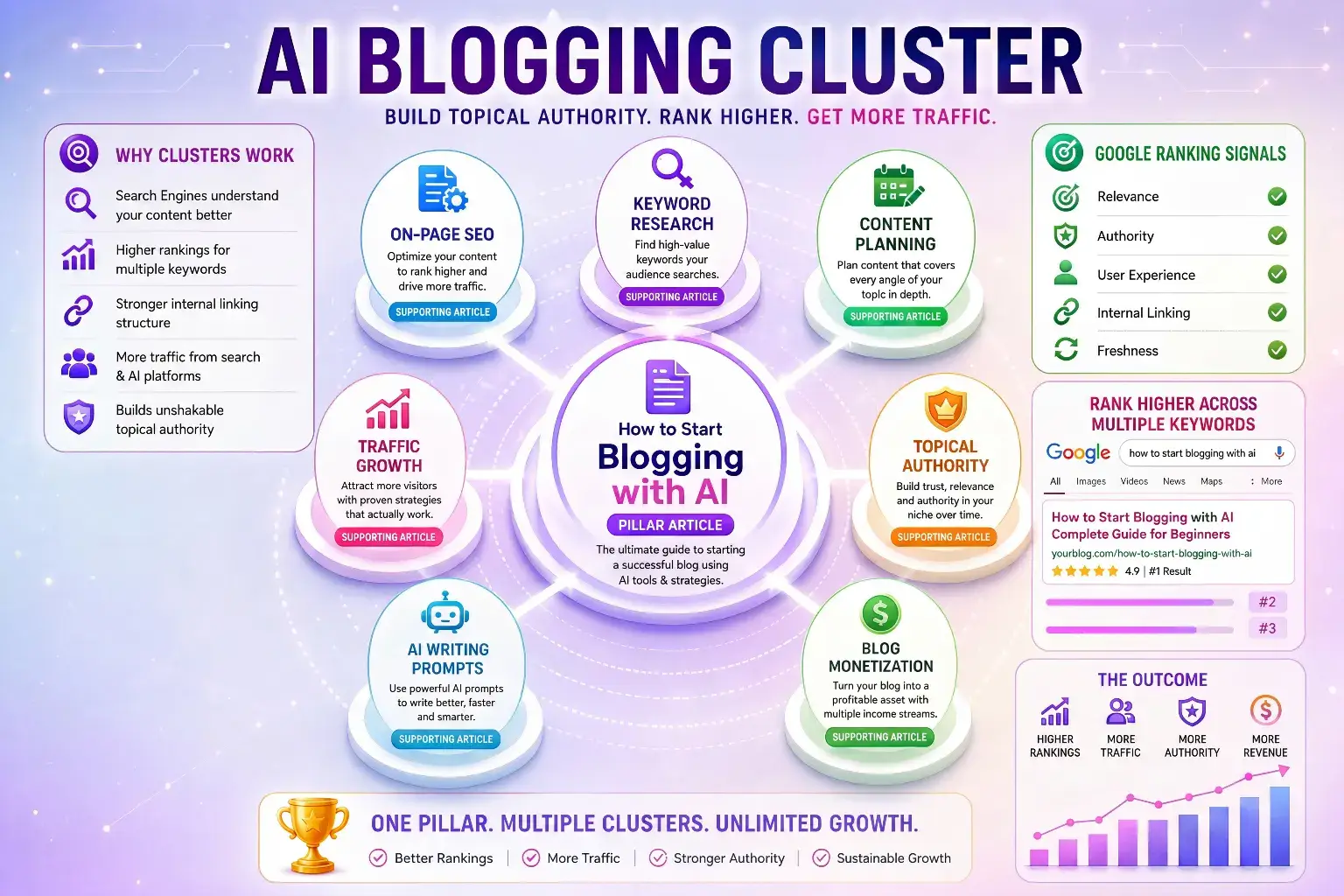
Here is a concrete example using the AI blogging niche — the exact cluster Arthify is building.
The pillar article — How to Start Blogging with AI — is the broad foundation. It covers everything from setting up a blog to publishing your first articles. Everything else in the cluster links back to this.
The supporting articles each go deeper on one specific aspect:
- How to Create a Content Plan for Your Blog Using AI — covering content strategy and planning in detail
- How to Do Keyword Research for Blogging Using AI — covering the full process of finding the right topics before writing
- On-Page SEO for Blog Posts — covering how to optimize every article before it goes live
- How to Get Traffic to Your Blog Using AI — covering how to grow readership through organic and AI-powered strategies
- How to Build Topical Authority for Your Blog — covering how to structure all of this into a system Google trusts
Alongside the AI Blogging cluster, Arthify also covers the broader picture of earning online through the Make Money with AI category — showing readers how everything they learn about blogging and AI tools connects directly to real income opportunities.
Each supporting article links back to the pillar. The pillar links out to each supporting article. Together they form a complete, interconnected system that covers AI blogging from every angle a beginner might approach it.
Google reads this structure and understands that Arthify is not just a collection of random posts. It is a comprehensive resource on one specific subject. That recognition is topical authority — and it is what separates blogs that grow steadily from blogs that stay invisible no matter how much effort goes into individual articles.
How Long Does It Take to Build Topical Authority
This is honestly the first question most beginners ask — and it deserves a straight answer rather than vague encouragement.
The timeline is not the same for everyone but the pattern is consistent enough that you can plan around it. Here is what to realistically expect:
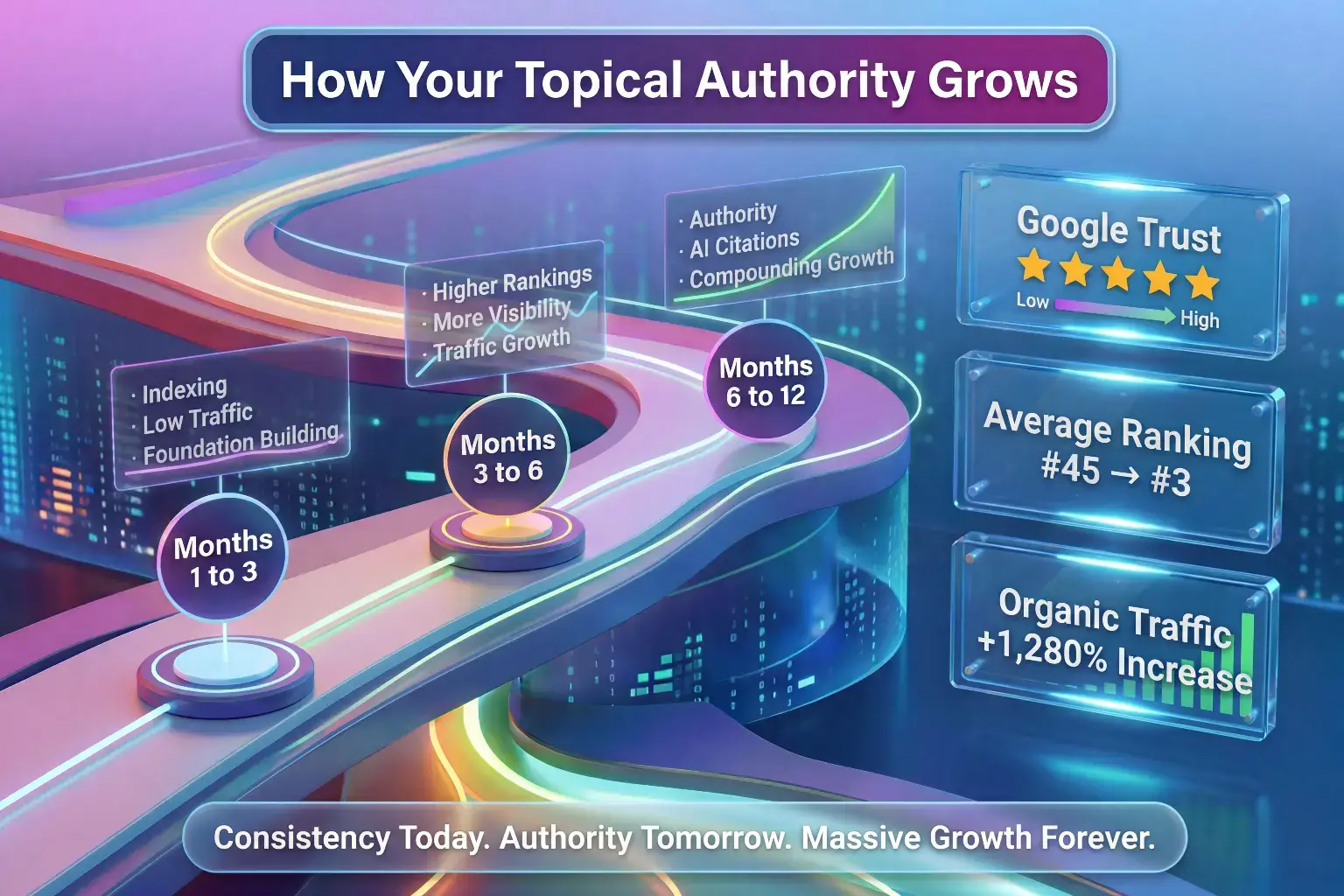
Most blogs take 3 to 6 months of consistent publishing to establish meaningful topical authority. The timeline looks roughly like this:
- Months 1 to 3 — Articles are being indexed but traffic is minimal. This is normal. Google is still evaluating your site and understanding what it is about. Do not stop publishing during this phase.
- Months 3 to 6 — Rankings start improving noticeably. Articles that were sitting at position 20 to 30 start climbing to page one. New articles begin ranking faster than earlier ones did. Traffic grows visibly.
- Months 6 to 12 — The compounding effect becomes clearly visible. New articles rank within weeks rather than months. Older articles continue climbing. Traffic grows month over month without dramatic changes to what you are doing.
The timeline varies based on these factors:
- How competitive your niche is — a specific niche like AI tools for beginner bloggers builds faster than a broad competitive niche
- How consistently you publish — two articles per week builds authority faster than two per month
- How well your content is internally linked — a well-connected cluster builds authority faster than the same number of disconnected articles
- How comprehensively you cover your topic — more complete coverage builds authority faster than narrow coverage
The bloggers who give up in the first three months never experience the compounding effect. The ones who stay consistent through the slow early phase almost always do.
Common Mistakes That Destroy Topical Authority
Understanding what goes wrong is just as important as knowing the right steps. These are the most common topical authority mistakes beginner bloggers make:
- Publishing on unrelated topics — Every off-topic article dilutes the topical signal you are building. If your blog is about AI tools and you publish an article about travel, Google gets confused about what your site is actually about. Stay focused.
- Ignoring internal linking — Writing great articles and never linking them to each other is one of the most damaging mistakes. Without internal links your articles are isolated pages rather than a connected authority system.
- Keyword cannibalization — This happens when two articles on your blog target the same focus keyword. Instead of one article ranking well, both articles compete against each other and neither ranks properly. Each article needs a unique focus keyword.
- Writing thin supporting articles — Supporting articles need to be genuinely detailed and useful. A 300-word article that barely scratches the surface adds no real depth to your cluster. Each article should fully answer the specific question it targets.
- Publishing near-duplicate content — If multiple articles on your blog cover mostly the same ground with different titles, consolidate them into one comprehensive resource. Before publishing any new article, identify clearly what unique question it answers that no existing article on your site addresses.
- Stopping too early — Three months without significant traffic is completely normal. The mistake is interpreting slow early growth as failure and abandoning the strategy before the compounding effect begins.
How to Know If Your Topical Authority Is Growing
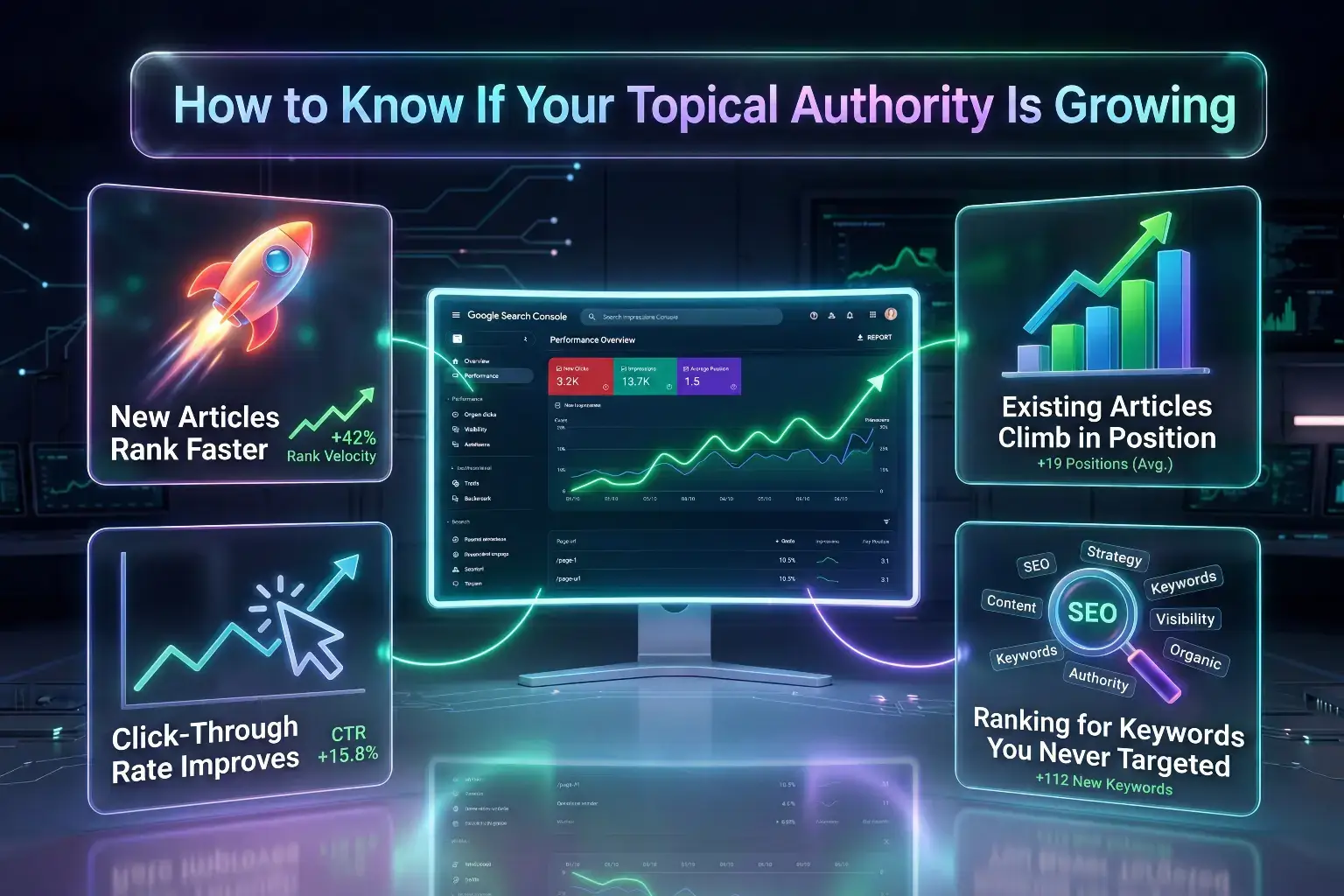
There is no single dashboard that shows a topical authority score. But there are clear signals that tell you your authority is building:
- New articles rank faster — When your earlier articles took three months to appear in search results but newer articles rank within three to four weeks, that is a clear sign Google has started trusting your site on the topic.
- You rank for keywords you never directly targeted — As your topical authority grows, Google shows your articles for related queries you never specifically optimized for. This is one of the clearest signals that your cluster strategy is working.
- Existing articles climb in position — Articles that have been sitting at position 15 to 20 for months often start moving up as your overall topical authority strengthens. The rising authority lifts every article in your cluster.
- Click-through rate improves — When Google recognizes your site as an authority, it tends to show your articles more prominently in results which leads to higher click-through rates.
Track all of these signals in Google Search Console weekly. They will not all appear at once but over three to six months of consistent publishing you will start seeing each one clearly.
Final Thoughts
Topical authority is not a complicated concept. It is the result of publishing consistently about one specific subject, connecting your articles to each other deliberately, and covering your topic more completely than anyone else in your niche.
The blogs that grow are not always the ones with the most articles or the strongest backlinks. They are the ones Google can clearly identify as the most reliable and most comprehensive resource on a specific subject.
Every article you publish from this point forward should have an intentional place in your topic cluster. It should answer a question your existing articles do not answer yet. It should link to the articles that came before it and be linked to from the articles that come after it.
That connected, intentional approach to content is what builds topical authority. And topical authority is what makes everything else — your keyword research, your on-page SEO, your content planning — actually work the way it is supposed to.
If you want to understand how all of this connects to growing your blog traffic consistently, our guide on How to Get Traffic to Your Blog Using AI covers every traffic strategy in detail.
Frequently Asked Questions
What is topical authority in SEO?
Topical authority is the recognition a website earns from Google when it consistently demonstrates deep, organized expertise on a specific subject. It is not a score or a metric — it is a signal built over time through publishing comprehensive, well-connected content that covers a topic from multiple angles. Websites with strong topical authority rank more consistently, hold their positions longer, and often rank for keywords they never directly targeted.
How long does it take to build topical authority?
Most blogs take 3 to 6 months of consistent publishing to establish meaningful topical authority. The first few months feel slow — articles are indexed but traffic is minimal. Between months three and six, rankings typically start improving noticeably. The key factor is consistency — publishing regularly and connecting every new article to your existing cluster through internal links.
How many articles do I need to build topical authority?
There is no fixed minimum, but a well-structured cluster of 8 to 15 supporting articles around one pillar article is generally enough to establish clear topical authority on a specific subtopic. Quality and connection between articles matters more than total count. Ten deeply useful, well-linked articles will build more authority than 30 thin, disconnected ones.
What is the difference between topical authority and domain authority?
Domain authority is a third-party metric that estimates the overall strength of a website based primarily on its backlink profile. Topical authority is about how comprehensively a website covers a specific subject. A site can have low domain authority but strong topical authority in a narrow niche — and in that niche it will consistently outrank higher-authority sites that cover the topic less thoroughly.
Can AI tools help build topical authority?
Yes. AI tools like ChatGPT and Claude are genuinely useful for mapping topic clusters, identifying content gaps, planning article structures, and auditing existing content. They speed up the research and planning phases significantly. However the actual authority comes from publishing genuinely useful content consistently — AI tools assist the process but do not replace the need for real quality and consistency.
Does topical authority help with AI search citations?
Yes, and this is increasingly important in 2026. When AI tools like ChatGPT, Perplexity AI, and Google AI Overviews generate answers and cite sources, they draw from websites that have demonstrated consistent, comprehensive expertise on the relevant subject. Building strong topical authority increases the likelihood that your blog is recognized as a reliable source worth citing by these AI systems.
What is a topic cluster?
A topic cluster is a group of articles that all cover different aspects of the same core subject. Every cluster has one pillar article — a broad, comprehensive guide to the main topic — and multiple supporting articles that each go deeper on one specific subtopic. All supporting articles link back to the pillar and the pillar links out to all supporting articles. This connected structure is what signals topical authority to Google.
Is topical authority more important than backlinks?
For most beginner bloggers in a specific niche, yes. Backlinks are still a ranking factor but topical authority can compensate significantly for a weak backlink profile. A blog with 20 deeply interconnected articles on one specific topic can and regularly does outrank blogs with stronger backlink profiles but scattered, unfocused content. Focus on topical authority first — backlinks become easier to earn naturally as your authority and traffic grow.

Hi, I’m Harshil Patel, founder of Arthify.
I share simple, practical guides on AI tools, blogging, and online earning to help beginners work smarter and grow online.
My goal is to simplify AI tools so anyone can build skills and create opportunities in the digital world.