“This beginner-friendly guide explains how to start blogging with AI step by step. Discover easy tools, niche ideas, and a simple system to write faster and grow your blog in 2026.”
Starting a blog used to feel difficult for beginners. You had to choose a topic, write everything yourself, plan the structure, and stay consistent for months before seeing results. Many people got stuck before they even published their first post.
In 2026, blogging is much easier because of AI.
AI tools can help you think of ideas, create outlines, write drafts, improve grammar, and organize your content. This does not mean AI replaces you. It means AI gives you support so you can work faster and more confidently.
If you want to start blogging but feel confused about where to begin, this guide will walk you through everything in a simple and practical way.
What Is AI Blogging
AI blogging means using AI tools to help with different parts of blogging, such as planning, writing, editing, and improving content.
Instead of doing everything manually, you can use AI to make the process easier.
AI can help you with things like:
- Finding blog ideas
- Creating article outlines
- Writing first drafts
- Improving grammar and clarity
- Making content easier to read
- Helping with SEO structure
The most important thing to understand is that AI is not a replacement for your own thinking. It is a helper. It saves time, reduces stress, and gives you a strong starting point.
For example, if you want to write about “how to use AI tools for students,” AI can help you break that topic into sections, suggest headings, and even write a draft. Then you can review it, improve it, and make it sound more natural.
In simple words, AI blogging is about working smarter, not harder.
If you’re completely new to AI, you can start with our step-by-step guide on How to use AI tools as a beginner in 2026.
Why Blogging with AI Is Growing Fast
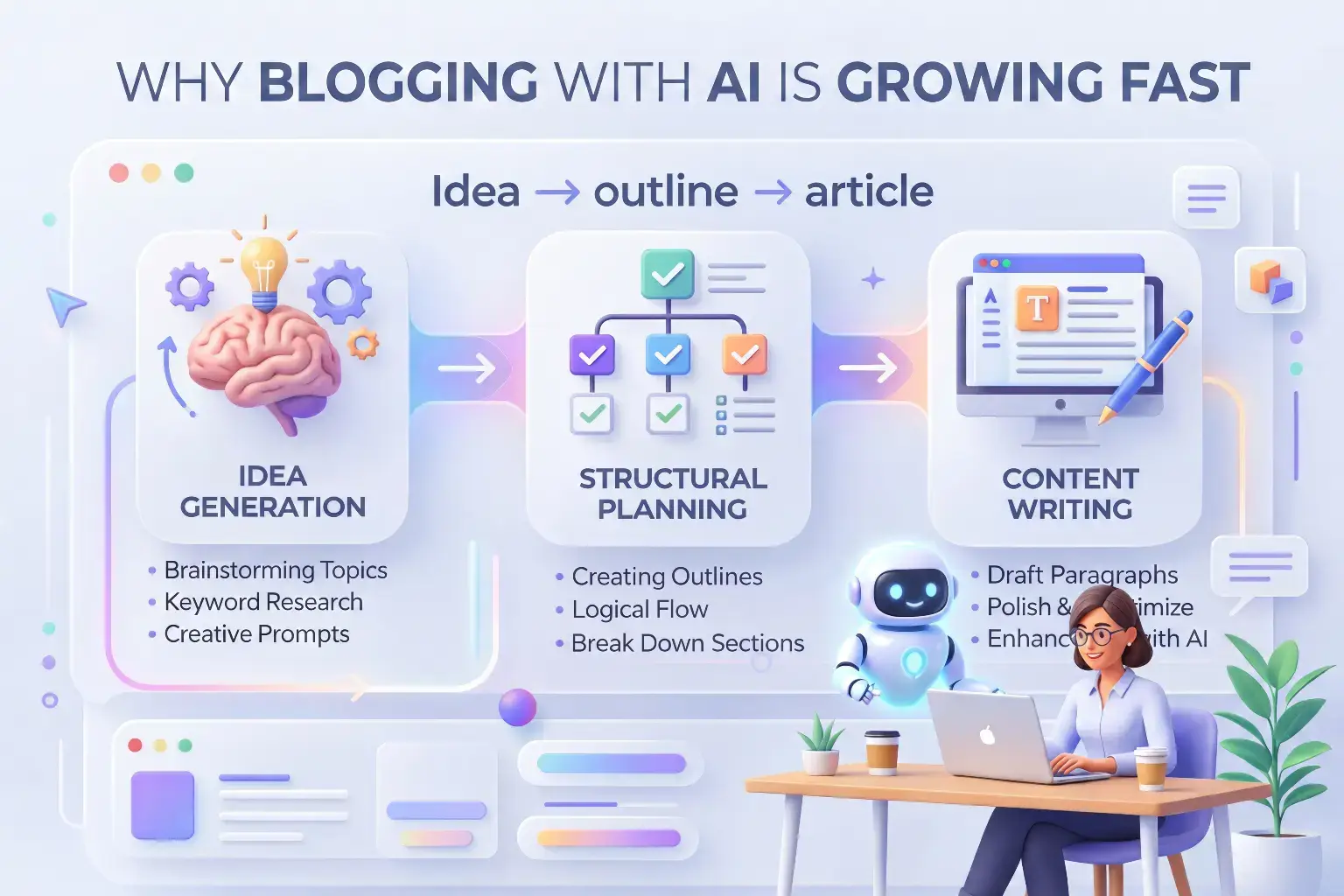
Blogging with AI is growing quickly because it solves many common problems beginners face.
Earlier, writing a blog required:
- Strong writing skills
- A lot of time
- Clear structure planning
Now AI helps reduce these problems.
For example, instead of thinking for hours, you can ask AI to suggest:
- Blog topics
- Headings
- Content ideas
- Draft paragraphs
AI makes this easier in several ways.
1. It helps you start faster
Many beginners do not fail because they lack ideas. They fail because they never begin. AI removes the pressure of starting from zero.
2. It helps you stay consistent
One of the hardest parts of blogging is not writing one article. It is continuing to write after the first few posts. AI helps you keep generating new ideas and outlines.
3. It saves time
You can move from topic idea to finished article much faster. That makes blogging more practical, especially if you are busy.
4. It helps beginners write better
Even if your writing is simple, AI can help you improve sentence flow, fix grammar, and make your content clearer.
5. It supports modern blogging workflows
Today’s AI tools are much better than older tools. They understand context more clearly and can help you build structured, useful content.
For beginners, the biggest benefit is simple:
“You can start blogging even if you do not feel fully confident yet.”
Things You Need Before Starting a Blog
Before you start blogging, you need a few basic things. Do not worry, you do not need anything complicated.
1. A Clear Topic
Choose one main subject for your blog. This is called a niche.
Examples:
- AI tools
- Student productivity
- Blogging
- Tech tutorials
- Personal growth
2. Blogging Platform
You need a place to publish your blog.
This can be:
- WordPress
- Blogger
- Any blogging platform
3. Simple Content System
You do not need a perfect plan. You only need a repeatable process:
- Choose a topic
- Create an outline
- Write the article
- Edit it
- Publish it
That is enough to start. AI will help you improve over time.
Before writing your first post, it’s important to understand what people are actually searching for. Learn How to do keyword research for blogging using AI.
Best Platforms to Start Blogging in 2026

There are many platforms available, but beginners should focus on simple and reliable options. Choosing the right platform matters because it affects how much control you have and how easy it is to grow later.
Here are the best blogging platforms in 2026:
1. WordPress
WordPress is the best choice for long-term blogging.
Why it is strong:
- Full control over your website
- SEO-friendly
- Easy to add plugins
- Good for monetization
- Scales well as your blog grows
It may feel slightly confusing at first, but once you learn it, it becomes very powerful.
2. Blogger
Blogger is a simple free platform from Google.
Why beginners like it:
- Easy to set up
- Free to use
- Simple interface
- Good for quick publishing
The downside is that it has limited customization and less flexibility than WordPress.
3. Medium
Medium is good if you want to focus only on writing.
Why it is useful:
- No website setup needed
- Very easy to start
- Built-in audience
- Clean writing environment
The downside is that you do not fully control your brand or site structure.
4. Ghost
Ghost is a clean and modern platform focused on writing.
Why it stands out:
- Minimal design
- Fast performance
- Good for writers
- Distraction-free experience
5. Wix
Wix is beginner-friendly and easy to design.
Why people use it:
- Drag-and-drop builder
- No coding needed
- Easy page design
- Quick setup
Which one should you choose?
- WordPress if you want serious long-term growth
- Blogger if you want something free and simple
- Medium if you only want to write and publish fast
For most beginners, WordPress is the best long-term option.
How to Choose a Blog Niche Using AI
Choosing the right niche is one of the most important steps in blogging.
A niche is the main topic your blog will focus on. If you choose the wrong niche, it becomes hard to stay consistent. If you choose the right one, writing becomes much easier.
AI can help you choose a niche by giving you ideas and helping you compare different topics.
A good niche should:
- Have enough topics to write about
- Solve real problems
- Have search demand
- Be easy for you to explain
- Be something you can write about for a long time
AI can help you:
- Find trending topics
- Explore ideas
- Identify beginner-friendly niches
Example prompt:
“Suggest beginner-friendly blog niches related to AI, productivity, and online growth.”
Choose something:
- You understand
- You enjoy
- You can write about regularly
Good beginner-friendly niches in 2026
If you are using AI for blogging, you should choose a niche where:
- There are regular topics to write about
- People are actively searching for answers
- You can explain things in simple ways
- You can stay consistent
Here are some of the best beginner-friendly blogging niches in 2026:
- Personal growth and self-improvement
- AI tools and guides
- Student productivity
- Blogging and online earning
- Tech tutorials
How to Choose the Right Niche for You
Instead of choosing the most popular niche, choose the one you can continue for a long time.
Ask yourself:
- Can I write 20-30 articles on this topic?
- Do I understand this topic at a basic level?
- Am I interested in learning more about it?
If the answer is yes, then it is a good niche for you.
Consistency matters more than choosing the “perfect” niche.
Many bloggers later expand into freelance content writing. If that’s your goal, our guide on How to Build an AI Freelancing Portfolio With No Experience shows how to create portfolio samples before landing your first client.
Step-by-Step Guide to Start Blogging with AI
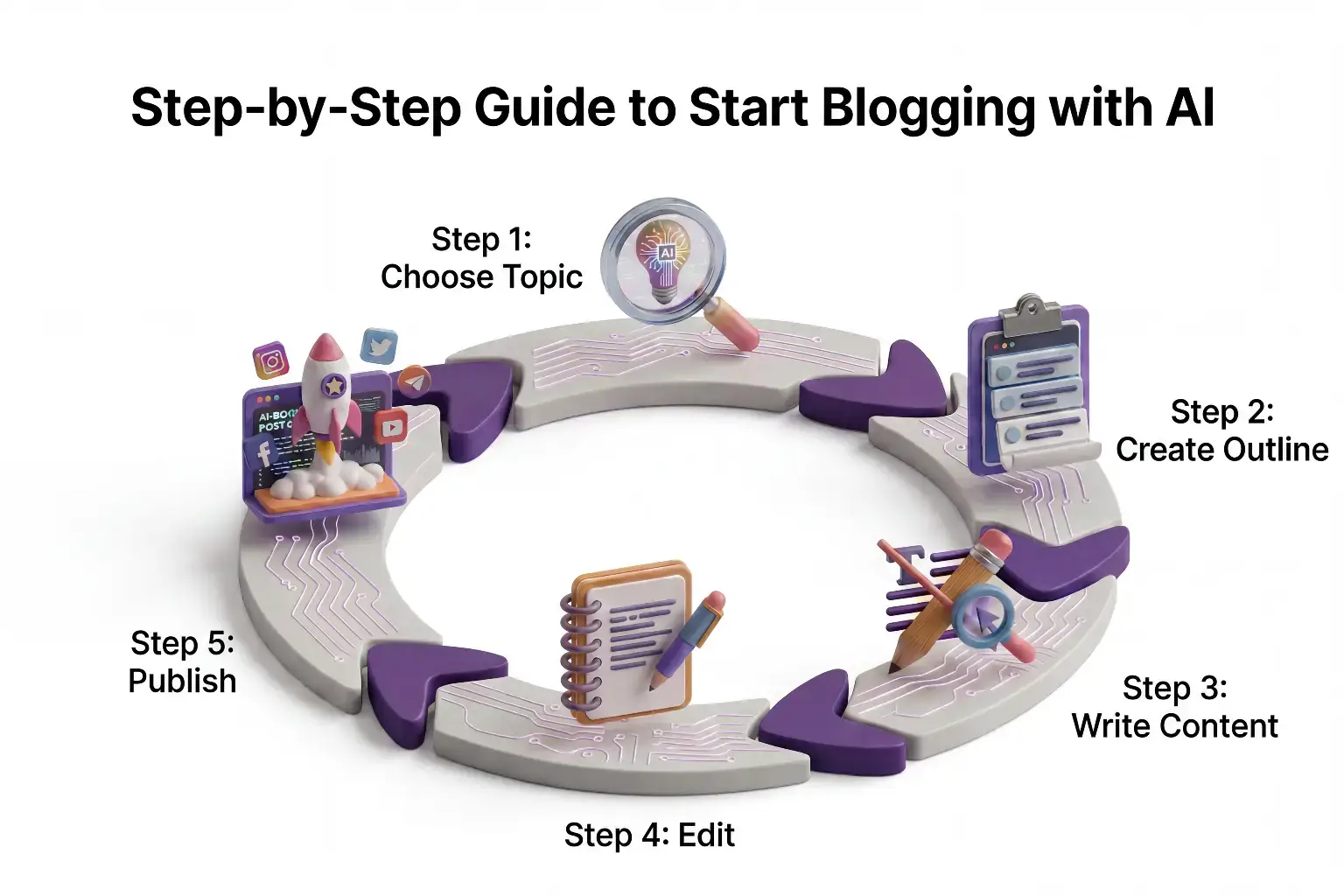
Step 1: Choose a clear topic
Start with one simple topic.
For example:
“AI content creation for beginner”
A focused topic is much easier to write about than a broad one like “AI.”
You can use AI to help with topic ideas by asking:
“Give me 10 beginner-friendly blog ideas about AI for students.”
That way, you are not guessing. You are building from a list of useful options.
Step 2: Set up your blog
Once you choose your platform, create your blog and keep the design simple.
Do not spend too much time trying to make everything perfect.
Focus on:
- A clean theme
- Basic pages
- Easy navigation
- Fast publishing
At the beginning, content matters more than design.
Step 3: Create an outline
An outline is one of the most useful things AI can help with.
It gives your article structure before you start writing. That makes the process easier and keeps your content organized.
You can ask AI:
“Create a beginner-friendly outline for this topic.”
Then review the outline and make small changes if needed.
Step 4: Write section by section
Do not try to write the whole article in one go.
Write one section at a time.
This makes the process easier and keeps your writing focused. It also helps you avoid repetition.
For example:
- Write the introduction first
- Then write the main explanation
- Then add examples
- Then finish with the conclusion
Step 5: Edit and improve
The first draft is never the final draft.
Editing is where your article becomes clear and useful.
Use AI to help you:
- Rewrite weak sentences
- Simplify difficult language
- Fix grammar
- Improve transitions
- Make the article easier to read
You can ask:
“Rewrite this in simple English for beginners.”
That makes a big difference.
Step 6: Publish and repeat
Once your article is ready, publish it.
Then repeat the same process for the next one.
Blogging grows when you keep publishing useful content consistently.
Once your blog is set up and you start publishing, making sure each article is properly optimized before it goes live is essential. Our complete guide on On-Page SEO for Blog Posts covers every element beginners need to check before hitting publish.
How to Write Blog Content with AI
Writing with AI works best when you follow a simple process.
Start with one idea.
For example:
“how to study better using AI”
Then ask AI to create an outline. After that, write one section at a time. This is much easier than trying to create a full article all at once.
AI can help you with:
- Idea generation
- Outlining
- Expanding sections
- Rewriting in simple language
- Improving sentence flow
But you should still review the final article carefully.
Your role is to guide the content and make sure it feels natural, helpful, and relevant.
A good AI-assisted article should still sound human, clear, and useful.
Blogging is a form of content creation, and you can learn more workflows in our guide on How to use AI for content creation.
How to Write SEO-Friendly Blog Posts with AI
SEO means Search Engine Optimization. It helps your blog appear on Google when people search for related topics.
If you want your blog to grow, SEO matters.
AI can help you build SEO-friendly content in a simple way.
Use one main keyword (also known as “Primary Keyword” Or “Focus Keyword”)
For example, The main keyword is:
“How To Use AI For Content Creation”
Use it naturally in:
- The title
- The introduction
- Some headings
- The conclusion
Do not repeat it too much.
Use clear structure
Search engines and readers both prefer well-organized articles.
Your article should have:
- Clear headings
- Short paragraphs
- Logical flow
- Easy-to-read language
Focus on search intent
Search intent means what the reader actually wants.
A person searching this topic probably wants:
- A beginner-friendly explanation
- A step-by-step system
- Tool suggestions
- Practical advice
So your article should answer those needs directly.
Write for people first
Do not stuff keywords into your content. That makes it sound unnatural.
Instead, write useful content that solves a real problem. That is what Google prefers.
Once you understand how to write and structure your blog, the next step is choosing the right tools to make your work faster and easier.
If you want to turn your content writing skills into freelance income, our guide on AI Freelancing for Beginners gives you the complete step-by-step process from building your first portfolio to landing your first paying client.
Best AI Tools for Blogging in 2026
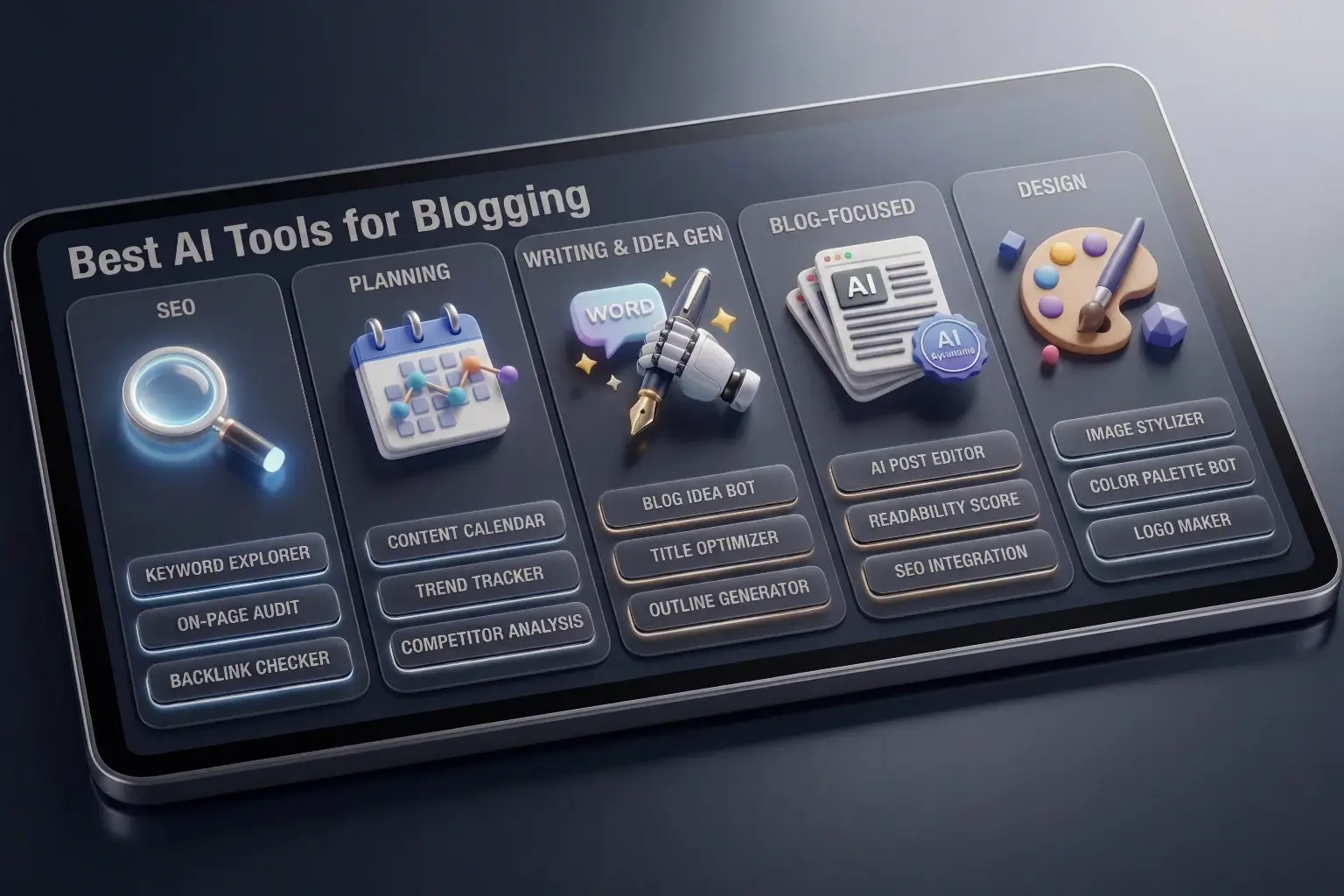
Most beginners only use basic AI tools, but blogging becomes much easier when you use tools designed specifically for writing, SEO, and content planning.
You do not need every AI tool. You only need a few tools according to your use and requirements.
SEO Tools:
These tools help you improve rankings and structure.
- NeuronWriter – Helps you write SEO-optimized content by suggesting keywords and structure.
- Surfer SEO – Improves your blog ranking by giving real-time SEO suggestions while writing.
- Frase – Helps you research top-ranking content and create better structured articles.
- Outranking – Combines research, writing, and SEO optimization in one platform.
- RankIQ – Helps bloggers find low-competition keywords and create content that ranks faster on Google.
Planning Tools:
These tools help you stay organized.
- Notion AI – Helps you organize blog ideas, plan content, and manage your workflow.
- WriterZen – Helps you find keywords and plan content based on search demand.
Writing and Idea Generation Tools:
These tools help you brainstorm, outline, and draft content.
- ChatGPT – Helps you generate blog ideas, outlines, and write content quickly.
- Claude – Best for writing long, detailed, and well-structured blog articles.
- Gemini – Useful for research-based writing and works well with Google tools.
You can explore our list of the Best AI writing tools for beginners in 2026 to choose the right tools for blogging.
Blog-Focused AI Tools:
These tools are built more specifically for content creation.
- Scalenut – All-in-one tool for topic research, writing, and SEO optimization.
- Koala AI – Generates ready-to-publish blog posts quickly with good structure.
Design Tool:
- Canva – Helps you create blog images, thumbnails, and simple graphics easily.
Best beginner setup
A simple beginner setup can be:
- Writing: ChatGPT or Claude
- SEO: NeuronWriter or Surfer SEO
- Planning: Notion AI
You do not need too many tools at the beginning. A few good ones are enough. As you grow, you can explore more tools.
You can also check our list of the Best new AI tools in 2026 to discover more tools for blogging and content creation.
Simple AI Blogging Workflow for Beginners
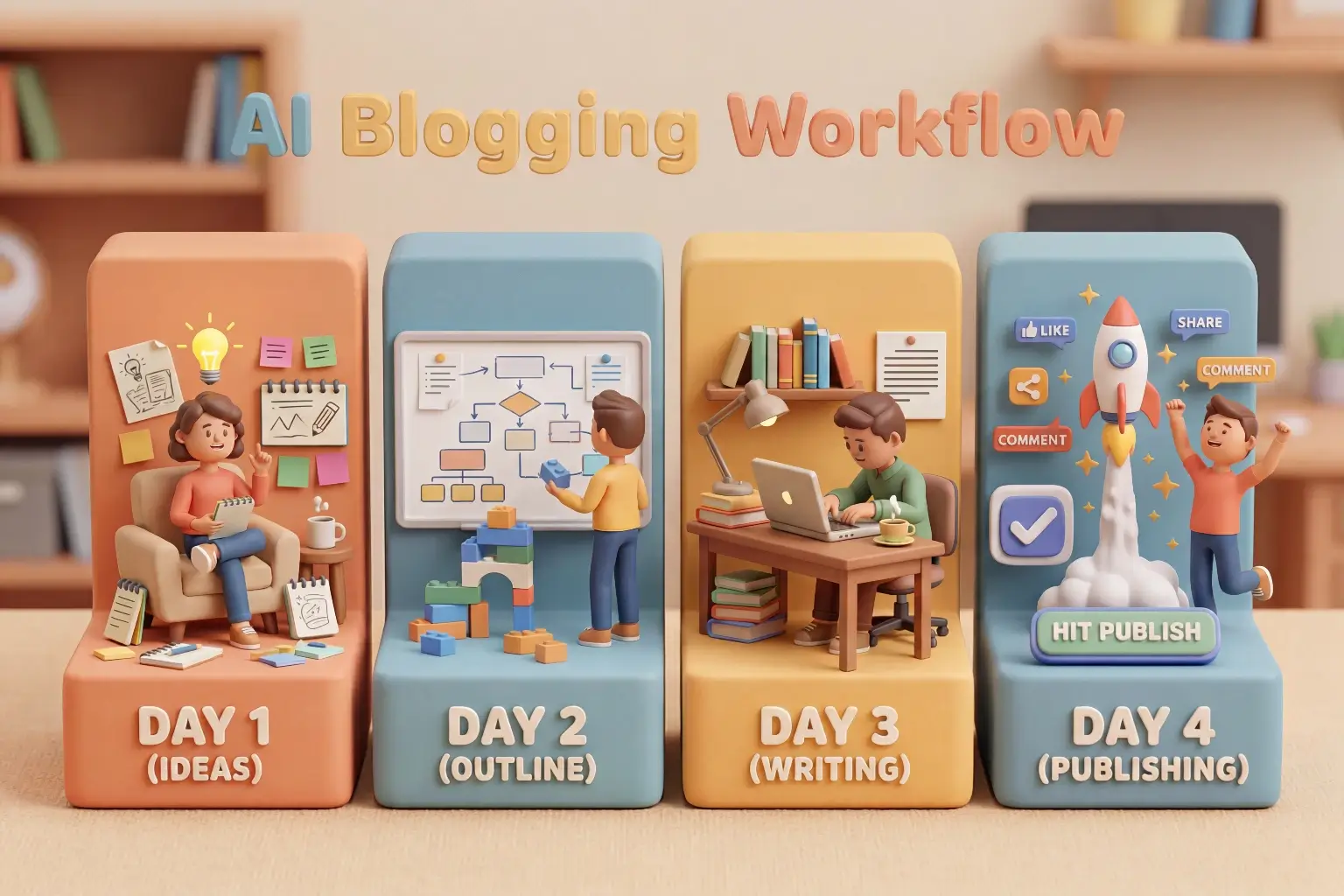
A repeatable system makes blogging easier.
Here is a simple workflow:
- Choose a topic
- Ask AI for ideas and angles
- Create an outline
- Write the draft section by section
- Edit and improve the content
- Publish the article
- Repeat the process
This system is simple, but it works.
The more you repeat it, the easier blogging becomes.
AI can also help you stay consistent and manage your blogging workflow. Learn more in our guide on How to use AI for daily productivity.
How to Stay Consistent with Blogging Using AI
Consistency is one of the biggest challenges in blogging.
Many beginners start strong but stop after a few articles because they run out of ideas or feel overwhelmed.
AI helps you stay consistent because it reduces effort.
You can use AI to:
- Generate future blog ideas
- Create outlines in advance
- Save time on writing
- Turn one idea into multiple posts
A good weekly plan could be:
- One day for ideas
- One day for outlines
- One or two days for writing
- One day for editing and publishing
That makes blogging feel more manageable.
Try not to aim for too much too early.
A good target for beginners is:
- 1 to 2 quality articles per week
That is enough to build momentum.
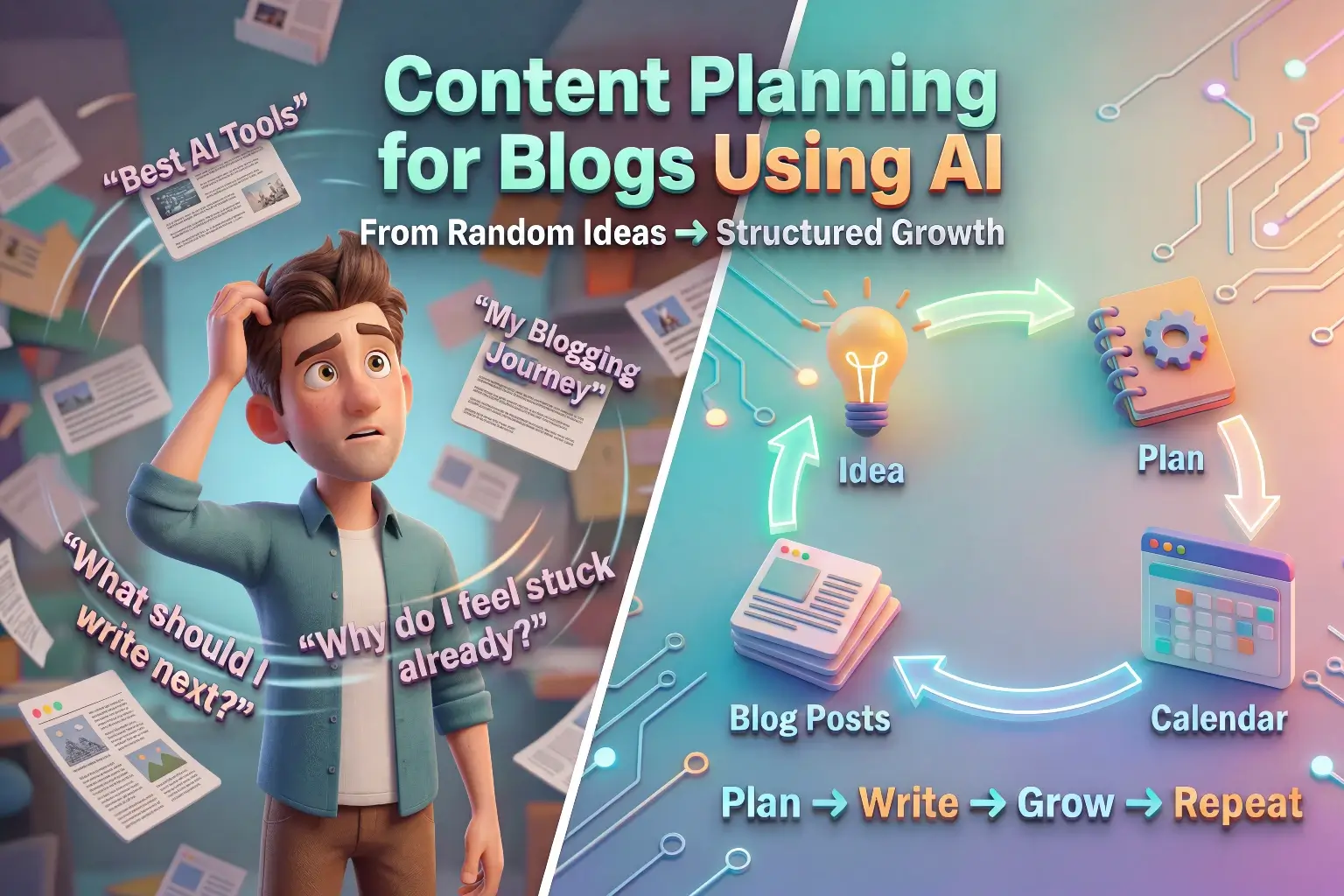
Once your blog is set up, the next step is to stay consistent. Follow our guide on How to create a content plan using AI.
How to Make Your Blog Content More Helpful
Helpful content is what makes readers stay on your page.
Many beginners write content that sounds okay but does not really help the reader. That is a mistake.
To make your content better, focus on usefulness.
You can do that by:
- Explaining things step by step
- Using simple examples
- Answering beginner questions
- Avoiding confusing language
- Giving practical advice
Before finishing any section, ask yourself:
“What will the reader gain from this part?”
If the answer is clear, your content is on the right track.
To get better blog content, you also need to write better prompts. Learn how in our guide on How to write better prompts for AI.
How to Turn One Blog Post into Multiple Content Ideas
One smart way to use AI is to turn one blog post into multiple pieces of content.
AI is very useful when you want to get more value from one article.
For example, one blog post can be turned into:
- Social media posts
- Short captions
- Video scripts
- Email content
- Future blog ideas
You can ask:
“Turn this blog post into 5 short content ideas.”
This saves time and helps you stay active across different content formats.
It is one of the smartest ways to grow faster without creating everything from scratch every time.
Common Mistakes Beginners Make in AI Blogging
Beginners often make the same mistakes when they start.
1. Writing everything in one prompt
This usually creates weak and messy content.
2. Copying AI output without editing
Always review and improve the article before publishing.
3. Using too much complex language
Keep your writing simple and clear.
4. Trying too many tools
Start with a small set of tools and build from there.
5. Not focusing on the reader
Always think about what the reader wants to learn.
6. Publishing without structure
A blog post should have clear headings and flow.
Avoiding these mistakes will improve your results much faster.
If you’re confused between different tools, read our comparison of ChatGPT vs Claude for beginners.
How Long Should Your Blog Posts Be?
This is a common beginner question. There is no exact rule, but beginner-friendly blog posts often do better when they are detailed enough to fully explain the topic.
A good blog post for this kind of article is usually:
- Around 1500 to 2500 words
- Clear and useful
- Well-structured
- Easy to read
Do not increase length just to make the article look bigger. The real goal is to answer the topic properly.
“Quality matters more than word count.“
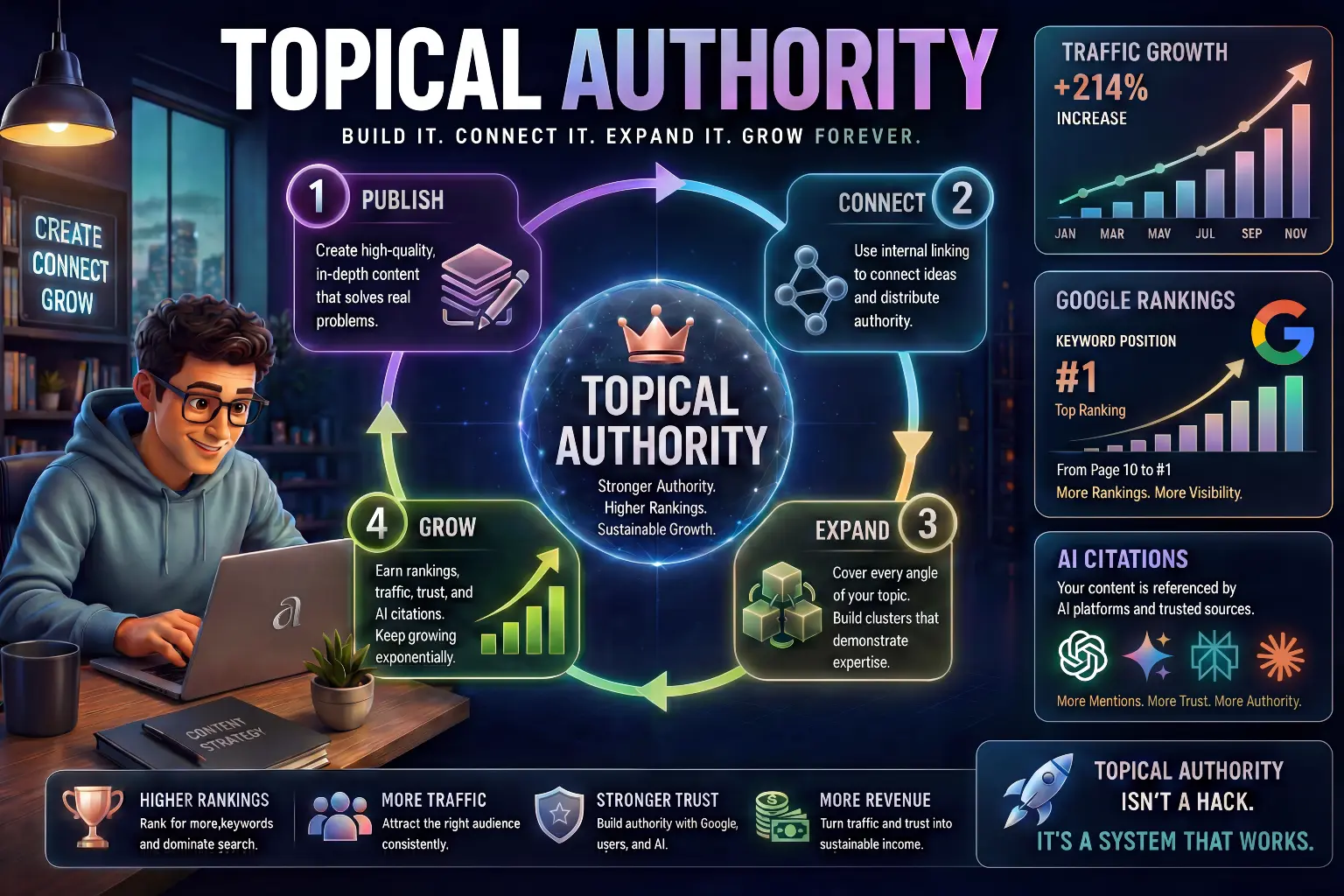
Once you have your blog set up and your first articles published, the next step is making sure everything you publish works together as a system. Our guide on How to Build Topical Authority for Your Blog explains exactly how to structure your content so Google recognizes your blog as a trusted expert on your topic.
How to Know If Your Blog Is Improving
Many beginners feel confused because they do not see results quickly.
Blogging takes time, so do not expect instant results.
At the beginning, growth may look small. But there are signs that your blog is improving.
Early signs
- You write faster
- Your outlines become clearer
- Your articles feel more organized
- You feel less confused while writing
Later signs
- More visitors
- Better ranking
- More time spent on your pages
- Better engagement
The most important thing is to stay consistent. Blogging grows step by step.
If you want to understand all the ways you can earn online using AI tools beyond just blogging, our complete guide on How to Make Money with AI in 2026 covers every beginner-friendly method in detail.
Final Thoughts
Starting a blog with AI in 2026 is one of the easiest and smartest ways to begin your blogging journey.
You do not need to be a perfect writer. You do not need expensive tools. You only need a clear topic, a simple process, and the patience to keep improving.
AI can help you brainstorm ideas, write faster, improve your content, and stay organized. But your own input still matters. Your judgment, your voice, and your consistency are what make the blog successful.
“Focus on helping readers, stay consistent, and improve with every article.”
Start small. Publish one article. Improve it. Then repeat the process. That is how a real blog grows.
If you use AI correctly, it can become a powerful assistant that supports your blogging journey step by step.
Once your blog is ready, the next step is getting visitors. Learn How to get traffic to your blog using AI.
Frequently Asked Questions
What is AI blogging and how does it work?
AI blogging means using AI tools to help you create blog content faster and more easily. Instead of writing everything from scratch, you can use AI to generate ideas, create outlines, write drafts, and improve your content.
Can beginners start blogging with AI in 2026?
Yes, beginners can easily start blogging with AI in 2026. AI tools remove many common problems like not knowing what to write, how to start, or how to structure content. Even if you have basic writing skills, AI can help you create better articles step by step.
What is the best AI tool for blogging?
There is no single best tool, but tools like NeuronWriter, Surfer SEO, ChatGPT, Claude and Notion AI are great for beginners.
Is AI blogging allowed by Google?
Yes, AI blogging is allowed as long as your content is helpful, original, and created for users. Search engines focus on content quality, not how it is created.
Can I earn money from AI blogging?
Yes, you can earn through ads, affiliate marketing, sponsored posts, and digital products, but it requires time and consistency.
How often should I publish blog posts as a beginner?
Beginners should aim for 1–2 high-quality articles per week. Focus on consistency instead of quantity.
Do I need technical skills to start blogging with AI?
No, most blogging platforms like WordPress and AI tools are beginner-friendly and do not require coding skills.
How do I choose the right niche for AI blogging?
Choose a niche you understand, can write about consistently, and that solves real problems for readers.
Can I fully rely on AI to write my blog posts?
No, AI should be used as a helper. You should always review, edit, and improve the content before publishing.
How long does it take to grow a blog using AI?
Blogging takes time, but with consistent posting and helpful content, you can start seeing results in a few months.
Do I need paid AI tools to start blogging?
No. You can begin with free or basic tools and upgrade later if needed.

Hi, I’m Harshil Patel, founder of Arthify.
I share simple, practical guides on AI tools, blogging, and online earning to help beginners work smarter and grow online.
My goal is to simplify AI tools so anyone can build skills and create opportunities in the digital world.